
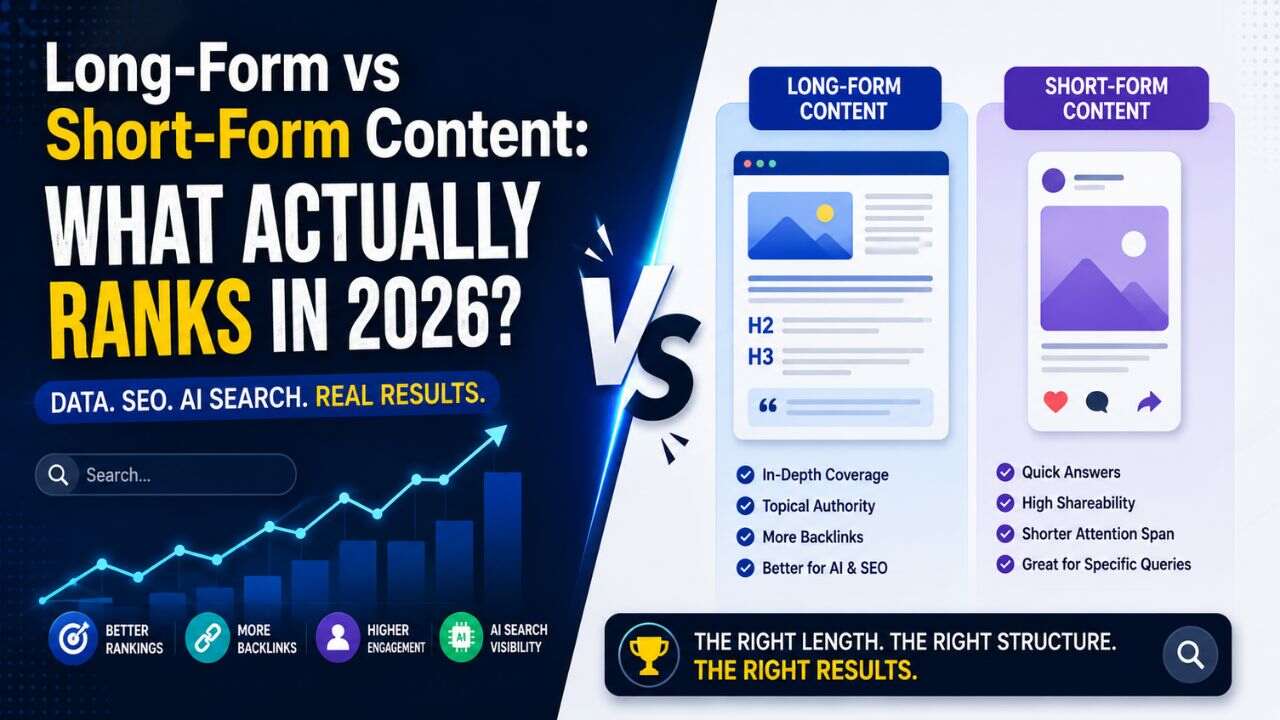
There’s a debate that’s been running in SEO circles for years, and it still hasn’t been settled.
Does longer content rank better? Or does Google now prefer concise, direct answers? Should you write a 2,500-word pillar guide or a tight 600-word post that gets to the point fast?
The honest answer in 2026: it depends – but not in the vague, unhelpful way that phrase usually implies. In long form vs short form content SEO 2026, the real deciding factor is search intent, not word count. Once you understand that framework, choosing the right content length becomes much easier.
Let’s break it down.
The Myth That Length Alone Determines Rankings
First, the thing most SEO guides get wrong: Google does not rank content based on word count.
There is no ranking algorithm that says “1,800 words = page one.” If that were true, you could pad every post with filler and watch your rankings climb. You can’t, and they won’t.
What Google actually evaluates is whether a piece of content comprehensively answers the searcher’s query – with the right depth, structure, and intent match. Sometimes that requires 2,500 words. Sometimes it requires 400.
The real question isn’t “how long?” – it’s “how much does this query actually need?”
How Search Intent Determines the Right Content Length
In 2026, search intent is the primary driver of content format decisions. Every query falls into a category, and each category has an appropriate content depth.
Informational Intent: Usually Favours Longer Content
When someone searches “how to do keyword research,” they want a complete answer – not a surface-level overview. These queries typically reward:
- Comprehensive guides (1,200–2,500 words)
- Step-by-step tutorials
- Content that covers the main question AND the follow-up questions a reader is likely to have
Google’s AI Overviews pull from content that answers questions thoroughly. A 500-word post on a complex informational topic will almost never be cited in an AI Overview because it doesn’t cover the topic with enough depth to be genuinely authoritative.
Commercial Intent: Medium Length, High Specificity
Queries like “best SEO tools India 2026” or “Semrush vs Ahrefs” sit in commercial territory. The searcher is comparing options before making a decision.
These posts typically perform best at 900–1,500 words – long enough to cover the comparison thoroughly, short enough to respect that the reader is actively evaluating, not leisurely reading.
Padding a commercial comparison post to 3,000 words usually hurts more than it helps. Readers are looking for clear, specific answers – not a comprehensive essay.
Transactional Intent: Short, Direct, Conversion-Focused
Someone searching “SEO agency contact” or “buy Semrush India” doesn’t want to read. They want to act.
Landing pages, product pages, and service pages targeting transactional queries should be concise, structured, and CTA-forward. Long-form content on transactional pages creates friction. It delays the action you’re trying to drive.
400–700 words is often the right range for transactional pages – focused on trust signals, clear value propositions, and a frictionless path to conversion.
Navigational Intent: Irrelevant for Content Length Debates
Navigational queries – “Ahrefs login,” “BeSky Marketing contact” – aren’t relevant to the content length discussion. The searcher already knows where they’re going.
Long-Form Content in 2026: Where It Still Wins
Despite the rise of AI-generated short answers and zero-click searches, long-form content remains the foundation of organic authority – especially for informational queries.
Here’s why long-form still wins in 2026:
- Topical authority signals. A comprehensive 2,000-word guide that covers a topic from every relevant angle signals to Google that your site is a genuine resource on the subject. A 500-word post signals that you’ve touched the topic, not owned it.
- AI Overview citation potential. Google’s AI Overviews pull from the most structured, authoritative content on a topic. Well-organised long-form content – with clear H2/H3 headings, FAQ sections, and direct answers at the start of each section – is significantly more likely to be cited.
- Internal linking opportunities. A comprehensive guide naturally links to and from multiple related pages, building the content cluster architecture that drives topical authority across your entire site.
- Backlink magnetism. Data consistently shows that long-form content earns more backlinks than short-form. Other writers and publishers cite comprehensive resources, not quick overviews. And backlinks remain one of the strongest ranking signals in 2026.
Short-Form Content in 2026: Where It Still Has a Role
Short-form content isn’t dead – but it serves a different purpose in a 2026 content strategy.
Where Short-Form Works Well
- Transactional and navigational pages – as discussed above
- FAQ pages – individual question-answer pages targeting very specific long-tail queries (“what is a canonical tag”) can rank effectively at 300–500 words if the answer is direct and properly structured
- News and trend content – where recency matters more than depth
- Social-first content – LinkedIn posts, Twitter threads, Instagram carousels – formats where brevity is a feature, not a limitation
The mistake most brands make is writing short-form content for informational queries – producing 500-word overviews on complex topics because it’s faster to write, and then wondering why they can’t crack the top 10.
The 2026 Standard: Comprehensive Over Long
Here’s the most important reframe in the long-form vs short-form debate:
Stop thinking about word count. Start thinking about completeness.
A 1,400-word blog post that directly answers the primary query, addresses the top follow-up questions a reader would have, includes a well-structured FAQ section with FAQPage schema, and links naturally to related cluster content is more valuable than a 3,000-word post that repeats itself, buries the key insights, and pads with generic information.
Google’s quality evaluators in 2026 are looking for:
- Does the content directly answer the searcher’s query?
- Does it demonstrate expertise, experience, authority, and trustworthiness (E-E-A-T)?
- Is it structured so both humans and AI systems can extract the key information easily?
- Does it serve the reader’s full intent – not just the surface-level keyword?
Length is a byproduct of meeting these standards, not the goal itself.
What the Data Actually Shows About Content Length and Rankings
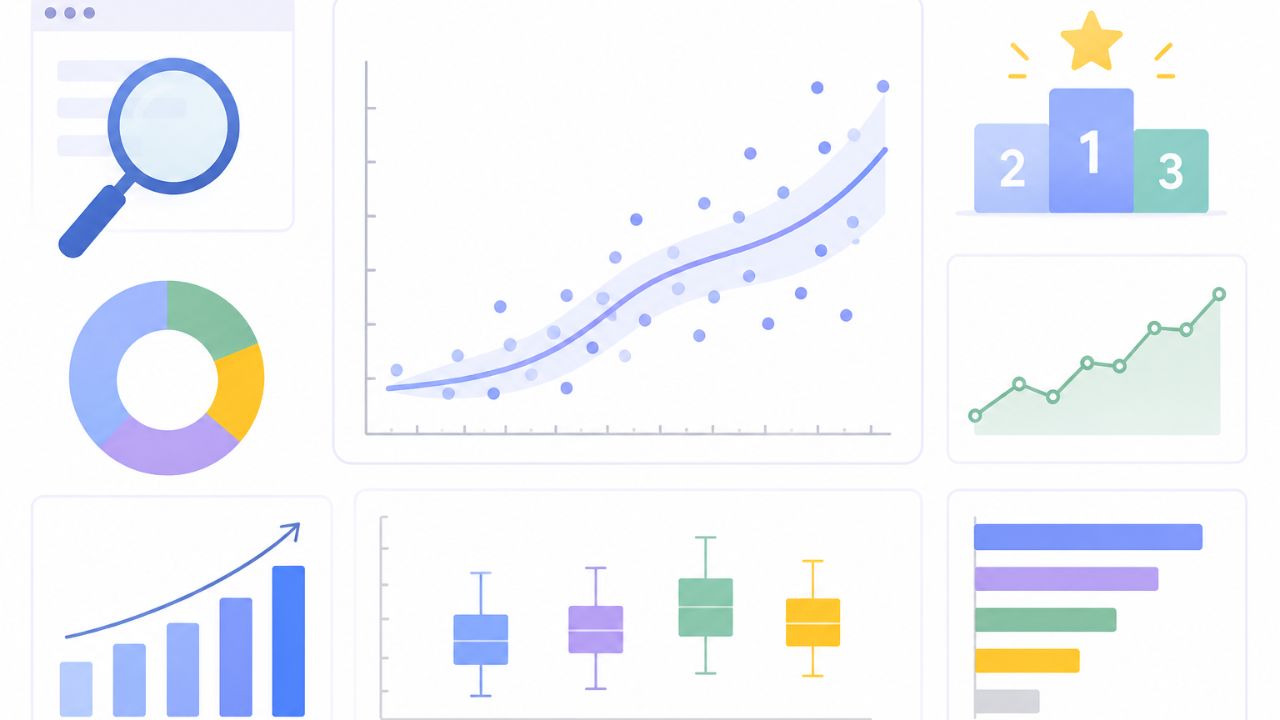
The research on content length ranking is frequently misread. Studies that show a correlation between longer content and higher rankings are measuring a proxy – not causation.
Longer content tends to rank better because:
- It’s more likely to cover the topic comprehensively (the actual ranking factor)
- It earns more backlinks (another actual ranking factor)
- It keeps readers on the page longer (an engagement signal Google uses)
But a 2,000-word post that’s thin, repetitive, and poorly structured will lose to a 1,200-word post that’s focused, expert, and well-organised – every single time.
The correlation between length and rankings is real. The causation runs through quality and comprehensiveness, not word count itself.
Practical Guidelines: What Length to Target in 2026
Use this as your starting framework for blog length SEO 2026:
| Content Type | Target Length | Priority |
| Pillar/cluster guide | 1,500–2,500 words | Comprehensiveness |
| How-to tutorial | 1,200–2,000 words | Step-by-step clarity |
| Comparison/commercial | 900–1,500 words | Specificity |
| FAQ/answer page | 300–600 words | Directness |
| Landing/service page | 400–700 words | Conversion focus |
| News/trend post | 400–800 words | Recency |
One more benchmark that matters in 2026: check what’s currently ranking for your target keyword. Open the top 3 results and assess their length. You’re not trying to copy their word count – you’re trying to understand what level of depth Google is already rewarding for that specific query.
The Bottom Line on Long-Form vs Short-Form
The best content length is the minimum length needed to completely satisfy the searcher’s intent.
For most informational queries in competitive niches, that number is 1,200 words or above. For transactional pages, it’s often 500 or below. For commercial comparisons, somewhere in between.
Answer that question well, and the length will take care of itself.
Need Help Getting Your Content Strategy Right?
Frequently Asked Questions (FAQs)
Q1. Does Google prefer long-form or short-form content?
Google prefers content that fully satisfies search intent, not a specific word count.
Q2. What’s the ideal blog length for SEO in 2026?
Most SEO blogs perform best at 1,200–2,000 words, while pillar pages may need 2,500+ words.
Q3. Can a 500-word blog rank in 2026?
Yes, for specific long-tail or FAQ queries where users want quick, direct answers.
Q4. Does longer content get more backlinks?
Comprehensive, useful long-form content usually earns more backlinks than thin or generic posts.
Q5. How does AI search affect content length?
AI search favours well-structured, authoritative content with clear headings, direct answers, and schema markup.
