
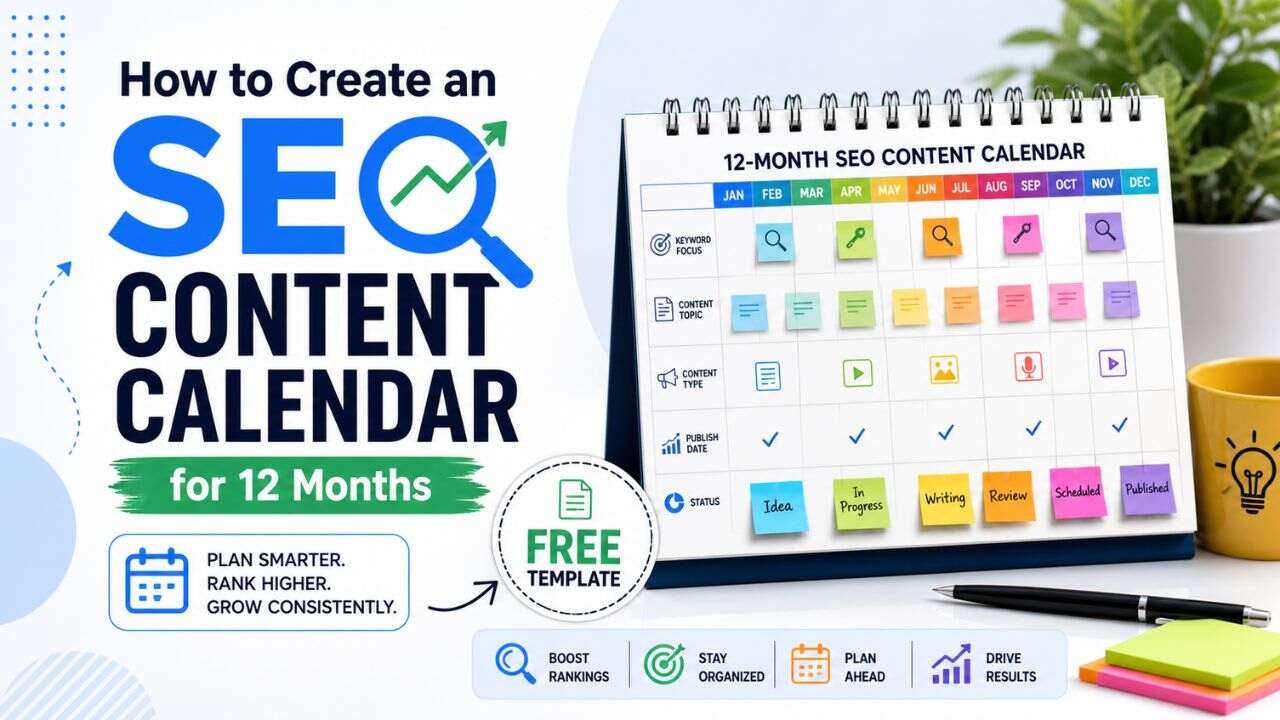
You will get Free Template after reading this blog.
Most content teams don’t have a content problem. They have a planning problem.
You write a blog post here, a product guide there, and somehow three months fly by with zero cohesion – and your rankings barely budge. Sound familiar? That’s what happens when you’re reacting to ideas instead of working from a solid SEO content calendar 2026
A well-built content calendar isn’t just a spreadsheet with dates on it. It’s a 12-month roadmap that connects your content to search intent, business goals, and seasonal demand – before you write a single word. And honestly, once you have one, you’ll wonder how you ever managed without it.
Let’s build one. From scratch. No fluff.
What Exactly Is an SEO Content Calendar (And Why Does Yours Need to Be Different)?
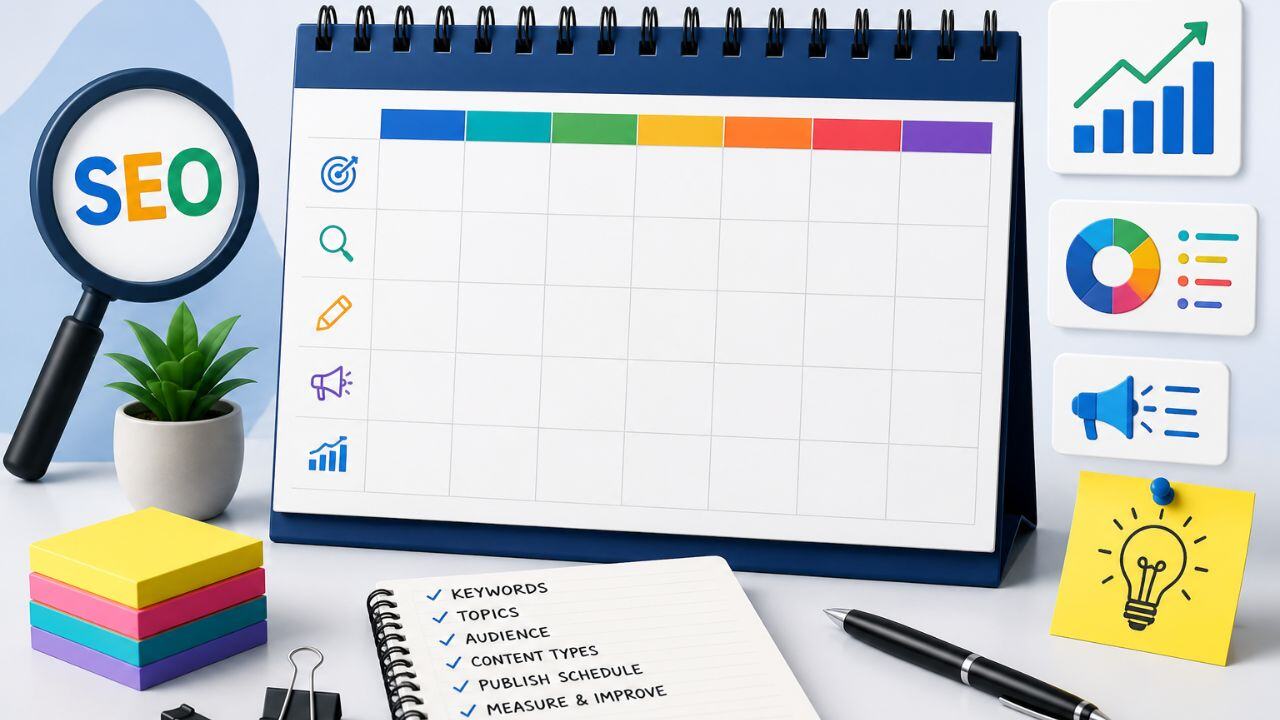
Here’s something most blogs won’t tell you: a generic content calendar and an SEO content calendar are not the same thing. A basic calendar tracks what you’re publishing and when. An SEO content calendar tracks why each piece exists – which keyword it targets, what search intent it satisfies, where it sits in your funnel, and how it links to other content on your site.
The difference matters more than people realise. Especially in 2025, when Google’s AI Overviews are pulling structured, topically authoritative content directly into search results. If your content plan isn’t built around topical clusters and search intent mapping, you’re essentially writing in a vacuum.
For marketing managers and content teams running multiple campaigns at once, this structure is what separates a brand that consistently shows up in search from one that publishes and prays.
Step 1 – Start With a Keyword and Topic Cluster Audit (Not a Brainstorm)
The instinct is to sit in a room and brainstorm blog ideas. Don’t.
Start with data. Use a tool like Ahrefs, Semrush, or even Google Search Console to identify:
- Keywords you’re already ranking on positions 4–20 (quick wins with proper optimisation)
- Topics your competitors rank for that you don’t
- Questions showing up in “People Also Ask” related to your core service
Once you have a list of 30–50 keyword opportunities, group them into topical clusters. For example, if you’re an SEO agency (like BeSky Marketing’s SEO services team), your clusters might look like:
- Technical SEO → site speed, crawlability, Core Web Vitals
- Content SEO → content strategy, keyword research, content briefs
- Local SEO → Google Business Profile, local citations, NAP consistency
Each cluster becomes a pillar page backed by supporting blog posts. This is what Google rewards – depth and authority on a topic, not isolated pieces of content scattered across random subjects.
Step 2 – Map Keywords to a 12-Month Schedule (Here’s How to Think About It)
Now comes the actual calendar building. Here’s the counter-intuitive part: don’t try to fill every week with a new post. Consistency matters more than volume. Two high-quality, well-researched posts per month will outperform eight thin, rushed ones – every time.
Here’s a simple framework for distributing content across 12 months:
Q1 (January–March): Foundation Content Focus on evergreen pillar pages and high-intent, low-competition keywords. This is also a good time to refresh old content that’s dropped in rankings.
Q2 (April–June): Authority Building Publish data-driven posts, original research, or case studies. These attract backlinks naturally and build topical credibility
Q3 (July–September): Seasonal and Trend-Based Content Plan for seasonal spikes – think festive season prep for Indian e-commerce brands, or B2B budget cycles for SaaS companies. Content about Diwali campaigns, for instance, should go live 6–8 weeks before October, not the week of.
Q4 (October–December): Conversion-Focused Content Comparison posts, “best of” listicles, and bottom-of-funnel content do extremely well in Q4 when purchase intent spikes. Plan these in August, brief them in September.
And honestly, this is where most brands get it wrong – they plan Q4 content in November. By then, Google hasn’t had enough time to crawl, index, and rank it before the season peaks.
What Should Your SEO Content Calendar Template Actually Include?
The Columns That Actually Matter
A lot of free templates you’ll find online track title and publish date – and that’s it. That’s not enough. Your monthly content schedule should include, at minimum:
- Target keyword (primary and one secondary)
- Search intent (informational / navigational / transactional / commercial)
- Content type (blog post, landing page, pillar page, video script)
- Funnel stage (TOFU / MOFU / BOFU)
- Internal links (which existing pages will this link to and from?)
- CTA (what do you want the reader to do next?)
- Status (planned / briefed / in progress / published / promoted)
You might be thinking – “that’s a lot of columns.” It is. But when you have a team of 3–5 people working on content simultaneously, this level of detail is what keeps everyone aligned and prevents duplicate or cannibalised content.
One Column Most Teams Skip – And Shouldn’t
Add a column for AI Overview potential. With Google increasingly surfacing structured answers directly in search results, tagging which posts you’re specifically optimising to appear in AI Overviews (through clean FAQ schemas, direct question-answer formatting, and E-E-A-T signals) helps your team prioritise content structure – not just content topics.
How to Actually Use the Calendar Week-to-Week (Without It Gathering Dust)

The best content calendar is the one that gets used. Here’s a simple operating rhythm that works:
Monthly: Review the next 6 weeks of content – confirm briefs are ready, writers are briefed, and any seasonal content has enough lead time (aim for 8 weeks minimum before a campaign goes live).
Weekly: Check status columns. Flag anything that’s slipping. Update publish dates if needed – a delayed post is better than a rushed one.
Quarterly: Audit what you published. Which posts are getting traction? Which are stuck on page 2? Re-optimise the latter before creating new content. This is the “compound interest” phase of SEO – existing content getting better over time.
One more thing worth flagging if you haven’t considered it: your content calendar should also track what you’re NOT writing. Keeping a “rejected ideas” tab with a reason (low volume, wrong intent, competitor already dominates) saves you from revisiting the same dead-end ideas six months later.
FAQ Section
Q1: What is an SEO content calendar?
An SEO content calendar 2026 is a structured plan that maps blog posts, landing pages, and content to target keywords, publish dates, and funnel stages-ensuring every piece supports a clear SEO goal.
Q2: How far in advance should I plan my content calendar?
Plan at least 3 months in advance and maintain a rolling 12-month view. Seasonal content – like Diwali campaigns or year-end buying guides – needs 6–8 weeks minimum before the target date for Google to index and rank it properly.
Q3: How many blog posts per month is ideal for SEO?
There’s no universal number. For most growing brands, 4–8 quality posts per month is more effective than publishing daily. Prioritise depth and keyword alignment over volume – Google rewards comprehensive, trustworthy content over frequency alone.
Q4: Can I use a Google Sheet as my SEO content calendar?
Absolutely. Google Sheets works well for most small to mid-sized teams. Include columns for keyword, search intent, funnel stage, publish date, content owner, status, and internal links. Tools like Notion or Airtable add workflow features if your team scales.
Q5: How is an SEO content calendar different from a regular editorial calendar?
A regular editorial calendar tracks what you publish and when. An SEO content calendar adds a strategic layer: keyword targeting, search intent mapping, topical clusters, and performance tracking. The SEO version treats every piece of content as a long-term search asset, not just a one-time publish.
Conclusion
Building a 12-month SEO content calendar isn’t a one-afternoon job – but it’s the closest thing to a guarantee that your content will actually drive traffic. You stop wasting time on random ideas, start building topical authority, and create content that compounds in value month after month.
The short version? Know your clusters, map your keywords with intent, build in lead time for seasonal content, and review performance quarterly. Everything else follows from that foundation.
If you want a team that builds this kind of strategic content engine – not just individual blog posts – explore what BeSky Marketing’s SEO agency services look like in practice. The free template is a start. A clear strategy is what makes it work.
