Your competitor is ranking on page one for twelve keywords you’re not even targeting.
Not because they have better content. Not because they have a stronger domain. But because they identified opportunities you haven’t mapped yet – and they moved on them first.
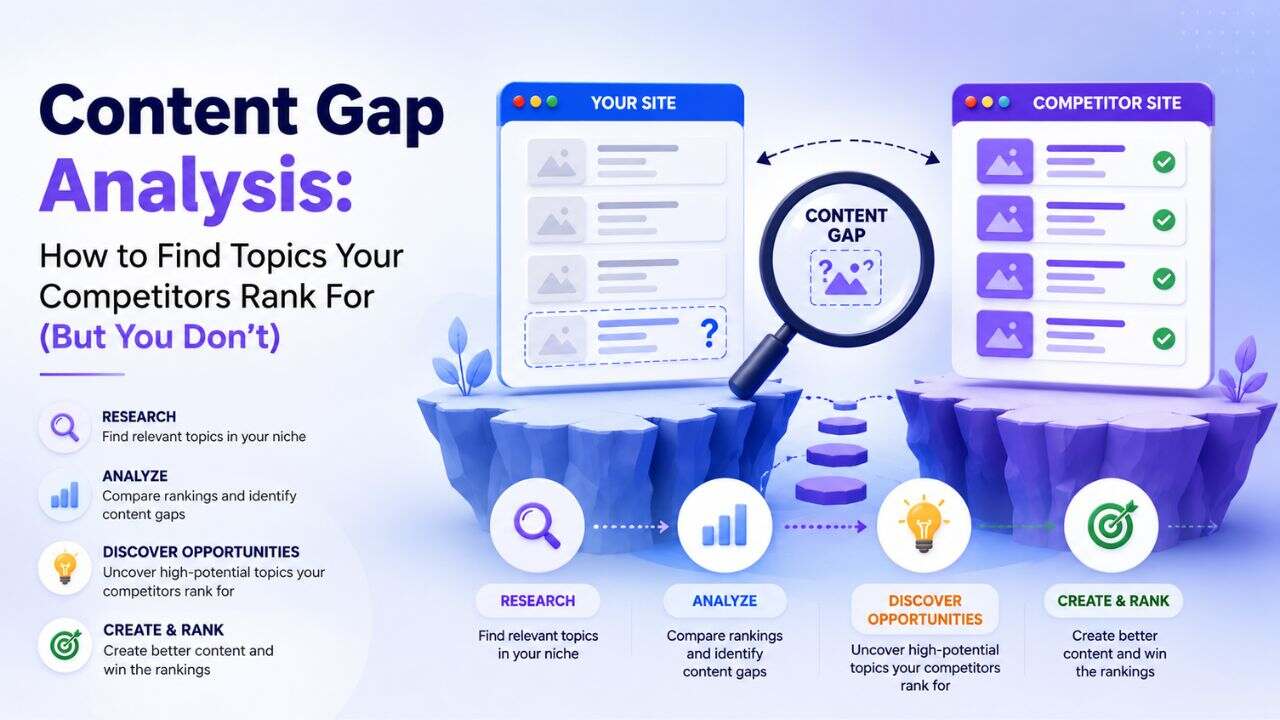
That’s what content gap analysis fixes. It’s the process of systematically finding the topics and keywords your target audience is searching for, that your competitors are capturing, and that your content strategy has completely missed.
In 2026, with Google AI Overviews dominating informational SERPs and topical authority becoming increasingly critical, content gap analysis SEO 2026 is no longer optional. It’s the difference between a content strategy that builds momentum and one that treads water.
What Is Content Gap Analysis – And Why Does It Matter More in 2026?

Content gap analysis is the structured process of identifying keyword and topic opportunities that:
- Your competitors rank for in the top 10
- Your target audience is actively searching for
- Your website currently has no content addressing
It sounds simple. Most brands think they’re doing it when they brainstorm blog ideas or look at what competitors are publishing. They’re not.
Real content gap analysis is data-driven, not intuition-driven. It uses actual search data to surface the specific queries where you’re invisible and your competitors are visible – and then turns those gaps into a content roadmap.
Why 2026 Changes the Stakes
Two things have raised the importance of gap analysis significantly in 2026.
First, AI Overviews now appear for a wide range of informational queries, pulling from the most topically authoritative sources. If you don’t have content covering a topic, you won’t be cited in AI Overviews for queries about that topic – regardless of your domain’s overall authority.
Second, Google’s topical authority signals have become more sophisticated. A site that comprehensively covers a topic cluster earns higher rankings across the entire cluster. A site with gaps – topics within a cluster it doesn’t address – is signalling incomplete expertise. Content gap analysis tells you exactly where those gaps are.
Step 1: Identify Your Real Competitors (Not the Ones You Think)
The first mistake in competitor content analysis is choosing the wrong competitors.
Your business competitors and your SEO competitors are not the same thing. The agency you compete against for clients may not be ranking for the keywords your audience is searching for. The site outranking you for “eCommerce SEO checklist” might be an SEO software company, a marketing blog, or an industry publication – not another agency.
How to identify your true SEO competitors:
- Search your 3–5 most important target keywords manually on Google
- Note which domains appear in the top 10 results for each
- Look for patterns – which domains appear across multiple searches?
- These are your SEO competitors for content gap purposes
Run this process in Ahrefs or Semrush using the Competing Domains or Organic Competitors feature. The tool will surface the domains that rank for the most keywords in common with your site – a much more reliable competitor list than your instincts alone.
Step 2: Run the Keyword Gap Analysis
Once you have your competitor list, the actual keyword gap 2026 analysis is straightforward.
Using Ahrefs
- Navigate to Site Explorer → your domain
- Open the Content Gap tool
- Enter 2–4 competitor domains
- Set the filter to “Show keywords that at least one competitor ranks for, but you don’t”
- Export the results
Using Semrush
- Navigate to Keyword Gap
- Enter your domain and up to 4 competitor domains
- Filter for keywords where competitors rank in positions 1–20 and you’re not ranking at all
- Sort by search volume and filter out irrelevant terms
What you’re looking for in the output:
- Informational queries your competitors cover that you’ve never targeted
- Commercial terms where competitors have dedicated comparison or review pages that you don’t
- Long-tail questions pulling significant traffic to competitor FAQ or resource pages
- Seasonal or occasion-specific content your competitors have built that you haven’t
Step 3: Qualify the Gaps (Not All of Them Are Worth Chasing)
A raw keyword gap export will contain hundreds or thousands of terms. Most of them aren’t worth targeting. Your job is to identify which gaps represent genuine priority opportunities.
Filter and prioritise by:
Search intent alignment. Does this keyword fit what your business actually offers? A keyword gap doesn’t help if the query intent doesn’t match what you can credibly address.
Keyword difficulty vs. your domain’s current authority. A gap for a KD 80 keyword isn’t an opportunity if you’re a new or low-authority domain. Focus on gaps in the KD 20–40 range first – these are where you can actually move rankings within 3–6 months.
Topical cluster fit. The most valuable gaps are ones that fit into content clusters you’re already building. A gap that fills a missing piece in your eCommerce SEO cluster is worth more than an isolated opportunity in an unrelated topic.
Volume and intent quality. A 200-search/month keyword with high purchase intent is often more valuable than a 2,000-search/month keyword that attracts browsers who’ll never convert.
Step 4: Manual Gap Discovery – What Tools Miss
Automated keyword gap tools are powerful but incomplete. They surface queries that already have measurable search volume. They don’t surface emerging topics, underserved questions, or gaps in content depth.
Manual Gap Discovery Tactics
People Also Ask mining. Search your main topic keywords and study the PAA boxes that appear. These are real questions Google identifies as related to your query. If competitors have pages answering these questions and you don’t, that’s a gap.
Reddit and Quora research. Search your topic on Reddit and Quora and look at what questions your audience is actually asking in the wild – not what they’re typing into Google. These surface content angles and sub-topics that keyword tools frequently miss.
Competitor blog and resource audits. Manually browse the blog archives of your top 2–3 SEO competitors. Look for content themes, categories, and topic areas they consistently cover that you haven’t touched. A competitor’s content structure often reveals their content strategy – which reveals your gaps.
Google Search Console queries. Export your GSC queries report and look for queries where you’re getting impressions (position 11–30) but have no dedicated page. These aren’t gaps – they’re opportunities to create targeted content for queries you’re already on the edge of ranking for.
Step 5: Turn the Gaps Into a Content Roadmap
A gap analysis without a roadmap is just a list. The output of your analysis should be a prioritised content plan that connects each gap to a content type, a keyword target, and a publishing timeline.
Gap-to-Content Mapping Framework
For each priority gap identified:
- Assign a content type: Is this a pillar page, a cluster blog post, an FAQ page, or a landing page?
- Match the intent: Informational gaps → educational guides. Commercial gaps → comparison or review content. Transactional gaps → service or product pages.
- Map to existing clusters: Which existing pillar page does this content support? If none exists, do you need to create one?
- Assign priority tier: Tier 1 (publish in next 30 days), Tier 2 (next 60–90 days), Tier 3 (quarterly planning)
- Note the AI citation opportunity: For informational gaps, flag whether the query currently triggers an AI Overview – if yes, structure the content specifically for AI extraction
For Indian brands, don’t overlook India-specific content gaps. Competitors may have English content for a topic but no India-localised version – this is a gap you can fill with specific ₹ pricing, local regulations, festive season context, or regional examples that generic content doesn’t address.
How Often Should You Run a Content Gap Analysis?
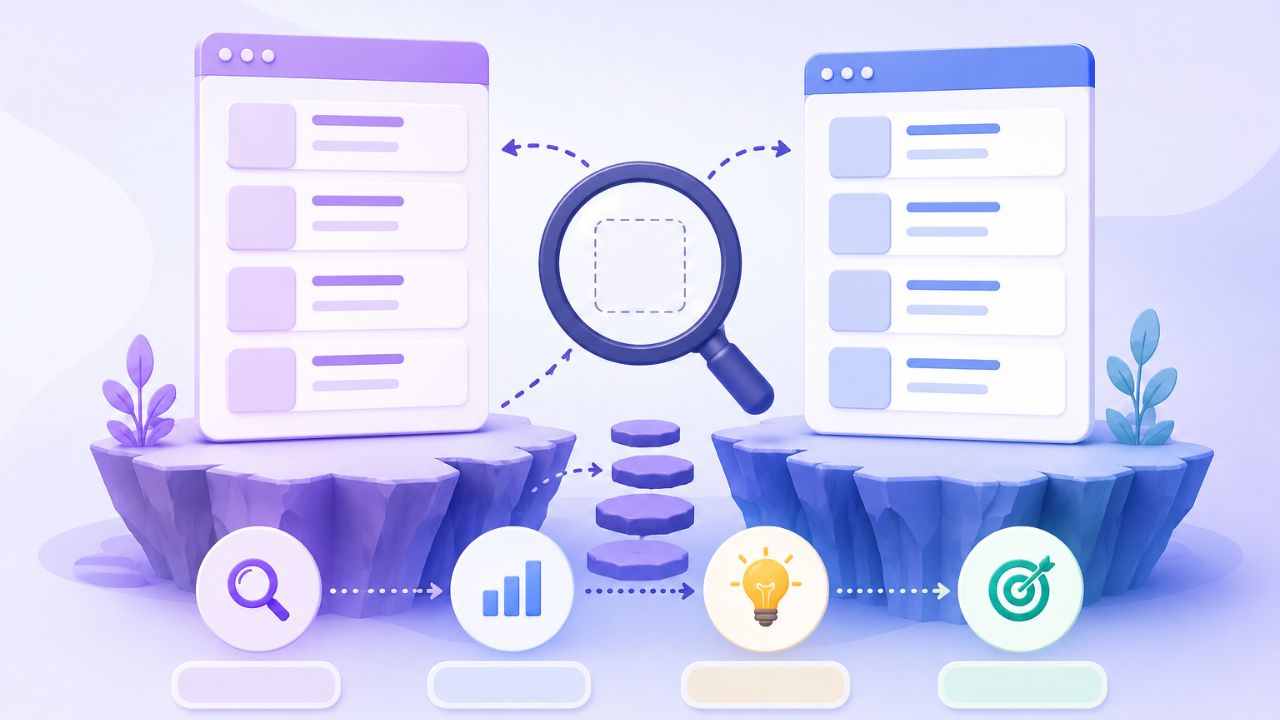
Content gap analysis isn’t a one-time exercise – it’s a quarterly discipline.
Search behaviour evolves. New competitors enter your niche. Google’s ranking landscape shifts. A gap analysis from eight months ago doesn’t reflect what’s happening in your SERP today.
Recommended cadence:
- Full competitor gap analysis: Quarterly
- PAA and manual discovery: Monthly (build it into your content planning rhythm)
- GSC query review for near-ranking opportunities: Monthly
The Bottom Line
Find content gaps SEO work is unglamorous. It involves exporting data, filtering spreadsheets, and making judgment calls about which opportunities are worth pursuing. It’s not the part of content strategy that gets showcased.
Your competitors aren’t ranking for those twelve keywords by accident. They ran the analysis, identified the gaps, and published the content.
The gap between you and them closes the same way.
Build Your Content Gap Strategy With BeSky Marketing
Frequently Asked Questions (FAQs)
Q1. What is content gap analysis in SEO?
It identifies keywords your competitors rank for but your website doesn’t cover yet.
Q2. Which tools are best for content gap analysis in 2026?
Ahrefs, Semrush, and Google Search Console are the top tools for finding content gaps.
Q3. How many competitors should I analyse?
Analyse 2–4 close SEO competitors for the most relevant and actionable insights.
Q4. How should I prioritise content gaps?
Focus on keywords with strong intent, moderate difficulty, and topical relevance to your site.
Q5. How is content gap analysis different from keyword research?
Keyword research finds opportunities broadly, while gap analysis finds keywords competitors already rank for.
