

A year ago, the conversation was whether AI would replace content writers.
In 2026, that question has been answered- partially. AI hasn’t replaced writers. But it has permanently changed what good writing looks like, how content gets made, and what Google actually rewards.
The writers and marketers who understand this shift are producing better content faster. The ones who haven’t adjusted are publishing more- and ranking less.
This is what every SEO writer needs to know about AI content writing SEO 2026.
The Shift That Actually Happened (It’s Not What Most People Expected)
The headline prediction was simple: AI generates content → humans become redundant → the internet floods with machine-written text.
What actually happened is more nuanced. AI tools got genuinely good at producing readable, structured, grammatically clean content at scale. And then Google got genuinely good at evaluating whether content was useful- regardless of who or what wrote it.
Google’s position in 2026 is unambiguous: it doesn’t penalise AI-generated content by default. It penalises content that is unhelpful, thin, generic, and produced purely for search manipulation. That content often happens to be AI-generated- but the quality problem, not the origin, is what triggers the penalty.
The result: AI-only content that’s surface-level and undifferentiated is struggling. Human-AI collaborative content- where AI handles structure and efficiency, and humans add expertise, perspective, and original insight- is consistently outperforming both pure extremes.
What AI Writing Tools Actually Do Well in 2026
Let’s be clear-eyed about where AI writing tools 2026 genuinely add value, because the answer isn’t “everything” or “nothing.”
What AI Does Well
Speed and structure. AI can produce a well-organised first draft of a 1,200-word blog post in minutes. For writers who previously spent the first hour staring at a blank document, this is transformative. The structural scaffolding- intro, subheadings, body paragraphs, conclusion- arrives fast.
Research aggregation. AI tools can synthesise publicly available information across a topic quickly, giving writers a starting point rather than a blank slate.
Repurposing and variation. Taking a long-form blog and generating a LinkedIn post, email newsletter, or short-form social version is something AI handles very effectively. The source material exists- AI adapts the format.
Editing and refinement. Using AI as an editing layer- to improve clarity, tighten sentences, check structure- is one of the highest-ROI uses of the technology.
What AI Still Gets Wrong
Original expertise. AI cannot draw on firsthand experience, proprietary data, client case studies, or genuine industry perspective. These are precisely the things Google’s E-E-A-T framework rewards- and AI can’t fabricate them credibly.
Current, specific, local context. An AI model trained on data from 2024 doesn’t know what’s happening in the Indian eCommerce market in Q2 2026. It doesn’t know your client’s recent campaign results. It doesn’t know which strategies are working right now in your niche.
Authentic voice. AI-generated content tends toward a particular kind of structured blandness- grammatically correct, logically organised, and devoid of genuine personality. Readers notice, even when they can’t articulate why.
Human vs AI Content: What Google’s Systems Actually Evaluate
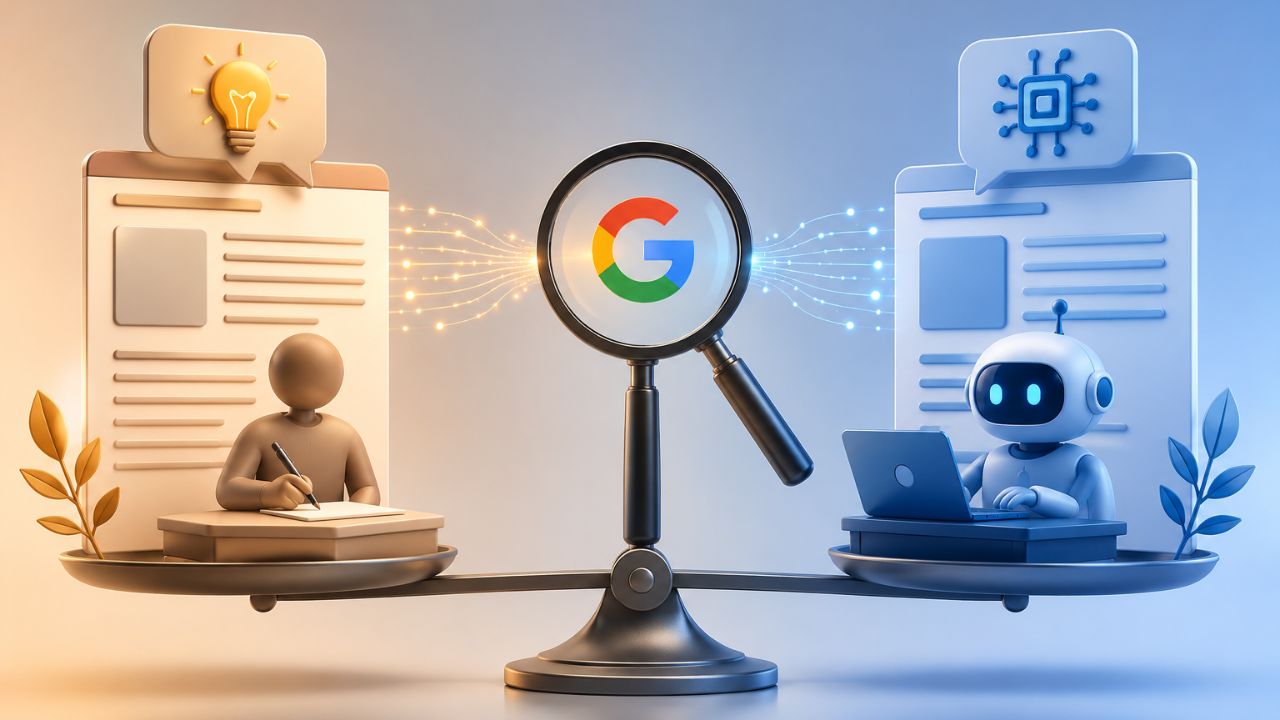
The human vs AI content Google debate has been clarified significantly in 2026 by Google’s own guidance and by observable ranking patterns.
Google’s systems evaluate content on what it calls E-E-A-T: Experience, Expertise, Authoritativeness, and Trustworthiness.
Here’s the critical implication for AI content:
- Experience: Has the author demonstrably done what they’re writing about? AI has no experience. A human writer who has executed an SEO strategy and can describe real results has a signal AI cannot produce.
- Expertise: Does the content reflect deep subject knowledge- or surface coverage? AI excels at breadth. Human experts bring depth.
- Authoritativeness: Is this content cited elsewhere? Does the author have a profile, a byline, a track record? AI-generated anonymous content has no authority signal.
- Trustworthiness: Does the content contain original insight, accurate data, and consistent perspective? Or does it hedge, generalise, and avoid commitment to a clear position?
The practical implication is straightforward: content that signals genuine human expertise- specific examples, first-person perspective, original data, consistent point of view- outperforms content that signals none of those things, regardless of how it was produced.
AI Content SEO: The New Rules for Ranking in 2026
For SEO writers specifically, AI content SEO in 2026 operates under a set of rules that are worth internalising.
Rule 1: AI Output Is a First Draft, Not a Final Draft
The single most damaging habit in 2026 is publishing AI-generated content with minimal human editing. The content that surfaces from an AI tool is a starting point- it’s the structure, not the substance.
Every piece of AI-assisted content needs:
- A human expert adding specific perspective, examples, or data that didn’t exist in the original draft
- Editing for voice- removing the tell-tale blandness that characterises unedited AI output
- Fact-checking, especially for any statistics, dates, or specific claims
- An original angle or positioning that differentiates it from the 50 other AI-generated pieces covering the same keyword
Rule 2: Structure for AI Extraction, Not Just Readability
In 2026, your content is read by two audiences: human readers and AI systems that summarise and cite content in Overviews, Perplexity answers, and AI chatbot responses.
Structuring for AI extraction means:
- Opening each H2 section with a direct answer to the implicit question
- Using specific, descriptive H2/H3 headings that mirror real search queries
- Including a well-structured FAQ section with FAQPage schema
- Keeping individual answers concise and self-contained- AI systems pull sections, not entire articles
Rule 3: Originality Is the Moat
With AI tools capable of generating competent coverage of any topic in minutes, the thing that differentiates rankable content in 2026 is what AI can’t provide: original thought.
Originality signals include:
- First-hand experience and case study references
- Proprietary data or survey results
- A clear, defensible point of view- not hedged, not generic
- India-specific context for Indian brands (something generic AI content consistently misses)
- Quotes from named experts or practitioners
This is the moat. Any brand can generate 20 AI posts per month. Very few can produce 4 posts per month with genuine expertise, original perspective, and specific market context. The latter consistently wins.
Rule 4: Author E-E-A-T Signals Matter More Than Ever
In 2026, Google’s systems place increasing weight on author credibility- not just page content.
Build author E-E-A-T by:
- Publishing under a named byline with a detailed author bio
- Including the author’s credentials, experience, and areas of expertise
- Linking the author to their external profiles (LinkedIn, industry publications)
- Using Article schema with author markup on every post
- Building a consistent body of published work under the same name
Anonymous content- regardless of quality- is at a systematic disadvantage in 2026’s ranking environment.
The Practical Framework: How to Use AI Without Losing Rankings

Here’s the workflow that produces AI-assisted content that consistently ranks:
Step 1: Research and angle first, AI second. Before opening any AI tool, know your target keyword, understand the search intent, study what’s currently ranking, and identify what your angle will be- the original perspective or expert insight that differentiates your piece.
Step 2: Use AI for structure and first draft. Let AI generate the framework- headings, section outlines, basic body paragraphs. This is where AI saves the most time.
Step 3: Human expert layer. Add specific examples, real data, case study references, and first-person perspective. This is the step most brands skip- and it’s the step that determines whether the content ranks or not.
Step 4: Edit for voice. Read the content aloud. Remove phrases that sound like AI wrote them. Inject personality, directness, and opinion.
Step 5: Technical optimisation. Add internal links, optimise title and meta, implement schema, and structure the FAQ section before publishing.
The Bottom Line
AI has made it cheaper and faster to produce mediocre content. It has also raised the bar for what ranks- because the internet is now flooded with competent, generic, undifferentiated posts.
In AI content writing SEO 2026, the content that wins is specific, expert, structured, and genuinely useful. AI is a tool for producing content more efficiently – but the expertise, experience, and original perspective that Google rewards still come from humans.
The writers who treat AI as a collaborator rather than a replacement are doing the best work of their careers. The ones who’ve outsourced their thinking to the tool are producing content nobody can rank.
Let BeSky Marketing Build Your Content Engine
At BeSky Marketing, we create long form vs short form content SEO 2026 strategies for Indian businesses – built around search intent, proper optimisation, and a deep understanding of how modern AI-era search actually works.
Frequently Asked Questions (FAQs)
Q1. Does Google penalise AI-generated content in 2026?
No. Google penalises low-quality, unhelpful content – not AI itself.
Q2. How should I use AI writing tools for SEO?
Use AI for drafts and structure, then add human expertise, examples, and optimisation.
Q3. How can I tell if AI content will rank?
Strong AI SEO content shows expertise, original insight, clear structure, and E-E-A-T signals.
Q4. Is human-written content still better for SEO?
Expert, well-optimised content performs best – whether AI-assisted or fully human-written.
Q5. How does AI search change SEO content strategy?
AI search rewards structured, authoritative content with direct answers, strong headings, and schema markup.
