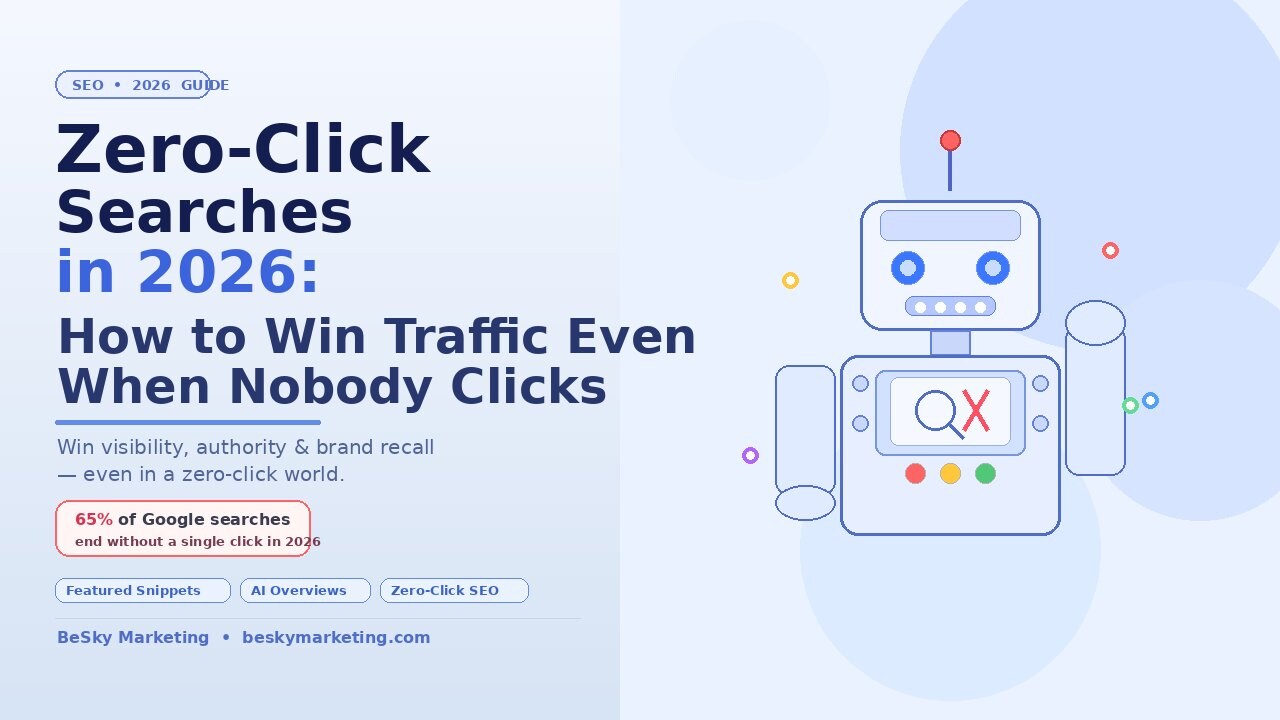
Here’s a number that should make every business owner sit up straight: nearly 65% of Google searches now end without a single click.
Not one visit to your website. Not one potential lead. Just a user who got their answer directly on the search results page – and moved on.
Welcome to the age of zero-click search. And in 2026, with Google AI Overviews eating up more screen real estate than ever before, this problem has gotten significantly harder to ignore.
But here’s the thing – zero-click doesn’t have to mean zero value. The brands winning right now aren’t the ones panicking about lost clicks. They’re the ones who rewrote the rules of what “winning” looks like in search.
In this blog, we break down what’s driving the zero-click surge, why AI Overview traffic loss affects some businesses more, and the exact zero click search SEO strategy 2026 that actually works.
What Are Zero-Click Searches – And Why Are They Exploding in 2026?
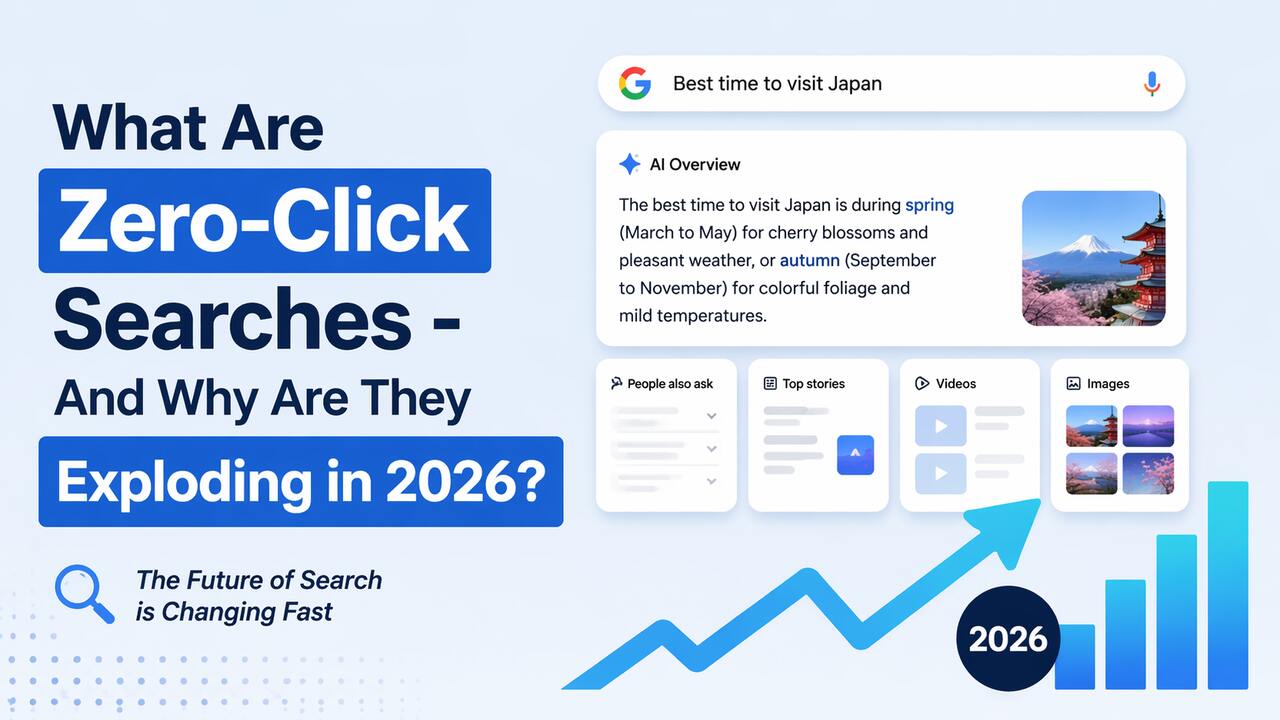
A zero-click search happens when Google answers a user’s query right there on the SERP – through a featured snippet, a People Also Ask box, a knowledge panel, a local pack, or an AI Overview – so the user never needs to visit any website.
This isn’t a new phenomenon. But in 2026, the scale is different.
Google AI Overviews have fundamentally changed the first page. Instead of showing 10 blue links with a featured snippet at the top, Google now often leads with a full AI-generated answer – sometimes 3–5 paragraphs long – before a single organic result appears.
For informational queries especially, this means your blog could be ranking #1 and still generating almost no traffic.
The zero-click search 2026 landscape is driven by a few key forces:
- AI Overviews pulling answers from multiple sources and presenting them as one response
- Voice search growing on mobile, where reading a result out loud is the entire interaction
- Rich results like definitions, calculators, and conversion tools that resolve queries instantly
- People Also Ask expanding to fill more vertical space on mobile
This isn’t Google being malicious. It’s Google doing exactly what it’s always done – optimising for user experience. The challenge for marketers is adapting their strategy to match.
Who’s Getting Hit the Hardest by AI Overview Traffic Loss?
Not every website is equally affected. AI Overview traffic loss is most severe in specific content categories:
Informational content takes the biggest hit. “What is X,” “how does Y work,” “difference between A and B” – these queries are now answered almost entirely within the SERP.
Definition-heavy blogs are being cannibalized. If your strategy relied on top-of-funnel educational content, you’ve likely already noticed a drop in impressions converting to clicks.
News and trending topic content is increasingly absorbed by AI Overviews that synthesize multiple sources into one answer.
On the other hand, commercial, transactional, and local queries still drive strong click-through rates. Users searching “best SEO agency in Chandigarh” or “buy running shoes under ₹3000” are looking to do something – and Google can’t complete that action for them.
The key insight? Not all traffic is equal, and not all zero-clicks are equal losses.
Rethinking What “Winning” Means in Zero-Click Search
Before we get into tactics, we need to shift the framework a little.
Clicks are not the only currency of SEO anymore.
In a zero-click world, getting cited in an AI Overview – even without a direct click – builds brand awareness, authority, and recall. A user who sees your brand name mentioned as a source three times in a week is far more likely to search for you directly later.
This is called brand imprint – and it’s becoming one of the most underrated metrics in modern SEO.
The question to ask isn’t just “did they click?” It’s also:
- Did they see our brand name?
- Did they read our framing of the answer?
- Will they remember us when they’re ready to make a decision?
Zero-click search SEO strategy in 2026 is about playing a longer game – one where visibility and authority sometimes matter more than immediate traffic.
The Zero-Click Search SEO Strategy for 2026 That Actually Works
1. Win the Featured Snippet – On Purpose
The featured snippet is still one of the most powerful pieces of real estate on Google’s SERP. Your featured snippets strategy should be intentional, not accidental.
Here’s how to engineer snippet wins:
- Answer the question in the first 40–60 words of a section, right after an H2 that mirrors the query
- Use definition-style formatting for “what is” queries
- Use numbered lists for “how to” and process queries
- Use tables for comparison queries
- Keep your answer tight. Google doesn’t want a paragraph of context – it wants the answer, then context
Pro tip: Look at what currently holds the snippet for your target keyword. Then write a better, cleaner, more complete version of that answer. That’s your path to displacement.
2. Optimize for AI Overviews – Not Just Google Rankings
This is where most SEO strategies are still lagging. Being in the top 3 organic results doesn’t guarantee you get cited in AI Overviews.
Google’s AI Overviews pull from sources it considers highly trustworthy and well-structured. To increase your chances of being cited:
- Use clear, structured content – H2s and H3s that directly mirror common questions
- Add Schema Markup (FAQ, HowTo, Article) so Google can parse your content more easily
- Build genuine E-E-A-T signals – author bios, expert quotes, case study data, original research
- Write in a format AI can extract – concise factual statements, not long narrative paragraphs
- Cover related subtopics within the same page or cluster, so your content answers follow-up questions too
Think of it this way: you’re not just writing for a human reader anymore. You’re also writing for an AI that will decide whether your content is worth citing.
3. Double Down on Transactional and Commercial Content
While informational content bleeds clicks to AI Overviews, transactional content remains highly click-worthy.
Searches with purchase intent – comparisons, reviews, “best X for Y,” local service queries – still drive strong CTRs because Google cannot complete the transaction for the user.
Shift more of your content investment toward:
- Product/service comparison pages
- “Best [service] in [city]” pages with real local SEO signals
- Case studies that demonstrate results (not just explain concepts)
- Pricing pages and service landing pages optimized for long-tail commercial keywords
This is exactly why local SEO and eCommerce SEO remain among the most click-resilient areas in 2026. A user searching for an SEO agency in Mohali still needs to contact one.
4.Use Your Brand as a Search Destination
One of the most powerful zero-click strategies is counterintuitive: stop relying only on Google to send you traffic, and start making your brand the destination users search for directly.
This means building branded search volume – people searching your company name, your team’s names, your specific frameworks or services.
How do you build that?
- Publish original research and data that gets cited elsewhere – your brand gets mentioned, even without a click
- Get featured in industry roundups, podcasts, and PR so your name appears across the web
- Create content with a clear point of view – not just information, but perspective. Opinion builds recall.
- Grow your email list and social media so you have traffic channels Google can’t touch
The goal: when someone sees your brand cited in an AI Overview today, they search you directly tomorrow.
5.Track the Right Metrics – Not Just Clicks
If you’re still measuring SEO success purely by organic traffic, you’re working with an incomplete picture in 2026.
Add these metrics to your reporting dashboard:
- Impressions vs. clicks ratio – are you appearing in more searches even if CTR is dropping?
- Branded search volume – is direct search for your brand growing?
- AI Overview appearances – use manual checks and tools like SE Ranking or Semrush’s AI tracking features
- Featured snippet ownership – how many snippets do you hold in your core topic cluster?
- Conversion rate from organic – fewer, more qualified clicks can still produce more leads
A drop in raw traffic numbers doesn’t automatically mean your SEO is failing. Sometimes it means the game has changed – and your measurement needs to catch up.
So, Is Zero-Click Bad for SEO? Not If You Adapt.
Zero-click searches aren’t going away. Google AI Overviews aren’t going anywhere. If anything, both will become more dominant over the next 12–18 months.
But the businesses that panic and abandon SEO are making a mistake. The ones who win are those who understand that visibility is still value – even when it doesn’t immediately look like a click.
Your zero-click search SEO strategy for 2026 should focus on:
Owning featured snippets with purpose-built content
Structuring content so AI Overviews cite you as a source
Shifting content investment toward transactional and commercial queries
Building brand authority that makes users search for you directly
Measuring visibility and brand recall alongside traditional traffic metrics
Zero-click doesn’t mean zero opportunity. It means the opportunity has moved – and your strategy needs to move with it.
Need Help Building a Zero-Click-Proof SEO Strategy?
At BeSky Marketing, we specialize in building SEO strategies that work with the way search is evolving – not against it. From featured snippet optimization and AI Overview readiness to content cluster architecture and local SEO – we build systems that keep your business visible, regardless of how Google changes the rules.
Frequently Asked Questions (FAQs)
Q1. What is a zero-click search?
A zero-click search is when a user types a query into Google and gets their answer directly on the search results page- through a featured snippet, AI Overview, knowledge panel, or People Also Ask box- without ever clicking through to any website.
Q2. How big is the zero-click search problem in 2026
Significant. Nearly 65% of all Google searches now end without a single click. The rise of Google AI Overviews has accelerated this sharply- especially for informational queries where Google can now serve a full AI-generated answer before showing any organic result
Q3. Does zero-click search mean SEO is dead?
Not at all. Zero-click search changes how SEO creates value- not whether it creates value. Brands that appear in AI Overviews and featured snippets still build awareness, authority, and brand recall, even without a click. The businesses losing out are those who haven’t updated their strategy yet.
Q4. Which types of content are most affected by AI Overview traffic loss?
Informational content takes the hardest hit- “what is,” “how does,” and “difference between” queries are now largely answered within the SERP. Definition-heavy blogs and news content are especially vulnerable. Transactional, commercial, and local queries still drive strong click-through rates because Google can’t complete those actions for the user.
Q5. How do I optimize my content to appear in Google AI Overviews?
Structure your content with clear H2/H3 headings that mirror real search questions, use Schema Markup (FAQ, HowTo, Article), write in concise factual statements rather than long narratives, build strong E-E-A-T signals through author bios and original data, and cover related subtopics within the same page or content cluster.
Q6. What is a featured snippets strategy and why does it matter in 2026?
A featured snippets strategy means deliberately engineering your content to win the snippet box at the top of Google SERPs. It matters because featured snippets are still among the highest-visibility positions on the page- even in a zero-click world. To win one, answer the target question in the first 40–60 words of a section, use the right format (list, table, or definition), and write a cleaner, more complete answer than what currently holds the snippet.
