
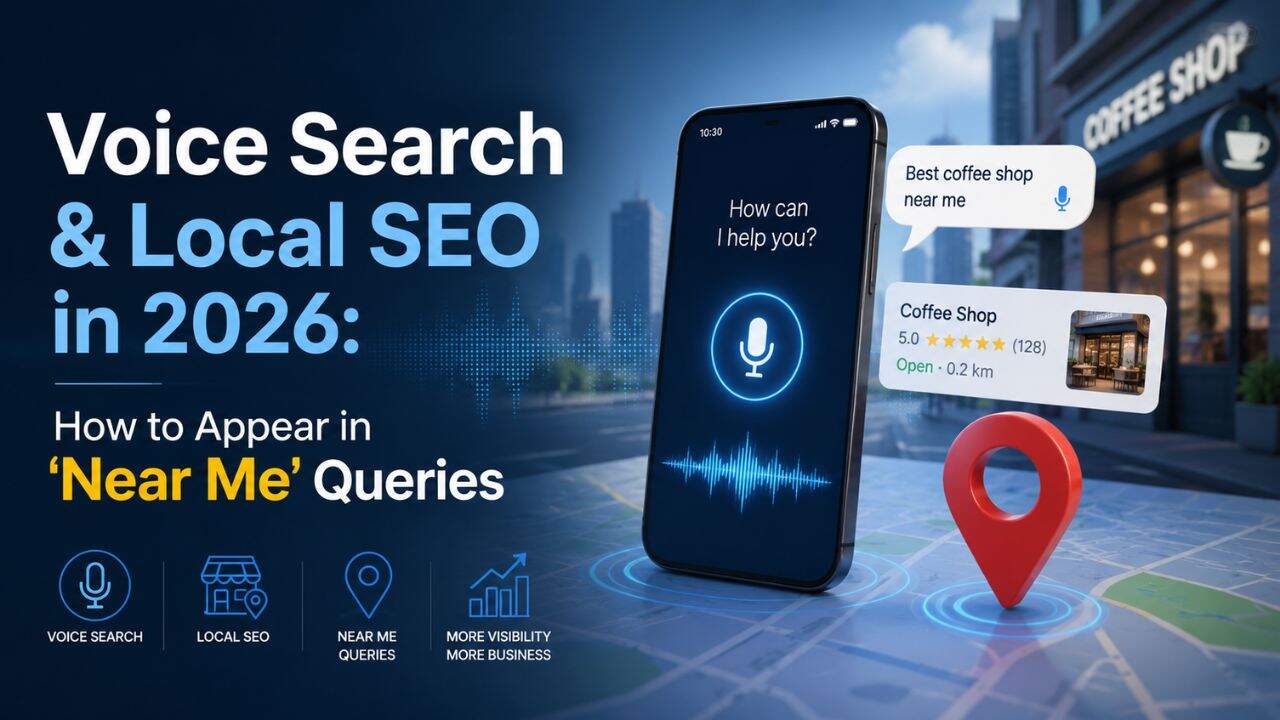
“Okay Google, find a dentist near me.”
“Alexa, what’s the best CA firm in Chandigarh?”
“Hey Siri, electrician open right now in Sector 22.”
These aren’t hypothetical searches. They’re happening millions of times a day across India – on smartphones, smart speakers, and in-car assistants. And the businesses appearing in those voice search results aren’t there by accident. They’ve optimised specifically for how people speak, not just how they type.
If your local SEO strategy is still built entirely around typed keyword searches, you’re missing a growing share of high-intent local queries in 2026. This guide covers everything you need to know about voice search local SEO 2026 – how it works, why India is a particularly important market, and exactly what to do to show up in near-me queries.
Why Voice Search Matters Especially in India
India is one of the fastest-growing voice search markets in the world, driven by smartphone-first internet usage, multilingual voice support, and rising local search behaviour. Users now search naturally in Hindi and regional languages for nearby services, businesses, and directions.
Because most voice searches have local intent, near me SEO has become essential for businesses in Chandigarh, Delhi NCR, Mumbai, Bengaluru, and other Indian cities in 2026.
How Voice Search Differs From Typed Search
Understanding the difference is the foundation of voice search optimisation. Typed and spoken queries are fundamentally different in structure – and that difference determines what content ranks.
Typed Search vs. Voice Search
Typed: “CA firm Chandigarh GST filing” Voice: “Which CA firm in Chandigarh can help me with GST filing?”
Typed: “dentist near me” Voice: “Is there a good dentist open right now near Sector 35 Chandigarh?”
Typed: “best plumber Mohali” Voice: “Who is the best plumber in Mohali Phase 7 and are they available today?”
The pattern is clear: voice queries are longer, more conversational, phrased as complete questions, and often include real-time intent signals (open now, available today, near me right now).
This means conversational search 2026 optimisation requires a different content approach – one built around answering specific questions in natural language, not just matching keyword strings.
What Google Uses to Answer Voice Queries

When someone asks a voice query with local intent, Google pulls the answer from a small set of sources – and the hierarchy is relatively predictable.
For “near me” and local voice queries, Google prioritises:
- Google Business Profile – your GBP is the most direct data source for local voice results. Business name, category, address, hours, services, and reviews are all extracted here.
- Featured snippets and position zero – for informational voice queries, Google reads out the featured snippet. Structuring your content to win snippets is critical for voice visibility.
- FAQ content with schema – questions and answers marked up with FAQPage schema are directly readable by Google’s voice systems. This is one of the most actionable voice SEO tactics available.
- Review content – voice results for “best [service] near me” queries pull from businesses with high ratings and substantial review volume. Review quality directly influences voice search inclusion.
Step 1: Optimise Your Google Business Profile for Voice
Voice search optimization India starts with GBP – the same place all local SEO starts. But for voice specifically, certain elements carry extra weight.
GBP Elements That Drive Voice Visibility
- Business description: Write in complete, natural sentences. Include phrases like “we provide,” “our [service] team serves,” “located in [area].” Voice systems extract information from your description in its written form – natural language performs better than keyword lists.
- Business hours: Keep these obsessively accurate. “Is [business] open right now?” is one of the most common voice queries. If your hours are wrong, you’ll appear in the result – and disappoint the customer.
- Services section: List every service with descriptions written in plain English. “We offer GST filing for small and medium businesses in Chandigarh” is more voice-extractable than “GST filing – Chandigarh.”
- Q&A section: Pre-populate your GBP’s Q&A section with common questions your customers ask – and answer them in complete, natural sentences. These feed directly into voice search responses.
- Reviews with specific language: Encourage reviews that mention specific services, locations, and outcomes. A review saying “best dentist in Sector 22, my root canal was completely painless” is voice-citation gold.
Step 2: Build FAQ Content That Answers Voice Queries
This is the highest-leverage voice search local SEO 2026 tactic for your website – and the one most businesses haven’t implemented yet.
Voice queries are questions. Position your content to answer them directly and Google will surface it in voice results.
How to Build Voice-Ready FAQ Content
Identify the actual questions your customers ask. Sources:
- Google Search Console – look for queries phrased as questions
- Your GBP Q&A section – questions customers have already submitted
- Google’s “People Also Ask” boxes for your primary service keywords
- What your team hears from new enquiries on the phone
Write direct, complete answers. Voice search systems read out answers of 29–40 words on average. Structure your FAQ answers to be:
- Complete in one paragraph
- Beginning with the answer (not “that’s a great question”)
- Including local context (city, area, service) naturally
Example: Q: Which CA firm in Chandigarh handles GST registration for startups? A: BeSky Marketing works with several CA partners in Chandigarh who specialise in GST registration for new businesses and startups – including same-day registration processing for eligible businesses in Sector 17 and across the Tricity.
Add FAQPage schema to every FAQ section. This markup signals to Google that your content is structured Q&A – making it significantly more likely to be used in voice and AI search responses.
Step 3: Optimise for Conversational, Long-Tail Queries
Near me SEO in 2026 requires shifting your keyword strategy from short, transactional terms to longer, conversational phrases that mirror how people speak.
Conversational Keyword Patterns to Target
Instead of targeting only: “plumber Chandigarh” Also target: “who is the best plumber in Chandigarh available on weekends”
Instead of only: “dental clinic Mohali” Also target: “which dental clinic in Mohali Phase 7 is open on Sunday”
Instead of only: “CA firm GST” Also target: “how much does GST filing cost at a CA firm in Chandigarh”
These longer conversational queries have lower competition, higher voice search frequency, and stronger commercial intent – making them some of the highest-value targets in your local content strategy.
Build blog content and FAQ pages around these longer-form questions. Each piece of content that directly answers a voice-style query is a potential voice search result.
Step 4: Win Featured Snippets – Voice’s Content Source
For non-directional voice queries (not “near me” but “how do I,” “what is,” “how much does”), Google reads out the featured snippet as the voice answer. Winning the featured snippet is the same as winning the voice result.
How to Target Featured Snippets
- Answer the question in the first paragraph of a section, not after lengthy preamble
- Use the question as your H2 or H3 heading – “How much does GST filing cost in Chandigarh?”
- Keep the answer to 40–60 words – concise, complete, and scannable
- Use numbered lists or bullet points for process-based queries (“How to register a company in Chandigarh: 1…”)
- Include the location in the answer – local context makes your snippet more relevant for location-based voice queries
Step 5: Ensure Your Website Is Mobile-Fast
Voice search happens overwhelmingly on mobile. If your website loads slowly on a mobile connection – or isn’t mobile-optimised – Google won’t surface it in voice results, regardless of how well your content is structured.
Mobile and Speed Checklist for Voice SEO
- Core Web Vitals: LCP under 2.5 seconds on mobile
- No intrusive interstitials or popups that block content
- Text readable without zooming
- Tap targets (buttons, links) appropriately sized
- HTTPS – non-secure sites are deprioritised in mobile and voice results
Run your site through Google’s PageSpeed Insights and Mobile-Friendly Test. Fix any issues flagged – particularly LCP and CLS scores, which directly affect voice search eligibility.
The Hindi and Regional Language Opportunity
Most voice search optimization India strategies focus entirely on English. This is a significant missed opportunity.
A large proportion of voice searches in India – particularly in Tier 2 cities and among users over 35 – are conducted in Hindi or regional languages. If your GBP description, reviews, and FAQ content are entirely in English, you’re invisible for this segment.
Practical steps:
- Add Hindi-language content to your GBP description (Google supports multilingual descriptions)
- Encourage Hindi-language reviews naturally – don’t script them, but don’t discourage them either
- Consider a Hindi FAQ section on your website for your highest-volume local service queries
- Ensure your business name pronunciation is clear – voice systems sometimes search by phonetic approximation
The Bottom Line
Voice search and local SEO are no longer separate disciplines in 2026. Every “near me” query, every “open right now” question, every “best [service] in [city]” ask is a voice search opportunity – and the businesses set up to capture them are the ones with complete GBPs, structured FAQ content, conversational long-tail pages, and mobile-fast websites.
The good news: most of your competitors haven’t done this yet. The technical barrier is low. The content investment is manageable. And the businesses that move on voice search optimisation now are building a local search advantage that compounds for years.
Want BeSky Marketing to Build Your Voice SEO Strategy?
Frequently Asked Questions (FAQs)
Q1. How is voice search different from regular local SEO?
Voice search targets conversational questions and depends heavily on GBP, FAQs, schema, and mobile speed.
Q2. Does voice SEO work differently in Hindi or regional languages?
Yes. Hindi and regional language optimisation helps businesses capture voice searches most competitors ignore.
Q3. How do I rank for “near me” voice searches?
Optimise your GBP, collect reviews, create location pages, and improve mobile speed.
Q4. Why does FAQPage schema matter for voice search?
It helps Google pull your answers into voice responses, AI Overviews, and featured snippets.
Q5. How long does voice search optimisation take?
Most businesses see early improvements within 4–8 weeks of consistent optimisation.
