
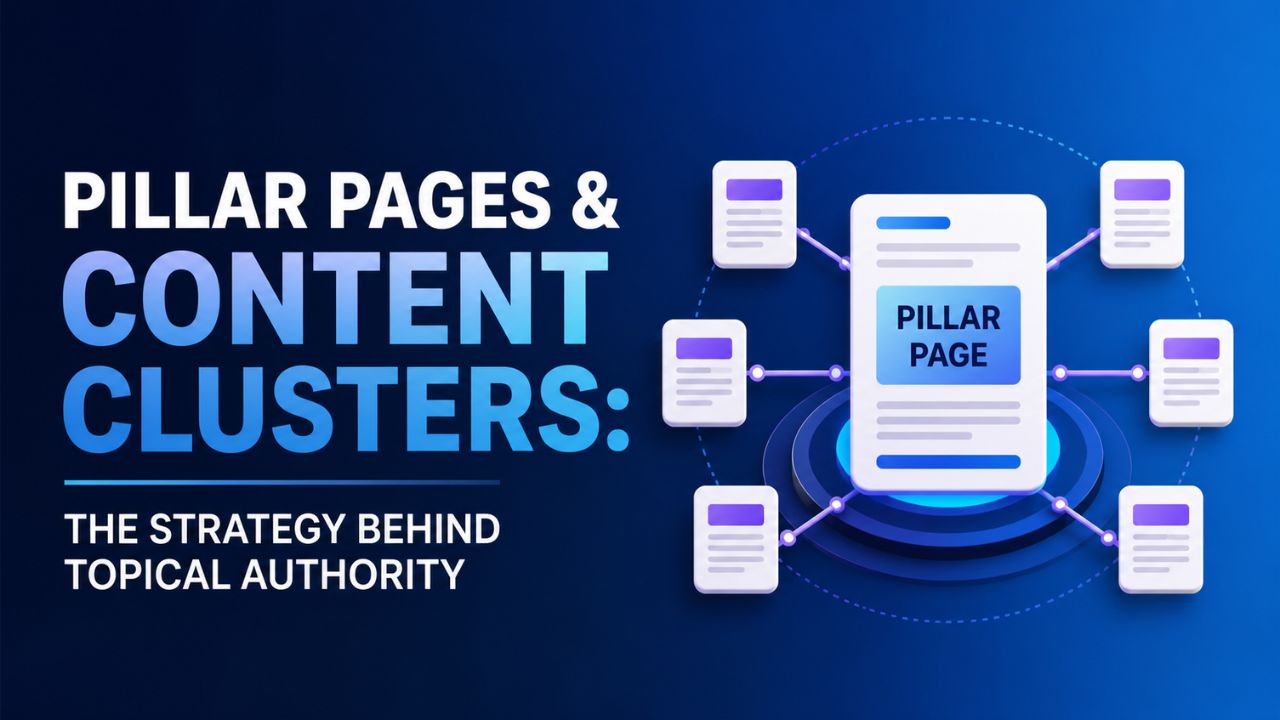
Why do some websites rank for dozens of keywords in their niche while others – with similar content and similar domains – struggle to hold a single position?
The answer is almost always topical authority. And topical authority is almost always built the same way: with a deliberate pillar page content cluster strategy that turns a collection of standalone blog posts into an interconnected architecture that Google recognises as comprehensive expertise.
Random publishing doesn’t build authority. Structured publishing does. This is what separates the brands that compound organic growth quarter over quarter from the ones that publish endlessly and wonder why the rankings aren’t moving.
What Is a Pillar Page?
A pillar page is your comprehensive, authoritative guide on a broad topic. It’s the page that covers everything a searcher might want to know about a subject – not at exhaustive depth on every angle, but at enough breadth to give the full picture.
Think of it as the home base for a topic. It covers the what, why, and overview of the how – and then points outward to deeper resources for anyone who wants to go further on a specific aspect.
In pillar page SEO, the pillar page typically:
- Targets a broad, high-volume keyword with strong commercial or informational intent
- Runs longer than most blog posts – 2,000–4,000 words is common
- Links out to every major cluster page within the topic
- Receives links back from every cluster page
- Is updated regularly to reflect new content added to the cluster
A strong pillar page is not a thin overview. It’s a genuinely useful, comprehensive resource that could stand alone – and is also the anchor for an entire ecosystem of supporting content.
What Are Content Clusters?
Content clusters are the supporting pages that orbit the pillar. Each cluster page goes deep on one specific subtopic within the broader pillar subject – targeting a specific keyword, answering a specific question, or covering a specific angle the pillar touches on but doesn’t fully explore.
The pillar-cluster relationship works like this:
- The pillar page covers “eCommerce SEO” broadly
- Cluster pages cover “product page SEO,” “category page optimisation,” “eCommerce schema markup,” “Shopify SEO checklist,” “eCommerce SEO case study” – each in depth
- Every cluster page links back to the pillar
- The pillar links out to every cluster
This is the hub and spoke content model – the pillar is the hub, the clusters are the spokes. Every link between them passes authority bidirectionally and signals to Google that these pages are topically related.
Why This Architecture Builds Topical Authority

Google’s ranking systems in 2026 don’t just evaluate individual pages. They evaluate websites as sources of expertise on topics.
A site with one good article on eCommerce SEO is not an authority on eCommerce SEO. A site with a comprehensive pillar page, 12 cluster articles covering every major subtopic, consistent internal linking across the cluster, and backlinks pointing to multiple pages in the cluster – that site is becoming an authority.
This is how topical authority is built:
- Google sees your pillar page and recognises it as covering the topic broadly
- Google discovers your cluster pages through internal links and recognises each as going deep on a specific subtopic
- The internal link architecture signals that all these pages are related and mutually reinforcing
- As the cluster grows and accumulates links and engagement signals, authority builds across the entire topic – not just on individual pages
- New pages added to a well-established cluster rank faster because the topical authority already exists
The compounding effect is the key advantage. A single blog post that ranks is a single asset. A content cluster that owns a topic is a compounding engine.
Topic Clusters 2026: What’s Changed
The pillar-cluster concept isn’t new – but the reasons it’s more important than ever are.
AI Overviews Are Pulling From Authoritative Sources
Google’s AI Overviews don’t pull from any page that’s ranking. They pull from the most credible, well-structured sources on a topic. A website with comprehensive topical coverage – a full content cluster – is significantly more likely to be cited in AI Overviews than a website with scattered, unrelated articles.
Topical Authority Accelerates Ranking for New Content
When a cluster is well-established and Google recognises your domain as authoritative on a topic, new pages added to that cluster rank faster. This is why brands that build systematically get compounding returns – the first cluster takes 6–12 months to establish authority, but the second and third clusters on related topics often see results in 3–4 months.
Content Silos Still Matter for Internal Architecture
Content silo SEO – keeping topically related content grouped and interlinked, while maintaining separation from unrelated topics – remains an important architectural principle. A home goods brand that also publishes content about cryptocurrency SEO tips is diluting its topical signals. A home goods brand that publishes content exclusively around home décor, sustainable living, and Indian interior design is concentrating them.
How to Build a Pillar-Cluster Architecture: Step by Step
Step 1: Choose Your Pillar Topic
Your pillar topic should be:
- Broad enough to support 8–15 cluster subtopics
- Directly relevant to your business, product, or service
- Something your target audience actively searches for
- A topic your competitors may have partially covered but haven’t fully owned
For an Indian digital marketing agency, good pillar topics might include: “eCommerce SEO,” “Local SEO India,” “Content Marketing Strategy,” “SEO for Startups.”
Step 2: Map Your Cluster Topics
From the pillar topic, generate every meaningful subtopic. Use Google Autocomplete, People Also Ask, and Ahrefs’ keyword explorer to find the real queries people search within your pillar topic.
Each cluster topic should:
- Target one specific keyword with clear search intent
- Be distinct enough to warrant its own page (not just a section of another post)
- Be closely enough related to the pillar that a searcher interested in the pillar would also want to read it
- Not compete with the pillar page for the same keyword
Step 3: Create the Pillar Page First
Build the pillar before you build the clusters. The pillar sets the topical framework – it’s the comprehensive overview that the clusters will deepen.
The pillar page should:
- Cover all the major subtopics at a high level
- Explicitly mention (and link to) each cluster page as it covers that subtopic
- Include a strong FAQ section with FAQPage schema
- Be the most comprehensively linked page in the cluster – both from internal links and external backlinks
Step 4: Publish Cluster Pages Systematically
Don’t publish all clusters at once and don’t publish them in isolation. Add them methodically – linking each new cluster page back to the pillar, updating the pillar to link to each new cluster, and crosslinking cluster pages where relevant.
Each cluster page should:
- Target one specific keyword at the subtopic level
- Include a prominent link back to the pillar page
- Link to 2–3 other relevant cluster pages
- Have its own FAQ section with FAQPage schema
- Be structured for AI Overview extraction (clear H2/H3 headings, direct answers in the first 50–75 words of each section)
Step 5: Build Links to the Cluster
Topical authority grows faster when external sites link to multiple pages within a cluster – not just the homepage or the pillar.
Target link acquisition for:
- The pillar page (highest priority – it’s the hub)
- Your 2–3 highest-performing cluster pages
- Any cluster pages that are already ranking in positions 4–15 and could move to top 3 with a few strong links
Digital PR, guest posting, and resource link building are the primary tactics – and for Indian businesses, building relationships with Indian industry publications and regional media is significantly less competitive than targeting international outlets.
What the Architecture Looks Like in Practice

Let’s take a concrete Indian eCommerce example.
Pillar page: “The Complete Guide to eCommerce SEO in India 2026”
Cluster pages:
- “Shopify SEO Checklist 2026”
- “Product Page SEO: How to Optimise for Google & AI Shopping”
- “Category Page SEO: Why It’s Your Biggest Revenue Driver”
- “eCommerce Schema Markup Guide 2026”
- “Festive Season SEO for eCommerce”
- “International eCommerce SEO: Indian Brands Going Global”
- “eCommerce SEO Case Study: ₹0 to ₹27 Lakh in Organic Revenue”
Every cluster page links to the pillar. The pillar links to every cluster. The pillar receives targeted link building. The cluster pages internally link to each other where relevant.
This is exactly what we’ve built for BeSky’s own content strategy – and it’s the architecture we build for clients.
The Bottom Line
Pillar pages and content clusters are not a content tactic. They’re a content architecture. The distinction matters because tactics produce one-time results; architecture produces compounding results.
Every piece of content you publish without a cluster strategy is an isolated asset with limited ceiling. Every piece you publish as part of a deliberate cluster is an asset that lifts the authority of every other page in that cluster.
Build the architecture first. Then fill it systematically. Then measure the compounding effect.
Build Your Topical Authority With BeSky Marketing
At BeSky Marketing, we build pillar-cluster content architectures for Indian businesses-aligned with how to write SEO blog posts in 2026, from topic selection and keyword mapping to content creation and technical execution.
Frequently Asked Questions (FAQs)
Q1. How many cluster pages does a pillar page need?
Typically 8–12 cluster pages. Focus on depth and coverage, not quantity-quality pages outperform many thin ones.
Q2. Should I create the pillar or cluster pages first?
Start with the pillar page. It acts as the hub, then build cluster pages around it with internal links.
Q3. Can an existing blog post become a pillar page?
Yes. Expand it with deeper content, internal links, and updated info to turn it into a strong pillar.
Q4. What’s the difference between a pillar page and a long-form blog post?
A pillar page covers a topic broadly and links to subtopics. A long-form post focuses deeply on one specific topic.
Q5. How long does it take to build topical authority?
Initial results in 4–6 months; strong authority usually takes 9–18 months with consistent content and linking.
