Most businesses think about SEO as something that happens off their website – links, outreach, authority building.
But the foundation of every page that ranks is what happens on the page itself. On-page SEO is what tells Google exactly what your page is about, who it’s for, and why it deserves to rank above every other page targeting the same query.
In 2026, on-page SEO has evolved beyond stuffing keywords into headings. Google’s AI-powered ranking systems now evaluate topical depth, structured data, user experience signals, and how well a page answers the full intent behind a search – not just the literal keyword.
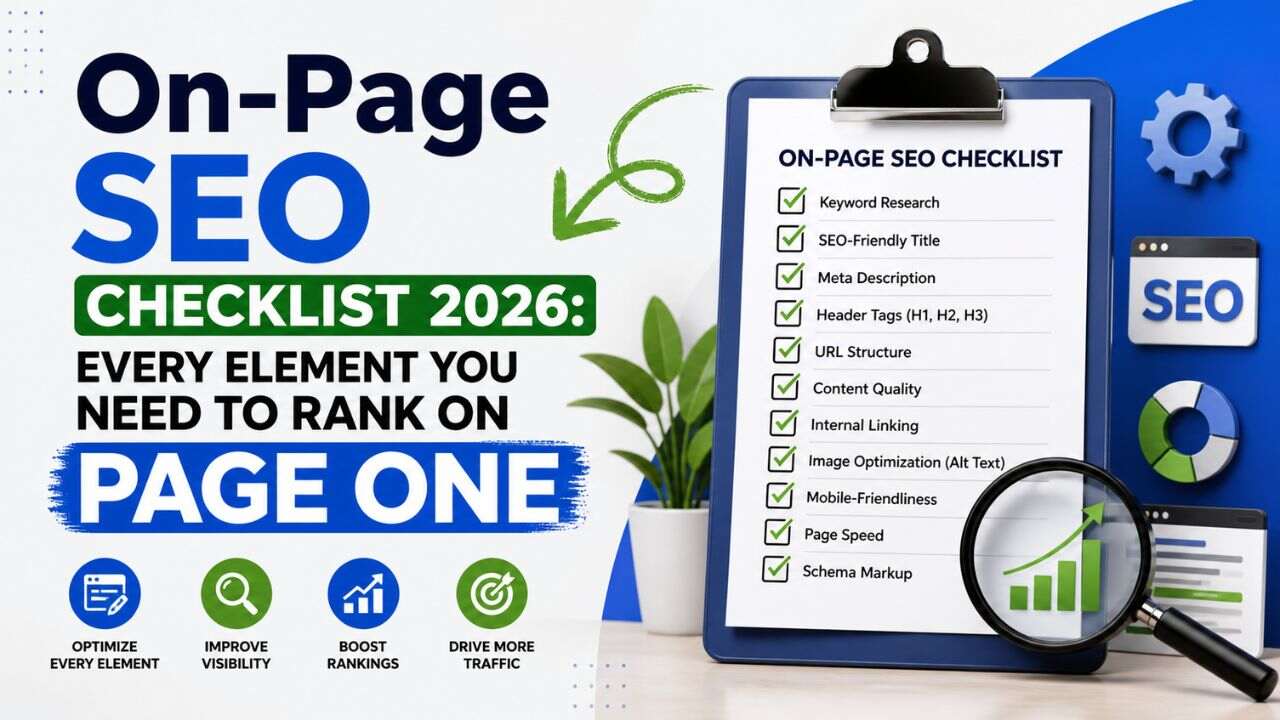
This on-page SEO checklist 2026 covers every element your pages need – from the basics that many sites still get wrong, to the 2026-specific optimisations that are becoming the new standard for competitive rankings.
1. Title Tag Optimisation
The title tag is still one of the highest-impact on-page SEO elements. It’s the first thing Google reads to understand what your page is about, and the first thing a searcher sees in the SERP.
What Good Title Tag Optimisation Looks Like in 2026
- Keep it under 60 characters – anything longer gets truncated in search results
- Place the primary keyword near the front of the title, not buried at the end
- Include a differentiator – a number, year, location, or benefit – that increases click-through rate
- Write for the click, not just the keyword – a title that ranks but doesn’t get clicked is wasted real estate
- Avoid duplicate title tags across pages – every page needs a unique title
Example: “On-Page SEO Checklist 2026: 15 Elements That Actually Move Rankings” – keyword first, year for freshness signal, specificity for CTR.
Google rewrites titles more frequently now in 2026. If your title is getting rewritten, it’s usually because it doesn’t match the page’s content or it’s too short, too long, or too keyword-heavy. Match your title to your H1 and your actual content.
2. Meta Description
The meta description doesn’t directly affect rankings – but it dramatically affects click-through rate, which does.
How to Write Meta Descriptions That Actually Get Clicked
- Keep it between 150–160 characters
- Include the primary keyword naturally – Google bolds it in results when it matches the query
- Lead with the value proposition – what will the visitor get from clicking?
- Add a soft call-to-action: “Learn how,” “See the full checklist,” “Find out”
- Write uniquely for every page – duplicate meta descriptions are a wasted opportunity
For an on-page SEO guide, your meta description should tell the searcher exactly what they’ll find on the page and why yours is worth reading over the ten other results above and below it.
3. H1 Tag – One Per Page, Every Time
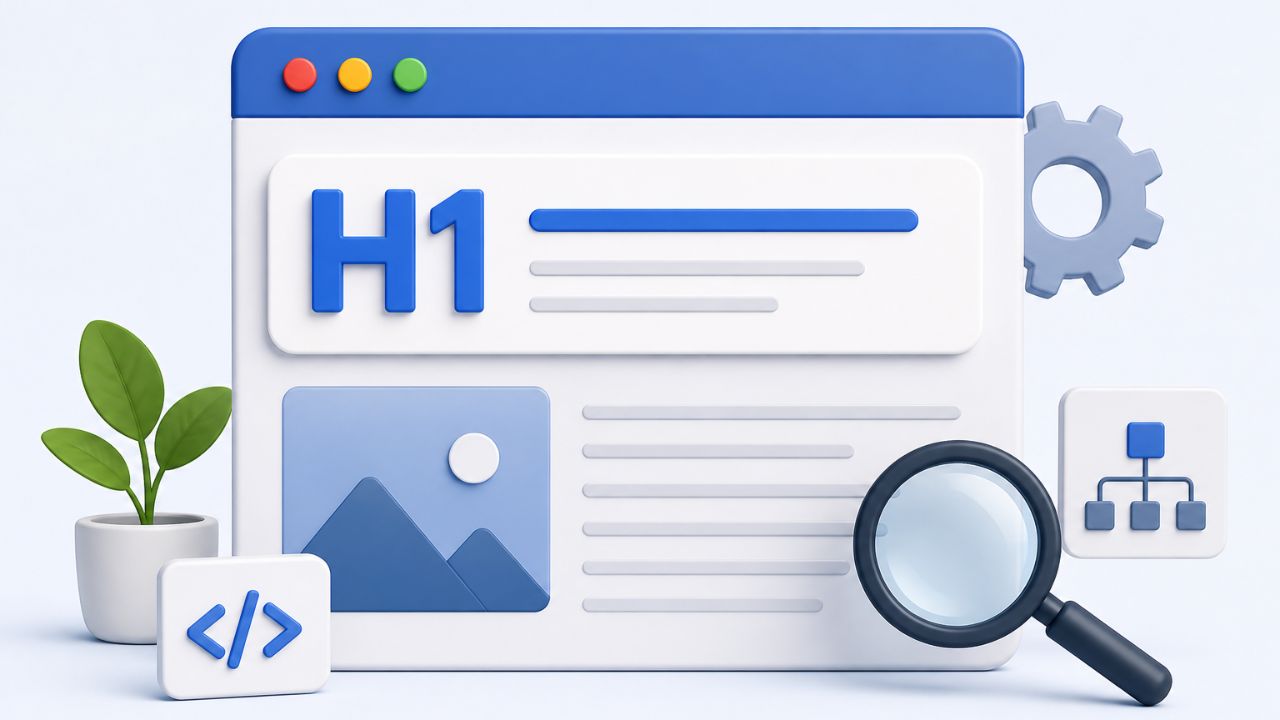
Your H1 is the primary headline of your page. Every page should have exactly one H1, and it should contain the primary keyword for that page.
Common H1 mistakes:
- Missing H1 – surprisingly common after CMS updates or theme changes
- Multiple H1s – confuses Google about the page’s primary topic
- H1 that doesn’t match the title tag – creates signal mismatch; they should be aligned, though not necessarily identical
- H1 stuffed with keywords – Google reads this as manipulation, not relevance
Write your H1 for the reader first. If it contains your keyword naturally and clearly states what the page is about, it’s doing its job.
4. H2 and H3 Subheadings
Subheadings are not just for readability – they’re structural signals that tell Google how your content is organised and what subtopics it covers.
H2/H3 SEO in 2026
In 2026, H2 and H3 subheadings that match real search queries matter more than ever. Google often pulls these into People Also Ask and AI Overviews.
Best practices:
- Use H2s for main sections, H3s for subsections
- Write headings as real questions users search for
- Add secondary/LSI keywords naturally
- Keep them clear and descriptive
Avoid skipping levels (e.g., H1 → H3)-it breaks structure and weakens SEO signals.
5. Keyword Placement – The First 100 Words
Include your primary keyword within the first 100 words to signal relevance early. Keep it natural—if it feels forced, your content structure likely needs adjustment.
6. Content Depth and Topical Coverage
In 2026, thin content is not just unhelpful – it’s a ranking liability.
Google’s AI ranking systems evaluate topical authority – whether your page covers a topic comprehensively enough to genuinely serve the searcher’s intent. A 400-word page targeting a competitive keyword is not going to rank against a well-structured 1,500-word guide that covers the topic from multiple angles.
What Comprehensive Content Looks Like
- Answers the primary question directly and completely
- Addresses related questions the searcher is likely to have next (this is where H2/H3 structure earns its keep)
- Includes original perspective, examples, or data – not just rephrased information that exists elsewhere
- Uses natural language variations of the target keyword throughout – not the same phrase repeated robotically
An on-page SEO guide that only lists checklist items without explaining why each matters is a thin page. One that explains the reasoning behind each element, gives examples, and connects it to real ranking outcomes is a comprehensive one.
7. Internal Linking
Every page you publish should link to – and receive links from – related content on your site.
Internal links do three important things:
- They distribute PageRank from your high-authority pages to newer or weaker ones
- They help Google understand the topical relationships between your pages
- They keep users on your site longer by pointing them to relevant next steps
Best practices for internal linking in 2026:
- Link from high-traffic, high-authority pages to pages you want to rank
- Use descriptive anchor text that includes the target keyword of the destination page
- Don’t use generic anchors like “click here” or “read more”
- Audit for orphan pages – pages with no internal links – and link to them from relevant content
8. Image Optimisation
Images are frequently the heaviest element on a page – and unoptimised images are the single most common cause of Core Web Vitals failures on Indian eCommerce sites.
Image On-Page SEO Checklist
- File format: Convert all images to WebP – significantly smaller than JPG or PNG with comparable quality
- File size: Compress before upload; product pages especially should have images under 100KB
- Alt text: Descriptive, keyword-relevant, and written for a screen reader – not keyword-stuffed
- Width and height attributes: Always specify these in the HTML to prevent Cumulative Layout Shift (CLS)
- Lazy loading: Implement loading=”lazy” on images below the fold to improve initial page load time
- File names: Name your images descriptively – red-leather-wallet-india.webp is better than IMG_4829.jpg
9. Schema Markup
Schema markup is where most on-page SEO checklist 2026 guides stop being generic and start being actually useful.
Schema is structured data that tells Google exactly what type of content is on your page – and in 2026, it’s increasingly what determines whether your page appears in rich results, AI Overviews, and Shopping features.
Minimum Schema Requirements by Page Type
- Blog posts: Article schema with author, date published, and date modified
- Product pages: Product schema with name, image, description, price, availability, and AggregateRating
- Service pages: Service schema with provider, areaServed, and serviceType
- FAQ sections: FAQPage schema on every page that includes questions and answers
- Category pages: ItemList schema listing the products or articles within the category
Verify every schema implementation using Google’s Rich Results Test at search.google.com/test/rich-results. An error in your schema is worse than no schema – it can suppress rich results for the entire page.
10. Page Speed and Core Web Vitals
Page speed is a confirmed ranking factor – and in 2026, it’s also the gateway to AI-powered SERP features.
Your Core Web Vitals targets:
- LCP (Largest Contentful Paint): Under 2.5 seconds
- CLS (Cumulative Layout Shift): Under 0.1
- INP (Interaction to Next Paint): Under 200ms
Run every important page – not just your homepage – through Google PageSpeed Insights. Issues on product and category pages are often where the most ranking opportunity is lost.
11. URL Structure
A clean, descriptive URL is a small but consistent ranking signal – and a significant trust signal for users deciding whether to click.
Good URL: beskymarketing.com/on-page-seo-checklist-2026 Poor URL: beskymarketing.com/blog?p=4829&cat=seo
URL best practices:
- Keep URLs short and descriptive – ideally under 60 characters
- Use hyphens to separate words, not underscores
- Include the primary keyword in the URL
- Avoid unnecessary parameters, session IDs, or tracking codes in indexed URLs
- Don’t change URLs on pages that are already ranking – if you must, implement a 301 redirect
12. FAQ Section
Adding a well-structured FAQ section to every major page is one of the highest-ROI on-page optimisations available in 2026.
Why: FAQ sections target People Also Ask boxes, enable FAQPage schema rich results, and feed directly into Google’s AI Overviews. A page with 4–6 genuine, well-structured FAQs is significantly more likely to appear in AI-generated answers than a page without one.
Write your FAQs to answer the actual questions your audience is searching for – not generic questions that anyone could have asked. Use the primary keyword in at least one FAQ question naturally.
The Bottom Line
On-page SEO in 2026 isn’t about tricks-it’s about matching search intent with clear structure and strong technical signals.
Use this checklist for every new page and review existing ones quarterly. Top-ranking sites win by executing fundamentals better, not by doing anything secret.
Ready to Audit Your On-Page SEO?
Frequently Asked Questions (FAQs)
Q1. Is keyword density important in 2026?
No-focus on topical relevance and depth. Use natural language; avoid keyword stuffing.
Q2. Should title tag and H1 be the same?
Not exactly, but closely aligned. Title = clicks, H1 = on-page clarity.
Q3. How many internal links should a page have?
No fixed number-usually 3-6. Prioritise relevance over quantity; avoid orphan pages.
Q4. Is schema markup necessary for non-eCommerce sites?
Yes-useful for all sites. It improves visibility in AI results and rich snippets.
Q5. How often should I update pages?
Every 6-12 months, or sooner if rankings drop. Fresh updates improve performance.
