
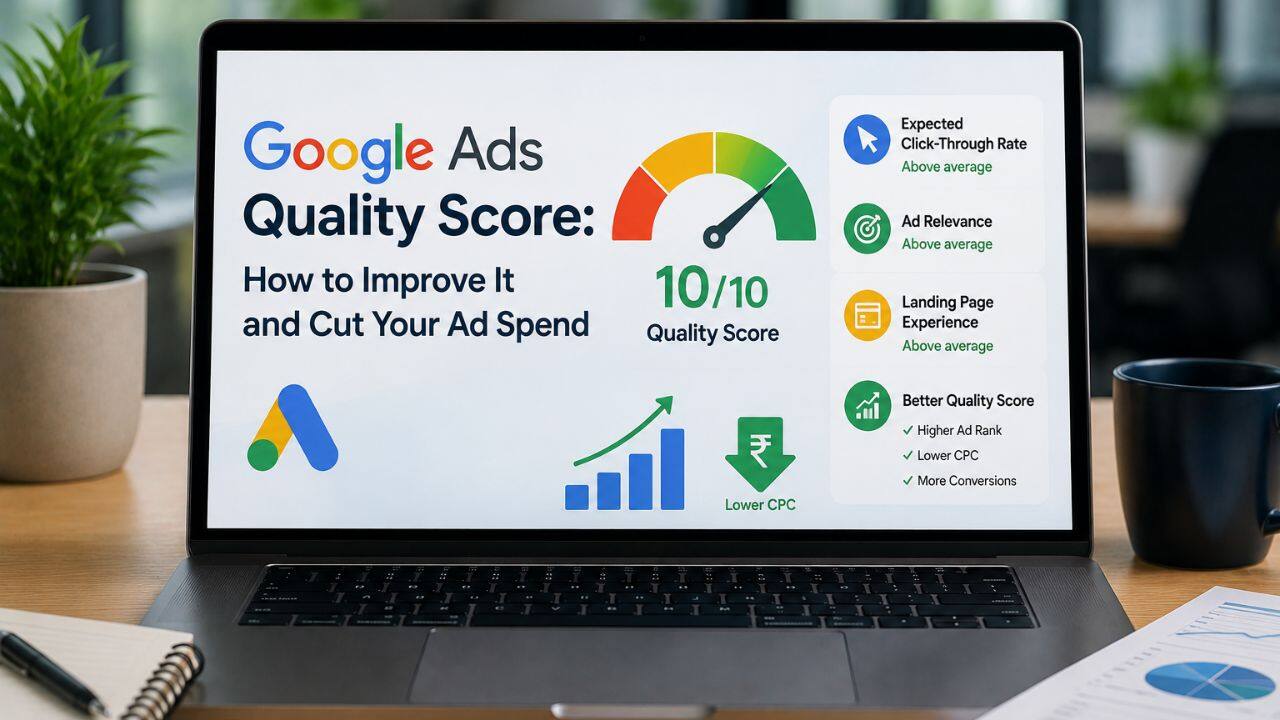
Most Google Ads accounts are overpaying. Not because of bad keywords or poor targeting – because of a number most advertisers either don’t check or don’t fully understand.
Quality Score.
It sits quietly in your keyword report, rated 1 to 10, and it has more influence over what you pay per click than your actual bid amount does. A business with a Quality Score of 8 can pay 50% less per click than a competitor with a Quality Score of 4 – for the same ad position.
In 2026, with CPC rising across nearly every Indian industry vertical, improving your Google Ads Quality Score 2026 isn’t optional – it’s the most direct path to cutting ad spend without cutting reach.
This guide explains what Quality Score actually measures, what the three components mean in practice, and exactly how to improve each one.
What Is Google Ads Quality Score?
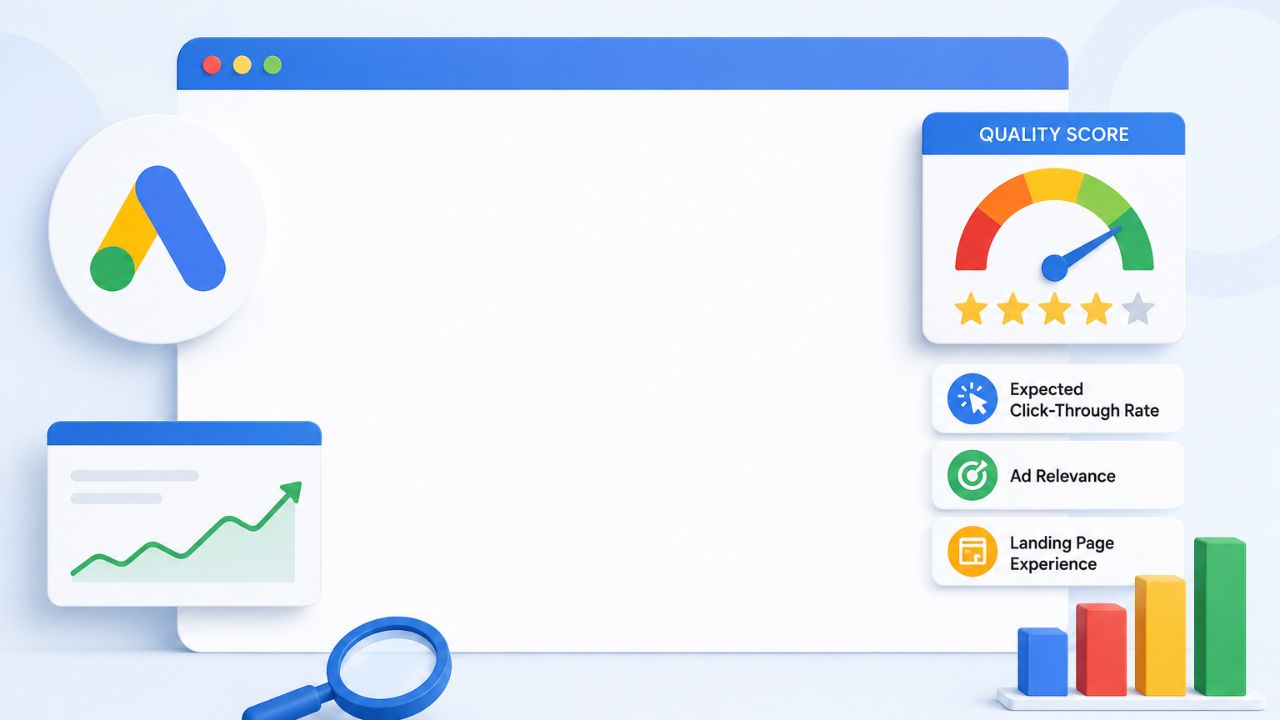
Quality Score is Google’s internal rating – from 1 to 10 – of how relevant and useful your ad is to someone searching a particular keyword.
It’s calculated at the keyword level. Every keyword in your account has its own Quality Score, based on its own ad copy, its own search queries, and its own landing page. This means two keywords in the same campaign can have wildly different Quality Scores – and wildly different CPCs – depending on how well each is set up.
Quality Score directly affects two things:
- Ad Rank – your position in the auction relative to competitors
- Actual CPC – the price you pay per click
Higher Quality Score = better position at lower cost. Lower Quality Score = worse position at higher cost. Google’s auction system is designed to reward relevance, and Quality Score is how it measures it.
The Three Quality Score Factors
Quality Score is built from three components, each rated as Below Average, Average, or Above Average:
1. Expected Click-Through Rate (CTR)
This is Google’s prediction of how likely someone is to click your ad when it appears for a specific keyword – based on historical CTR data for your ad and for similar ads competing for the same keywords.
Expected CTR is not your actual CTR. It’s a predictive score. Google asks: “Given this keyword and this ad, how likely is a click compared to what we’d expect?” If your ad is compelling, specific, and clearly relevant to the search query, expected CTR is rated Above Average. If it’s generic or poorly matched to the keyword, it rates Below Average.
This is why having one generic ad copy for 30 different keywords destroys Quality Score – the predicted match between any specific query and a broad ad is weak.
2. Ad Relevance
Ad relevance measures how closely your ad copy matches the intent of the keyword being searched. If someone searches “GST consultant Chandigarh” and your ad headline says “Professional Business Services – Contact Us Today,” Google’s relevance assessment will be poor. If your headline says “GST Consultant in Chandigarh – Book a Free Call,” relevance scores high.
This component rewards specificity. The more precisely your ad copy reflects the exact keyword and search intent, the better your ad relevance Google score.
3. Landing Page Experience
Landing page experience measures how relevant, useful, and trustworthy your landing page is for someone who clicked your ad on a specific keyword.
Google evaluates:
- Does the landing page content match the ad’s promise?
- Does the page load quickly on mobile?
- Is the page easy to navigate and free from intrusive popups?
- Is the content genuinely useful to the visitor?
A common mistake: running an ad for “chartered accountant services Chandigarh” that links to the homepage of a CA firm’s website. The homepage covers 10 different services, none prominently. The landing page experience score drops, Quality Score drops, CPC rises.
Why Quality Score Matters More in 2026
Google’s auction has always rewarded relevance – but in 2026, the stakes are higher for Indian advertisers for two reasons.
First, CPC has risen significantly across competitive categories. Legal, finance, real estate, education, and healthcare keywords in Indian metro cities now regularly cost ₹200–₹600 per click. At those rates, a two-point Quality Score improvement can mean saving ₹80–₹150 per click – which compounds enormously across thousands of monthly clicks.
Second, Google’s AI-driven campaigns (Performance Max, Smart Bidding) use Quality Score signals as inputs. A campaign with strong keyword-level Quality Scores gives the algorithm better creative and relevance data to optimise against. Weak Quality Scores across a campaign starve the AI of the signal quality it needs to perform.
How to Improve Quality Score: Component by Component
Improving Expected CTR
Step 1: Tighten your ad groups.
The most impactful structural change you can make is reducing the number of keywords per ad group. Aim for 1–5 tightly related keywords per ad group – ideally all variations of the same core term. This makes it possible to write ad copy that is specifically relevant to every keyword in the group.
Step 2: Include the keyword in your headline.
When your ad headline contains the search term the user typed, Google bolds it in the search result – dramatically increasing visual relevance and CTR. “GST Filing Services Chandigarh” in the headline for someone who searched “GST filing services Chandigarh” is a direct relevance signal.
Step 3: Use all 15 headline slots in responsive search ads.
Google’s AI tests combinations to find the highest CTR. More variety = more opportunities for the algorithm to find winning combinations. Don’t leave headline slots empty.
Step 4: Write specific, benefit-led CTAs.
“Book a Free GST Consultation Today” outperforms “Contact Us.” “Get a Same-Day CA Appointment” outperforms “Learn More.” Specificity drives clicks.
Improving Ad Relevance
The fix for poor ad relevance is almost always campaign restructuring.
When ad groups are too broad – containing keywords across different intents, different service types, or different geographic modifiers – it’s impossible to write ad copy that’s relevant to all of them simultaneously.
The solution: break broad ad groups into tightly themed groups, each with dedicated ad copy that precisely mirrors the keyword intent.
For a digital marketing agency:
- Ad group 1: SEO services keywords → headlines about SEO specifically
- Ad group 2: Google Ads management keywords → headlines about paid ads management
- Ad group 3: Social media marketing keywords → headlines about social media
Each ad group gets copy written for its specific keywords. Ad relevance scores go up, Quality Score improves, CPC drops.
Also: use Dynamic Keyword Insertion (DKI) carefully. DKI automatically inserts the searched keyword into your headline – which can boost relevance scores. But it requires tight keyword control so the inserted term always makes grammatical and contextual sense in the headline.
Improving Landing Page Experience
Landing page experience is often the most impactful Quality Score component to improve – and the most neglected.
Fix 1: Match the landing page to the ad.
If your ad promises “Free GST Consultation – Book Today,” your landing page should open with that exact offer. The headline, the CTA, and the primary content should directly match the ad’s promise. Visitors who see mismatched landing pages bounce – and Google tracks that bounce signal.
Fix 2: Speed up your mobile load time.
Run your landing page through Google’s PageSpeed Insights. In India, where 70%+ of Google Ads traffic is mobile, a page that takes 5 seconds to load on mobile will tank both your landing page experience score and your conversion rate simultaneously. Target LCP (Largest Contentful Paint) under 2.5 seconds.
Fix 3: Create dedicated landing pages, not homepage links.
Your homepage is designed for everyone. A landing page is designed for one specific audience with one specific intent. Build a separate landing page for each significant ad group – one for GST services, one for company registration, one for audit services if you’re a CA firm. Each page should have one clear CTA and content that directly addresses the keyword intent.
Fix 4: Remove intrusive elements.
Popups that appear immediately, chat widgets that cover the page, auto-play videos – Google’s quality evaluators flag these as poor landing page experience signals. Keep the page clean, focused, and fast.
How to Check Your Quality Score
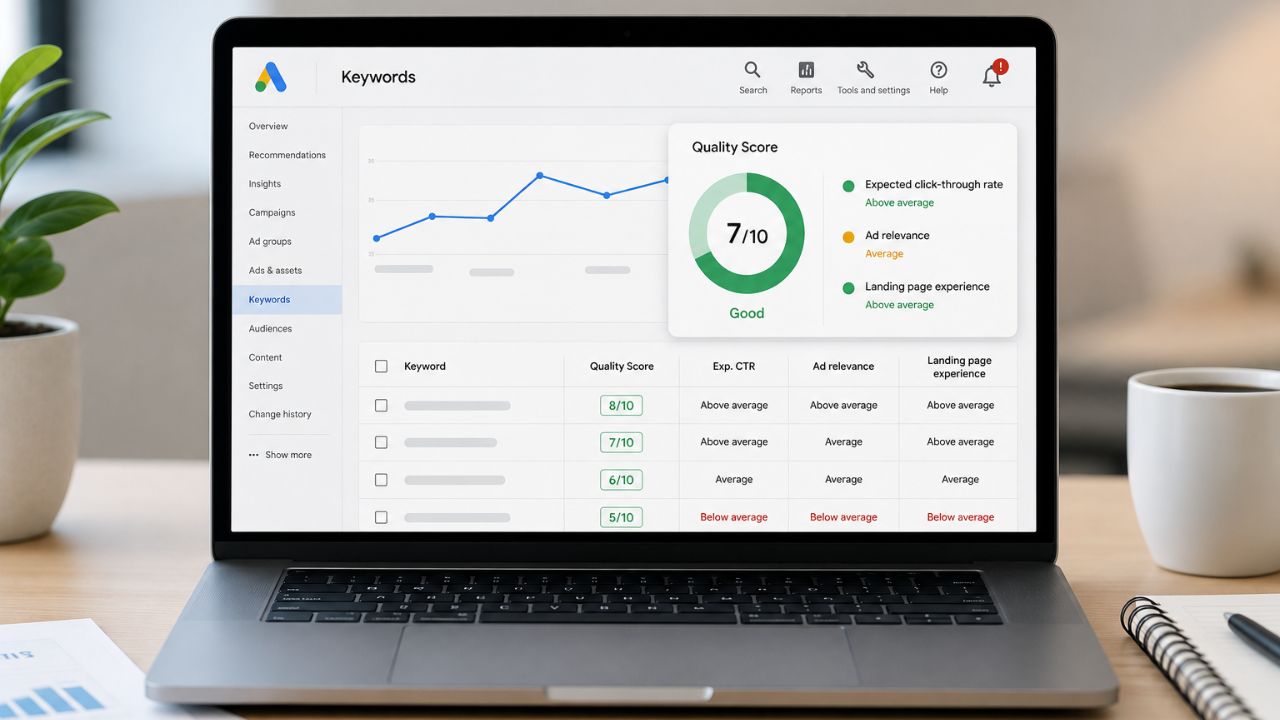
In Google Ads:
- Go to Campaigns → Keywords
- Click the Columns icon → Modify columns
- Under Quality Score, add: Quality Score, Landing Page Exp., Ad Relevance, Exp. CTR
- Apply – your keyword table now shows all four Quality Score components
Sort by Quality Score ascending to find your worst-performing keywords first. These are your highest-priority fixes.
Also check the Quality Score History column – available under the same column settings – to see whether your scores are trending up or down over time.
The Bottom Line
Quality Score is a multiplier. Improve it, and every other element of your Google Ads account gets better simultaneously – lower CPC, better ad position, more conversions per rupee of spend.
The three levers are clear: tighter ad groups for better expected CTR, more specific ad copy for better ad relevance, and dedicated fast-loading landing pages for better landing page experience.
Want BeSky Marketing to Audit Your Quality Score?
Frequently Asked Questions (FAQs)
Q1. What is a good Quality Score in Google Ads?
A Quality Score of 7+ is considered strong and usually lowers CPC while improving ad positions. Scores 8–10 are excellent, while 1–3 signal poor relevance and need optimisation.
Q2. Does Quality Score directly affect ad position?
Partly. Quality Score impacts Ad Rank, but bids and ad extensions also matter. A higher Quality Score helps you rank better while paying less per click.
Q3. How long does it take to improve Quality Score?
Ad copy improvements can show results in 1–2 weeks, landing page updates in 2–4 weeks, and full campaign restructuring in 30–45 days.
Q4. Can I improve Quality Score without changing my landing page?
Yes. Better ad copy and tighter ad groups can improve CTR and ad relevance, but landing pages are still important for achieving high scores (8–10).
Q5. Should I Pause Low Google Ads Quality Score Keywords in 2026?
Not always. First, improve ad relevance and structure. Pause keywords only if they stay low-performing (1–3) and are not relevant or converting well.
