Every business owner running paid advertising eventually asks the same question.
“Should I be on Google or Facebook?”
And every agency that answers with “it depends” without explaining what it depends on is being unhelpful. So here’s the real answer – built for Indian businesses in 2026, with a clear framework for making the right call.
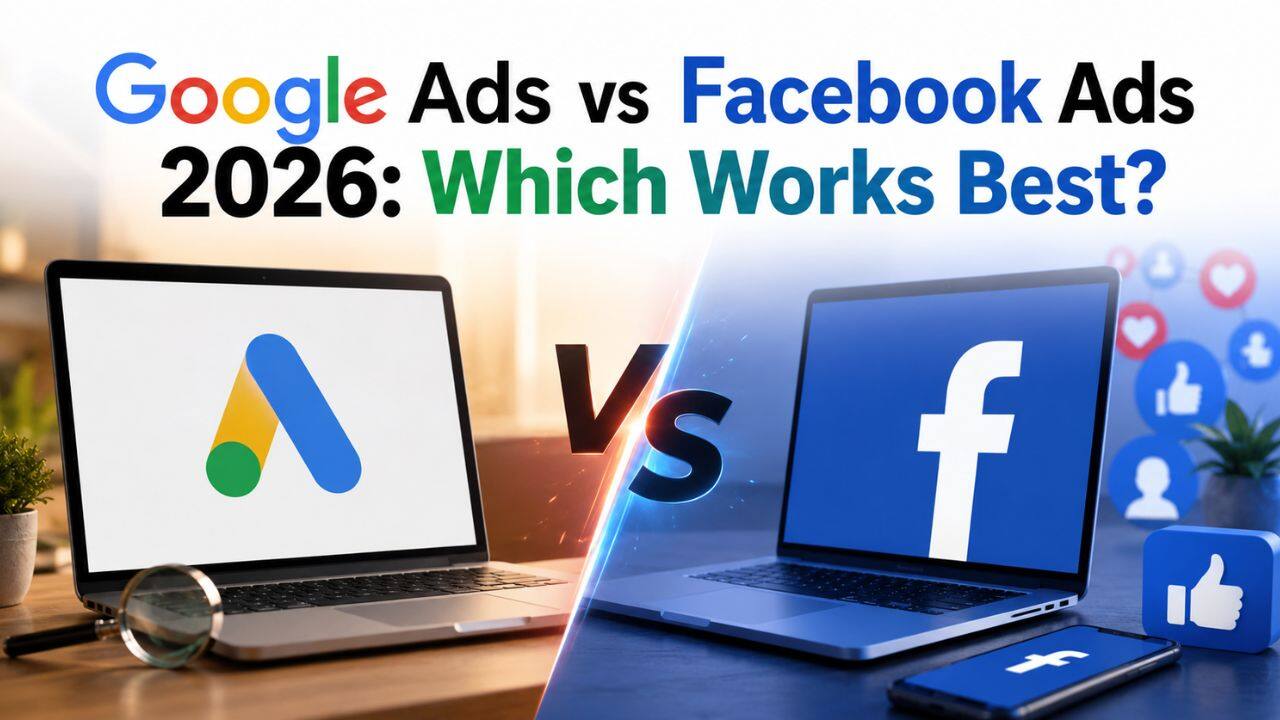
Google Ads vs Facebook Ads 2026 isn’t really a competition. They’re two fundamentally different tools that solve different problems. Understanding the difference is what separates businesses that get strong ROI from paid advertising and businesses that burn budget wondering why their ads aren’t converting.
The Core Difference Nobody Explains Clearly
Here’s the single most important thing to understand about both platforms:
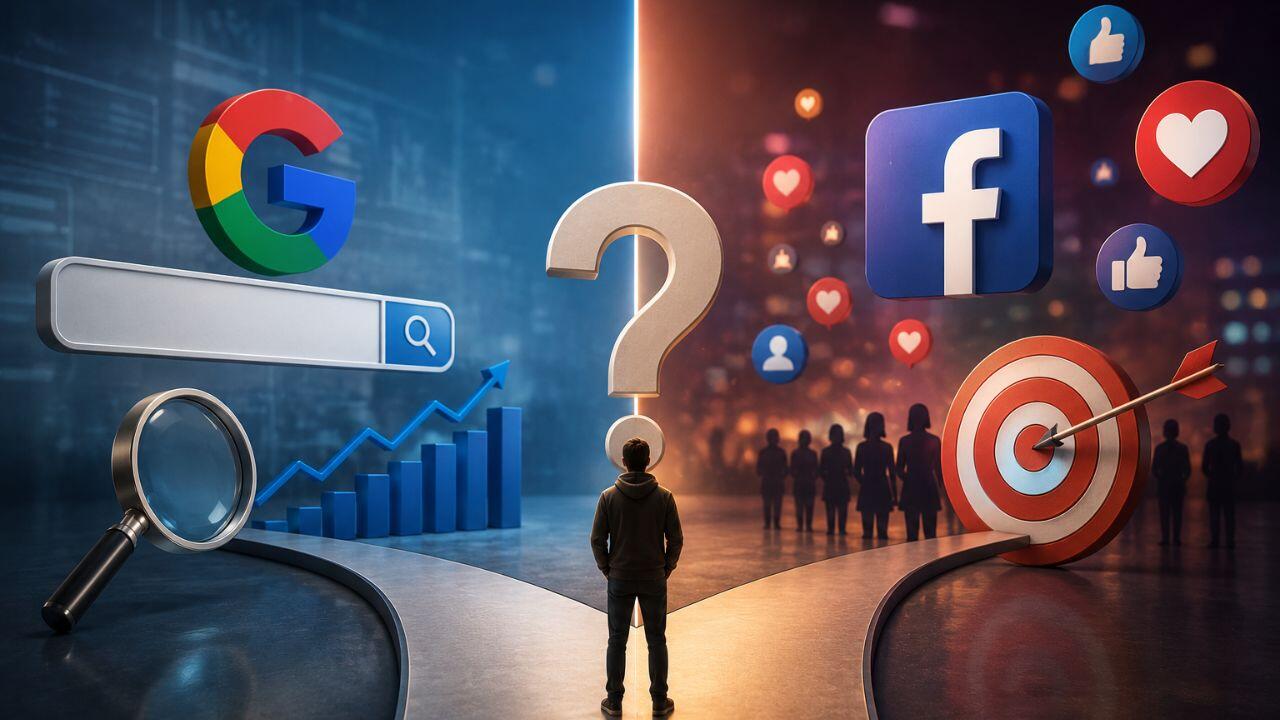
Google Ads captures existing demand. Facebook Ads creates new demand.
When someone searches “GST filing consultant in Chandigarh” on Google, they already have a problem and they’re actively looking for a solution. Google Ads puts your business in front of that person at the exact moment of intent. The demand already exists – you’re just capturing it.
Facebook, on the other hand, is a discovery platform. Nobody opens Instagram thinking “let me find a GST consultant today.” But they might scroll past an ad for a premium leather wallet they didn’t know they needed, click it, and buy it within minutes. Facebook Ads creates the desire – you’re introducing your product or service to an audience that wasn’t actively looking.
This single distinction should drive most of your platform decisions.
When Google Ads Is the Right Choice
Google Ads works best when there’s clear, measurable search demand for what you offer.
Use Google Ads if:
- People actively search for your product or service. If your keyword research shows 500+ monthly searches for your core offering in your city or nationally, Google Search Ads are worth testing.
- You’re a service business where timing matters. A plumber, a lawyer, a clinic, a CA firm – these are high-intent searches where the person needs help now. Capturing that moment is exactly what Google Ads does.
- You need local search visibility quickly. Google Local Service Ads (available in India for select categories) appear above regular Google Ads and charge per lead rather than per click – extremely valuable for home services, legal, and medical categories.
- You’re in a B2B category with long sales cycles. Google Ads combined with remarketing lets you stay visible to prospects throughout a long decision process.
- Your product or service solves an immediate problem. Emergency services, urgent repairs, time-sensitive needs – all suit the intent-capture model perfectly.
Google Ads Realities for Indian Businesses
Cost per click in competitive Indian categories is rising. Legal, finance, real estate, and education keywords in major cities can cost ₹150–₹800 per click. At those rates, your conversion rate and average order value need to justify the investment before you scale.
Quality Score is everything. Google’s algorithm rewards ad relevance. A well-structured campaign with targeted keywords, relevant ad copy, and a fast-loading, relevant landing page will consistently outperform a larger budget on a poorly structured campaign.
When Facebook Ads Is the Right Choice
Facebook and Instagram Ads (both managed through Meta Ads Manager) are the best ads platform 2026 for businesses that need to build awareness, drive discovery, or reach audiences based on interests and behaviour rather than search intent.
Use Facebook Ads if:
- Your audience doesn’t know they need your product yet. D2C brands, lifestyle products, fashion, home decor, wellness services – these categories thrive on discovery-driven platforms.
- You have a strong visual product. Instagram’s visual feed is tailor-made for products that photograph well: food, apparel, interior design, jewellery, fitness equipment.
- You’re building a brand, not just capturing immediate sales. Facebook’s retargeting capabilities allow you to reach the same person with awareness content, then consideration content, then conversion offers – across weeks or months.
- Your target audience is specific and definable. Facebook’s demographic, interest, and behavioural targeting is still among the most granular available. You can reach women aged 28–40 in Pune who follow specific lifestyle accounts and have recently engaged with competitor brands.
- You’re launching a new product or service. Facebook Ads excels at generating initial traction for launches because it can put your offer in front of a cold but well-targeted audience at scale.
Facebook Ads Realities for Indian Businesses
CPMs (cost per thousand impressions) are lower in India than in Western markets – making Facebook Ads relatively cost-effective for reach and awareness campaigns. However, conversion rates from Facebook traffic tend to be lower than Google because the audience isn’t in buying mode when they see the ad.
Creative quality drives everything. A weak video or static image will produce poor results regardless of targeting. In 2026, short-form video (Reels format) consistently outperforms static images in both click-through rate and conversion on Meta platforms in India.
The Head-to-Head: Paid Advertising Comparison 2026
| Factor | Google Ads | Facebook Ads |
| Intent | High – active search | Low – passive browsing |
| Best for | Services, B2B, urgent needs | Products, brand building, D2C |
| Cost model | CPC (per click) | CPM or CPC |
| Creative requirement | Text-heavy, keyword-relevant | Visual-first, video preferred |
| Audience targeting | Keyword + demographic | Interest + behaviour + demographic |
| Learning curve | Moderate | High (creative testing required) |
| Time to results | Faster (days–weeks) | Slower (weeks–months for cold audiences) |
| Remarketing | Strong (Google Display Network) | Very strong (Meta Pixel) |
The Google vs Facebook Ads India Decision Framework
Use this framework to decide where to start:
Start with Google Ads if:
- You can identify at least 5–10 high-intent keywords with decent search volume for your category
- Your average transaction value is high enough to justify ₹200–₹500+ per click
- You need leads or enquiries within 30 days
- You’re in a service category (legal, medical, financial, home services)
Start with Facebook Ads if:
- Your product is visual and benefits from demonstration
- You’re targeting a consumer audience (B2C) with a defined demographic profile
- Your transaction value is lower but volume potential is high
- You have good creative assets (photos, videos, Reels)
- You’re building brand awareness before conversion
Run Both if:
- You have sufficient budget to test and optimise both simultaneously
- Your business has both a discovery phase (awareness) and a search phase (conversion)
- You want to use Facebook for awareness and Google for capturing the demand Facebook creates
This last approach – using Facebook to create demand and Google to capture it – is one of the most effective full-funnel paid strategies for Indian D2C brands and service businesses in 2026.
What Changes in 2026: AI and Automation

Both platforms have leaned heavily into AI-driven campaign management in 2026, and this changes how you approach both.
Google’s Performance Max campaigns use AI to allocate budget across Search, Display, YouTube, Gmail, and Maps automatically. For businesses without the time to manage granular campaigns, PMax can deliver solid results – but it requires strong creative assets and conversion tracking to work properly.
Meta’s Advantage+ campaigns similarly use AI to automate audience targeting and creative selection. In 2026, Meta’s algorithm has become good enough that manual detailed targeting is often outperformed by Advantage+ on conversion campaigns – provided you feed it enough creative variations to test.
The implication for Indian businesses: AI campaign management lowers the barrier to entry for both platforms – but it increases the importance of creative quality (for Meta) and keyword intent structure (for Google). The platforms do more of the optimisation; your job is to give them good inputs.
Budget Allocation: Where to Start
If you’re starting with a limited budget and need to choose:
₹15,000–₹30,000/month: Pick one platform based on the framework above. Split testing two platforms at this budget dilutes both to ineffectiveness.
₹30,000–₹75,000/month: You can run one primary platform well and use a portion (20–30%) to test the secondary platform.
₹75,000+/month: Run both with dedicated budgets, separate creative strategies, and clear KPIs for each.
For most Indian service businesses starting out, Google Ads produces faster, more measurable results. For D2C brands and consumer products, Facebook and Instagram Ads produce better discovery-to-purchase journeys.
The Bottom Line
There’s no one-size-fits-all answer to Google Ads vs Facebook Ads – the right choice depends on your business and goals.
If people are searching for your service, start with Google Ads.
If you need to create demand, start with Facebook Ads.
If you need both, scale strategically – not all at once.
Want BeSky Marketing to Build Your Paid Ads Strategy?
Frequently Asked Questions (FAQs)
Q1. Which is cheaper – Google Ads or Facebook Ads in India?
Facebook Ads are usually cheaper for reach and awareness, while Google Ads often deliver higher-intent leads. The better ROI depends on your business and cost per acquisition.
Q2. Can I run Google Ads and Facebook Ads simultaneously?
Yes. Many businesses use Facebook for awareness and Google Ads to capture high-intent searches. Smaller budgets usually perform better focusing on one platform first.
Q3. Which platform works better for B2B businesses in India?
Google Ads generally work better for B2B since buyers actively search for solutions. Facebook is more effective for awareness and remarketing.
Q4. How long does it take to see results from Google Ads vs Facebook Ads?
Google Ads can generate leads within days, while Facebook Ads usually take 1–2 weeks to optimise and perform consistently.
Q5. What is a good starting budget for Google Ads or Facebook Ads in India?
Google Ads usually need ₹15,000–₹20,000/month, while Facebook Ads can start around ₹10,000–₹15,000/month for useful results.
