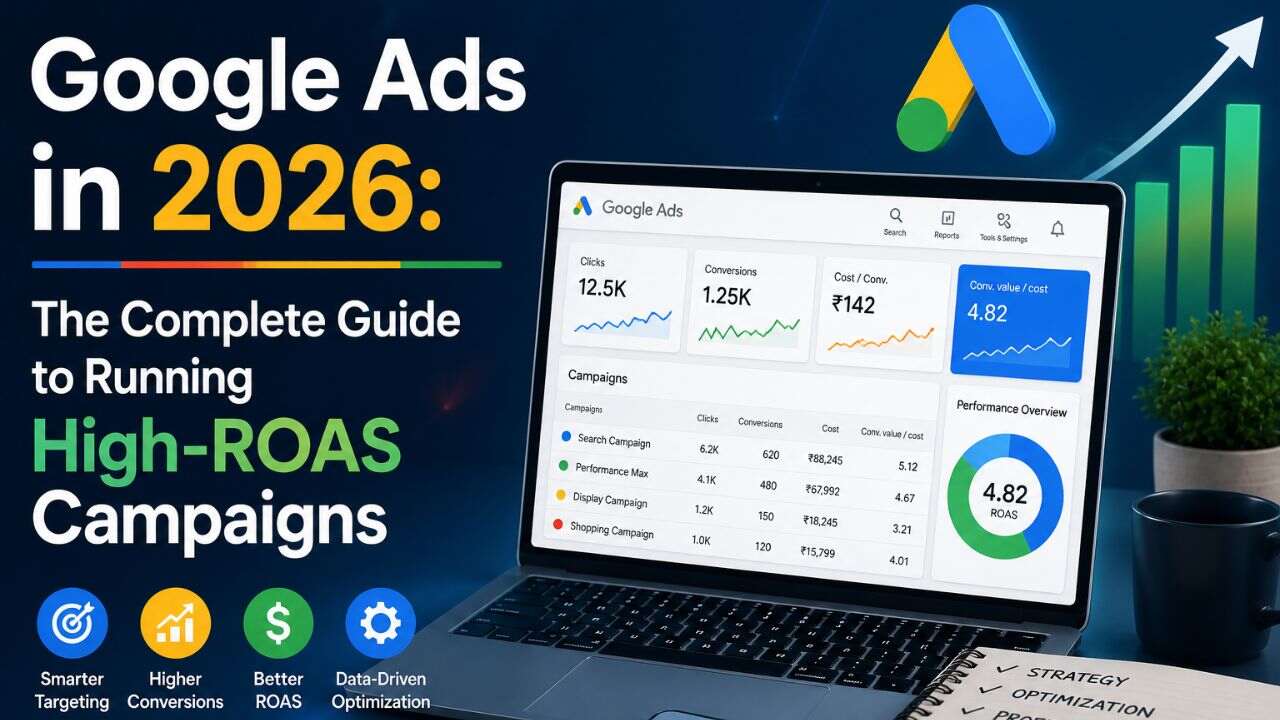
If you’ve been running Google Ads for a while, you already know – what worked in 2022 barely works today.
The platform has changed dramatically. AI-driven bidding is now the default. Search terms are less visible. And your competitors? They’re getting smarter about where every rupee goes.
This guide breaks down exactly what a solid Google Ads guide 2026 looks like – whether you’re a brand running campaigns in-house or a performance marketing agency managing client budgets.
Why Google Ads Still Matters in 2026
Let’s address the elephant in the room: with Meta, YouTube, and influencer marketing all competing for budget, does Google Ads still deserve a seat at the table?
Short answer – yes. Emphatically.
Google Ads captures intent-driven traffic. Someone searching “buy running shoes under ₹3000” isn’t browsing mindlessly – they’re ready to act. That’s the fundamental advantage no social platform has fully replicated.
For performance marketing India, where mobile search volumes are massive and CPC costs are still relatively lower than Western markets, Google Ads remains one of the highest-leverage channels available.
What’s Actually Changed in Google Ads (2026 Edition)
Before diving into strategy, you need to understand the landscape shifts:
- Smart Bidding is no longer optional – manual CPC campaigns are nearly obsolete for most advertisers
- Search Match Types are looser – broad match powered by AI now pulls in queries you’d never have manually targeted
- Performance Max (PMax) is everywhere – Google now pushes PMax campaigns aggressively as the default recommendation
- First-party data is king – with third-party cookies fully phased out, your customer lists and CRM data are your competitive edge
- AI Overviews in search results – these are reshaping how users interact with search pages, pushing traditional results further down
Understanding these shifts isn’t optional. It’s the foundation of every tactical decision below.
Building a High-ROAS Google Ads Strategy in 2026
1. Start With Your Data Infrastructure
Before you touch campaign settings, audit your data setup.
High ROAS Google Ads campaigns don’t happen by accident – they’re built on clean, reliable conversion data. Make sure you have:
- Google Tag Manager set up correctly
- Enhanced Conversions enabled (this uses hashed first-party data to fill gaps from iOS and privacy updates)
- Google Ads linked to GA4 with imported conversion goals
- Customer Match lists uploaded – past buyers, email subscribers, high-value users
If your tracking is broken or incomplete, Smart Bidding is flying blind. Fix this first. Everything else is secondary.
2. Campaign Structure: Less Is More
A common mistake? Too many campaigns, too many ad groups, not enough data per unit.
Google’s AI needs signal volume to optimize. Fragmented campaigns starve the algorithm.
In 2026, a lean structure often wins:
- Fewer, broader campaigns with higher budgets
- Consolidated ad groups rather than hyper-segmented ones
- Let Performance Max handle full-funnel targeting where it makes sense
- Keep branded search as a separate, protected campaign
Pro tip: Don’t create a new campaign every time you want to test something. Use ad variations and experiments within existing campaigns to preserve your learning history.
3. Performance Max: Use It, But Control It
PMax is powerful. It’s also a black box.
Google consolidates all its inventory – Search, Shopping, Display, YouTube, Discover, Gmail – into one campaign type. In the right situations, it works brilliantly.
But here’s what most guides won’t tell you: PMax can cannibalise your best-performing campaigns if you don’t manage it carefully.
To get the most out of it:
- Feed it rich asset groups – headlines, descriptions, images, videos, logos. Garbage in, garbage out.
- Use audience signals – upload your customer lists and warm audiences so the algorithm has a head start
- Exclude brand terms at the account level so PMax doesn’t eat into your branded search
- Monitor search themes – the limited visibility you do get is gold. Use it.
4. Smart Bidding: Choose the Right Strategy for the Right Stage
Not all Smart Bidding strategies are created equal. Picking the wrong one at the wrong stage is one of the most common reasons campaigns underperform.
Here’s a simple framework:
| Stage | Recommended Strategy |
| New campaign, no data | Maximize Clicks → gather data first |
| 30+ conversions/month | Target CPA or Target ROAS |
| Scaling an already profitable campaign | Target ROAS with gradual budget increases |
| High-value leads, not just volume | Target CPA with value rules |
Resist the urge to change bid strategies frequently. Every change triggers a new learning period. Give the algorithm at least 2–4 weeks before drawing conclusions.
5. Creative Is Now a Performance Lever
For years, Google Ads was treated as a “text and keywords” game. That’s no longer true.
What this means practically:
- Write at least 10–15 varied headlines per RSA – don’t repeat the same idea in different words
- Pin sparingly – let Google test combinations
- Video assets matter now – even a simple 15-second product video can dramatically improve PMax performance
- Use ad strength as a guide, not a gospel – “Excellent” ad strength doesn’t guarantee results, but “Poor” strength usually hurts
6. Audience Strategy: The Real Differentiator
In a world where keywords are getting fuzzier, audiences are becoming your sharpest targeting tool.
For Google Ads strategy 2026, think in terms of audience layers:
- Remarketing lists – people who visited your site, added to cart, watched your YouTube videos
- Customer Match – your email lists, past customers, loyalty members
- Similar Segments – Google’s AI-built lookalikes based on your lists
- In-Market Audiences – users actively researching your category
Layer these onto Search campaigns as observation targets first. See which segments convert at a lower CPA, then bid up on them.
7. The India-Specific Advantage
If you’re running performance marketing India, a few nuances are worth calling out.
Mobile-first is non-negotiable. Over 80% of Google searches in India happen on mobile. Your landing pages need to load in under 2 seconds and convert on a thumb-scroll.
Vernacular campaigns are underutilised. Hindi, Tamil, Telugu, and Bengali search queries often have lower competition and strong intent. Many brands still haven’t cracked this.
Seasonality is intense. Diwali, festive season, IPL – these create massive search spikes. Plan your budget calendar around them, not just Q4.
UPI and EMI messaging converts. Payment flexibility matters to Indian buyers. If your ads and landing pages highlight easy payment options, expect better CTR and conversion rates.
Measuring What Actually Matters

ROAS is important – but it’s not the only number to watch.
Track these alongside it:
- Impression Share (Lost to Budget vs. Lost to Rank) – tells you whether you’re losing ground due to money or Quality Score
- Search Term Coverage – are your ads showing for the right queries?
- Conversion Lag – especially for B2B or high-consideration products, last-click attribution understates Google Ads’ real contribution
- Profit per conversion – ROAS looks great until you factor in margins. Know your break-even ROAS and optimize toward it
Common Mistakes Killing Your Google Ads ROAS
Quick list of what to stop doing immediately:
- Setting and forgetting campaigns without weekly check-ins
- Ignoring negative keywords (especially with broad match expanded so aggressively)
- Running the same ad copy for 6+ months without testing
- Launching PMax without any asset variety or audience signals
- Chasing low CPC over high conversion rate
Conclusion: Ready to Run Smarter Google Ads in 2026?
FAQs: Google Ads in 2026
Q1. Is Performance Max worth using in 2026?
Yes – but with guardrails. PMax works best when you have strong creative assets, clean first-party data, and a clear conversion setup. Without these inputs, it can waste budget quickly. Start with a controlled test budget before scaling.
Q2. What’s a good ROAS target for Google Ads in India?
It depends on your margins, but a 3x–5x ROAS is a reasonable starting benchmark for e-commerce. For lead generation, focus on Cost Per Lead and Lead Quality instead of ROAS, since the revenue connection is less direct.
Q3. How much budget do I need to start seeing results?
For Smart Bidding to work, campaigns need enough conversion volume – ideally 30–50 conversions per month per campaign. If your budget doesn’t support that, consider consolidating campaigns or lowering your conversion event threshold (e.g., tracking “Add to Cart” instead of just purchases).
Q4. Are exact match keywords still relevant?
They’re less powerful than they used to be – Google has expanded what qualifies as an “exact” match. That said, exact match still gives you the most control and is worth using for your highest-value, proven keywords. Think of it as protecting your core traffic.
Q5. How do I reduce wasted spend in Google Ads?
Start with a thorough negative keyword audit. Then review your Search Terms report weekly (where visible) and exclude irrelevant queries. Also check for low-quality placements in Display and PMax campaigns and exclude those. Tightening your audience targeting and improving landing page relevance will also reduce spend on non-converting traffic.
