
You spent three hours writing a blog post. It got published. A handful of people read it. And then it disappeared into the archive, never to be seen again.
That’s the content lifecycle most brands are living in – and it’s exhausting. Every week, new content. Every month, the same scramble. And despite all that effort, organic traffic barely moves.
Here’s the shift that changes everything: your blog post isn’t the final product. It’s the raw material.
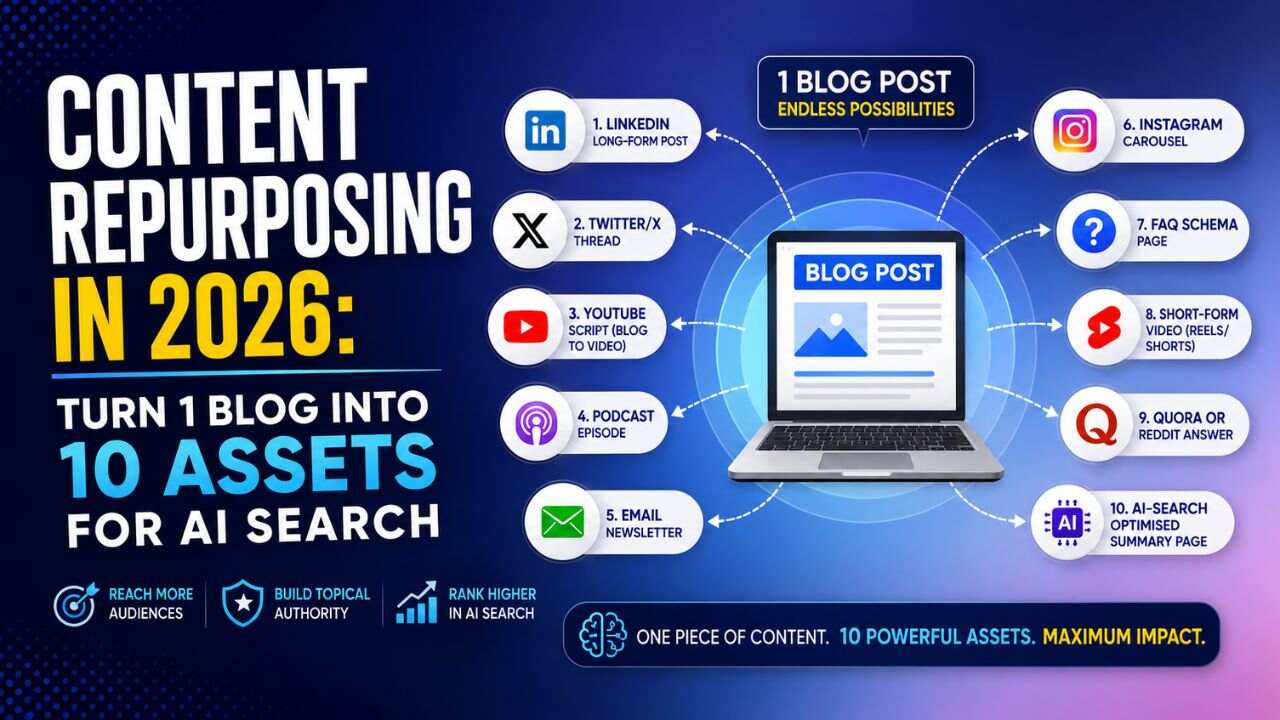
A single well-researched, well-structured blog post contains enough valuable content to fuel 10 different assets – across search, AI platforms, video, audio, and social. The brands winning in 2026 aren’t necessarily creating more content. They’re creating smarter, and distributing further.
This is your content repurposing strategy 2026 guide.
Why Repurposing Is More Valuable Than Ever in 2026
The way people consume content has fragmented significantly. Some discover through Google. Others through AI search tools like Perplexity or Claude. Others through YouTube, podcasts, LinkedIn, or Instagram Reels.
A blog post that only lives on your website is only visible to one of those audiences.
Content repurposing is how you take one piece of research and serve it across all of them – without starting from scratch each time. And in 2026, there’s an additional dimension that most brands are missing.
Google’s AI Overviews prefer brands with topical authority. That means the more places your expertise appears – in different formats, on different platforms, with consistent messaging – the more your brand is recognised as a credible source. Repurposing isn’t just distribution. In 2026, it’s an authority signal.
The Foundation: Not Every Blog Is Worth Repurposing

Before we get into the 10 assets, one important point.
Not every blog post deserves the full repurposing treatment. Focus your repurposing effort on:
- Evergreen content – posts that are relevant year-round, not tied to a news cycle
- High-performing posts – ones already getting traffic or ranking on page 2 (potential to push to page 1 with additional authority signals)
- Comprehensive guides – posts with multiple sections, data points, and actionable takeaways
A 400-word opinion post isn’t a repurposing candidate. A 1,500-word guide on keyword research methodology? That’s a gold mine.
The 10 Assets You Can Build From One Blog Post
Asset 1: The LinkedIn Long-Form Post
Take your blog’s core argument and write it as a first-person LinkedIn post. Not a link share – an actual standalone piece that delivers the insight without requiring the reader to click away.
LinkedIn’s algorithm rewards native content. A well-written LinkedIn piece from a B2B brand can reach 5–10x the audience of a link post. Take your top three takeaways from the blog, write them as a personal narrative, and end with a question to drive comments.
Asset 2: The Twitter/X Thread
Your blog’s structure is already a thread outline. Each H2 or H3 heading becomes a tweet. Each bullet point becomes a detail within that tweet.
A 10-tweet thread on a practical SEO or marketing topic – if it delivers genuine value – can earn shares, saves, and profile visits from an audience that will never discover your blog organically.
Asset 3: The YouTube Script (Blog to Video)
This is one of the highest-ROI repurposing moves available in 2026.
Take your blog, adapt the language for speech (shorter sentences, more direct address), add a hook for the first 30 seconds, and you have a YouTube script. A 1,500-word blog translates to roughly a 6–8 minute video – the sweet spot for SEO-driven YouTube content.
The blog to video podcast format is particularly powerful because it creates a second indexable asset around the same keywords. YouTube now appears in Google’s main search results for many informational queries – giving you two shots at the same searcher.
Asset 4: The Podcast Episode
If you have a podcast (or are considering starting one), your blog is your episode outline. Record a conversational breakdown of the post – no script-reading, just talking through the key ideas. Add a co-host or guest for dynamic audio.
Podcast listeners are a loyal, high-intent audience. And podcast content, when transcribed and published, adds another indexed text asset to your domain.
Asset 5: The Email Newsletter
Take the most actionable section of your blog and turn it into a standalone email. Not a “we published a new post” notification – a genuinely useful email that delivers one key insight and then offers the full blog for those who want to go deeper.
Email drives qualified traffic back to your site – visitors who already know and trust your brand, which means higher time-on-page and lower bounce rates. Both positive signals for Google.
Asset 6: The Instagram Carousel
Extract 5–7 key points from your blog. Each becomes a slide. Slide 1 is the hook (a bold claim or surprising stat). Slides 2–6 are the points. Slide 7 is the CTA.
Instagram carousels have among the highest save rates of any content format – and saves signal the algorithm to show your content to more people. For Indian D2C and B2B brands specifically, carousels consistently outperform single-image posts in engagement and reach.
Asset 7: The FAQ Schema Page (or FAQ Additions)
Every comprehensive blog post raises questions. Those questions – and their answers – can be extracted, formatted as clean Q&A pairs, marked up with FAQPage schema, and added either as a standalone resource page or as an FAQ section on an existing page.
In 2026, FAQPage schema is one of the fastest ways to capture People Also Ask real estate and feed content into Google’s AI Overviews. The questions your blog answers are often the exact queries people search for.
Asset 8: The Short-Form Video (Reels/Shorts)
Take the single most counterintuitive point from your blog. Record a 60-second talking-head video explaining it. No production required – just a phone, decent lighting, and confident delivery.
Short-form video is the highest-reach format across Instagram, YouTube Shorts, and LinkedIn. One good 60-second clip from a 1,500-word blog can reach audiences who will never read a blog post in their lives – and bring them into your ecosystem for the first time.
Asset 9: The Quora or Reddit Answer
Search for questions on Quora or Reddit related to your blog topic. Write a detailed, genuinely helpful answer – drawing directly from your blog’s research and insights. Link to the full post where it genuinely adds value.
These platforms rank in Google for thousands of long-tail queries. A well-written Quora answer can drive targeted referral traffic for months or years. It also builds topical authority signals across platforms beyond your own domain.
Asset 10: The AI-Search-Optimised Summary Page
This is the 2026 addition that most content distribution 2026 guides don’t mention yet.
Create a short, structured summary page for your blog post – 300–400 words, broken into clear sections with H2/H3 headings, direct answers in the first sentence of each section, and FAQPage schema throughout. Think of it as an optimised extract of your blog, designed specifically for AI extraction.
AI tools like Perplexity, ChatGPT, and Google’s AI Overviews pull from structured, concise content. A well-formatted summary page increases the chance your expertise gets cited when someone asks an AI tool a question your blog answers.
The Repurposing Workflow: How to Make This Sustainable

The biggest reason content repurposing fails isn’t strategy – it’s execution. Teams plan to repurpose and then run out of bandwidth.
The fix is systematising it. Here’s a simple workflow:
- Publish the blog – optimised, with schema, internal links, and FAQ section
- Extract assets immediately – create the LinkedIn post, thread outline, and email while the content is fresh
- Schedule the video and carousel for the following week – don’t try to do everything on publish day
- Add the FAQ schema content to your existing FAQ page or create a resource page
- Set a 30-day reminder to post the Quora answer and check if a Reddit thread needs a response
This five-step workflow means every major blog post you publish generates activity across 10 touchpoints – without creating any new research or writing from scratch.
Repurposing and AI SEO: The Connection Most Brands Miss
When your expertise appears consistently across multiple platforms and formats – your blog, your YouTube, your podcast, your LinkedIn – AI systems begin to recognise your brand as an authoritative source on a topic.
This is called brand entity recognition, and it’s increasingly how AI search tools decide which sources to cite. A brand that only exists in one place is invisible to AI. A brand that appears across multiple credible contexts is one AI systems learn to trust.
Repurposing your blog content isn’t just about distribution. It’s about making your brand’s expertise visible to the algorithms that are reshaping how people find information in 2026.
The Bottom Line
The content you’ve already created is an underused asset. One good blog post, executed with a repurposing strategy, can reach 10 different audiences across 10 different platforms – and build the topical authority signals that help your brand show up everywhere your buyers are looking.
Write less. Distribute smarter. Compound more.
Want Help Building a Repurposing-Driven Content Strategy?
At BeSky Marketing, we build content strategies for Indian businesses that work harder – from initial keyword research through to multi-platform distribution and performance tracking.
Frequently Asked Questions (FAQs)
Q1. How do I know which blogs to repurpose?
Focus on evergreen, high-performing, and in-depth posts (1,000+ words), especially those ranking in positions 6–20.
Q2. Do I need to create all 10 assets from every blog?
No. Start with 3–4 assets (post, email, video, FAQ). Use full repurposing only for priority content.
Q3. When should I repurpose a blog?
Start immediately for posts and emails. Add video/audio within 1–2 weeks; other formats after 30–60 days.
Q4. Does repurposing help SEO?
Indirectly. It drives traffic, improves engagement, supports AI visibility, and strengthens brand authority.
Q5. What tools help with content repurposing?
Use ChatGPT/Gemini for writing, Descript for video, Buffer for scheduling, and Rank Math for schema-plus a solid workflow.
