
Google ranking factors for product-based businesses go far beyond basic keyword targeting. For product-based businesses, Google visibility can directly influence how easily potential customers discover and evaluate your products. Whether you sell fashion, beauty products, electronics, footwear, home goods, or other consumer products, appearing in relevant search results can help bring qualified shoppers to your website. But ranking product pages is not as simple as adding keywords or publishing more products.
If you sell beauty and personal care products, the ranking factors below apply with a few category-specific nuances – see our detailed eCommerce SEO strategy for beauty & personal care brands for a deeper breakdown.
A successful eCommerce SEO strategy combines search intent, product-page optimization, helpful content, technical SEO, website structure, user experience, structured data, and relevant authority. These elements help search engines understand what your business offers while making it easier for customers to find the right products and make informed purchasing decisions.
For product-based businesses, the real SEO goal is not just to achieve higher rankings. It is to increase qualified organic traffic, improve product visibility, build trust, and turn search visibility into meaningful business results. Understanding the Google ranking factors for product-based businesses is essential for brands that want to increase qualified organic traffic, improve product visibility, and attract potential customers through search.
1. Helpful and Relevant Content
Google’s systems prioritize helpful, reliable, people-first content over content created mainly to manipulate rankings.
For product-based businesses, content should answer genuine customer questions and provide useful information throughout the buying journey.
Your content can include:
- Detailed product descriptions
- Buying guides
- Product comparisons
- How-to guides
- FAQs
- Product-use and care information
- Category and collection content
Product descriptions should clearly explain features, benefits, specifications, use cases, and other information customers need before buying. Avoid creating pages simply to target keywords. The content should provide genuine value to the person reading it.
2. Optimize Your Collection and Product Pages
Product pages are some of the most important pages on an ecommerce website. Each page should clearly communicate what the product is and why it is useful.
Focus on:
- Descriptive and relevant page titles
- Clear product descriptions
- Logical headings
- Descriptive URLs
- High-quality product images
- Useful image alt text
- Accurate specifications
- Pricing and availability information
- Relevant internal links
- Product structured data where appropriate
Avoid using identical manufacturer descriptions across multiple products. Original and useful descriptions can give search engines and shoppers more context about each product.
Google’s ecommerce guidance also recommends providing structured data and clear ecommerce information so Google can better understand your products and website.
3. Strengthen Technical SEO
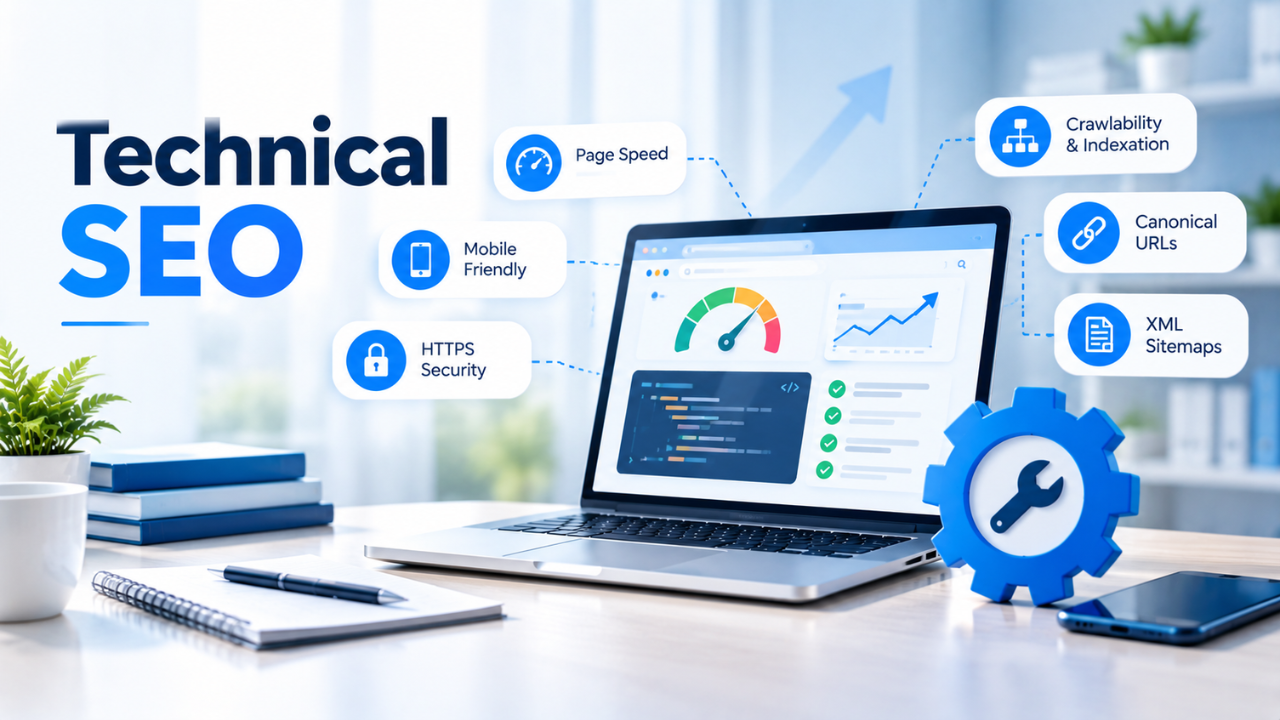
Technical SEO provides the foundation that allows search engines to discover, crawl, understand, and index your website.
Important areas include:
- Mobile-friendly pages
- Fast and stable page performance
- HTTPS
- Crawlable links
- XML sitemaps
- Proper canonical URLs
- Correct indexation
- Clean URL structures
- Broken-link management
- Duplicate-content control
- Proper redirects
Google uses automated systems to crawl and index web pages before determining which results are most relevant for a search. Making your site technically accessible helps search engines understand and process your content more effectively.
For ecommerce websites, technical SEO is particularly important because large product catalogs can create duplicate URLs, filter variations, pagination issues, and unnecessary crawl paths.
4. Build a Logical Website Structure and Internal Linking
Your website structure should help customers and search engines easily move from broad topics to specific products.
A typical ecommerce structure might look like:
Homepage → Category → Subcategory → Product
For example, a fashion store could link from its homepage to “Women,” then “Dresses,” and finally to individual dress product pages.
Use relevant internal links between related categories, products, buying guides, and supporting content. A logical ecommerce site structure can help Google understand how different pages relate to one another.
5. Match Search Intent
Ranking for the right keyword is more valuable than ranking for a keyword that does not match your product or content.
Before creating a page, understand what the searcher is actually trying to find.
For example:
- “Buy running shoes” → Product or category page
- “Best running shoes for beginners” → Comparison or buying guide
- “How to clean running shoes” → Informational guide
- “Running shoes for flat feet” → Product/category content with specific buying information
Google’s systems aim to understand the meaning and intent behind searches, not simply match individual words.
This makes search-intent analysis an important part of product-focused SEO.
6. Improve Page Experience
A good SEO strategy should also provide a useful experience for visitors.
Make sure your website is:
- Easy to navigate
- Mobile-friendly
- Secure
- Fast and responsive
- Easy to read
- Free from disruptive elements
- Simple to use when comparing or purchasing products
Google recommends considering page experience as a whole rather than focusing on one isolated metric. Core Web Vitals can help website owners evaluate loading performance, responsiveness, and visual stability, but good page experience involves more than these measurements alone.
7. Build Trust and Demonstrate Experience
Product websites need to make important information easy for customers to verify.
Include:
- Accurate product specifications
- Genuine customer reviews
- Clear shipping and return policies
- Contact information
- About-us information
- Secure checkout information
- Product images that accurately represent the product
Google’s guidance emphasizes creating helpful and reliable content and demonstrating experience, expertise, authoritativeness, and trustworthiness. However, E-E-A-T itself is not a single ranking factor. Instead, Google’s systems use various signals that help identify content demonstrating these qualities.
8. Earn Relevant Authority and Backlinks
Links from relevant, trustworthy websites can help search engines discover your content and can contribute to your site’s authority.
Instead of focusing on the number of backlinks alone, aim to earn relevant mentions through:
- Industry publications
- Digital PR
- Useful resources
- Partnerships
- Expert contributions
- Original research
- Valuable guides
- Product-related resources
The priority should be quality and relevance rather than acquiring large numbers of low-quality links. Google’s current ranking guidance recognizes links among the signals used to understand pages and their relevance, while its spam policies discourage manipulative link practices.
9. Use Structured Data Correctly
Structured data can help Google better understand information on ecommerce pages. Relevant ecommerce markup may include product information and other supported structured data types.
However, structured data should not be treated as a guaranteed ranking boost. Its primary value is helping Google understand your content and potentially making pages eligible for supported search features.
For product businesses, accurate product information is especially important. Make sure structured data reflects the visible information on the page and follows Google’s guidelines.
10. Optimize Content for Search and AI Experiences
Search is evolving beyond traditional blue-link results. Google is also developing generative AI features that can help users explore information and products.
The best approach is not to create separate content solely for “AI ranking.” Instead, continue following strong SEO fundamentals while making information clear, useful, unique, and easy to understand.
You can improve content by:
- Answering important questions directly
- Using descriptive headings
- Providing concise explanations
- Adding relevant FAQs
- Supporting claims with reliable information
- Covering the topic comprehensively
- Demonstrating first-hand experience where relevant
Google’s 2026 guidance says SEO best practices remain foundational for visibility in its generative AI search features.
How BeSky Marketing Can Help
At BeSky Marketing, we combine ecommerce SEO, technical optimization, content strategy, product-page optimization, internal linking, and authority building to help product-based businesses improve organic visibility.
Our approach focuses on more than rankings. We work to make websites easier for search engines to understand and more useful for potential customers.
Explore our SEO and digital marketing services to learn more about our approach to organic growth.
For product-based businesses, the stronger objective is to attract relevant visitors, provide useful product information, and turn organic visibility into qualified customers.
Conclusion
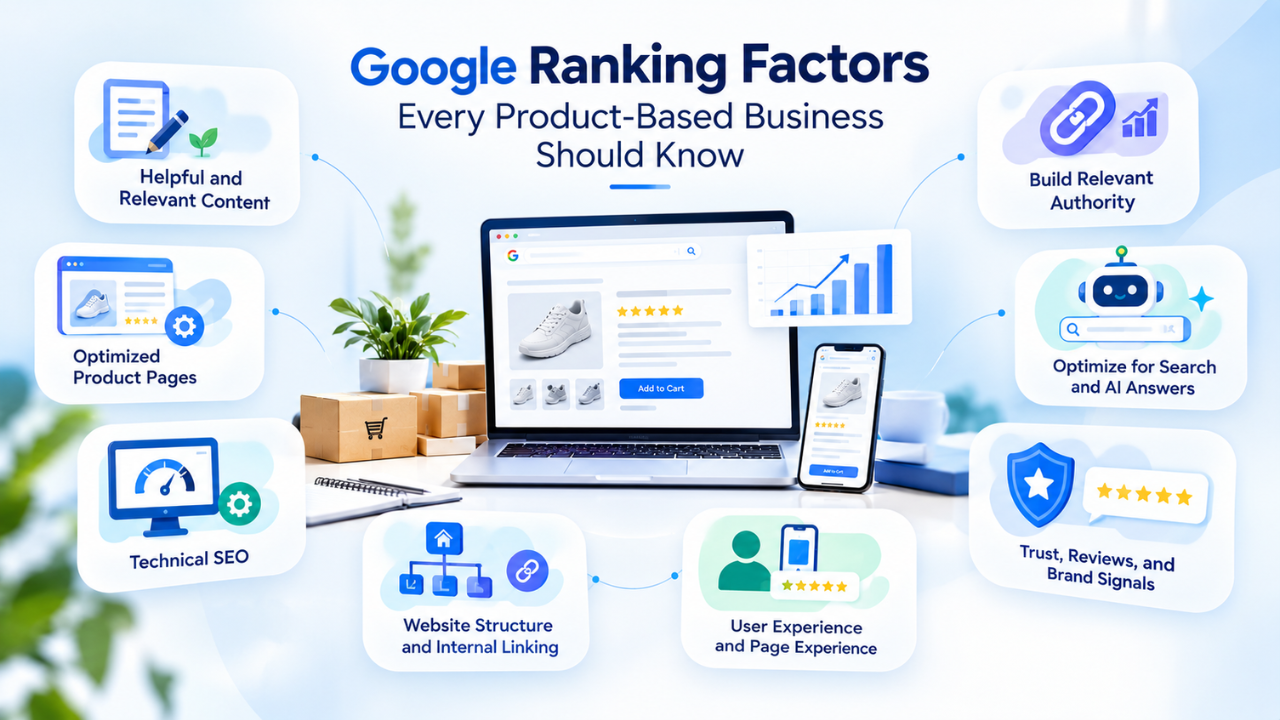
Google rankings are influenced by multiple signals rather than one single ranking factor. Product-based businesses should focus on creating helpful content, matching search intent, optimizing product pages, maintaining strong technical SEO, building a logical site structure, improving page experience, earning relevant authority, and providing accurate product information.
Structured data and AI-search optimization can further support how Google understands and surfaces your content, but they should be part of a broader SEO strategy rather than treated as shortcuts to higher rankings.
A balanced approach helps product businesses build sustainable organic visibility while creating a better experience for potential customers.
FAQs
1. What are the most important Google ranking factors for product-based businesses?
Important areas include content relevance, search intent, product-page quality, technical SEO, website structure, internal linking, page experience, relevant authority, and trustworthy information.
2. How can product pages rank higher on Google?
Create unique and useful product descriptions, use descriptive titles and headings, optimize images, provide accurate product information, implement relevant structured data, and connect product pages with useful internal links.
3. Does technical SEO affect ecommerce rankings?
Technical SEO helps search engines crawl, understand, and index ecommerce websites. Mobile usability, crawlability, indexation, canonical URLs, sitemaps, redirects, and website performance are important areas to monitor.
4. Why is search intent important for product-based businesses?
Search intent helps you create the right type of page for what users actually want. Product searches may require product or category pages, while informational searches may be better served by guides, comparisons, or FAQs.
5. How can BeSky Marketing help a product-based business with SEO?
BeSky Marketing can support product-based businesses with ecommerce SEO, keyword research, product-page optimization, technical SEO, content strategy, internal linking, and authority building to improve relevant organic visibility and attract potential customers.
