Most Indian businesses treat SEO and PPC as competing priorities.
“We’re doing SEO right now, so let’s hold off on ads.” Or the reverse: “We’re running Google Ads – we’ll sort the organic side later.”
This either/or thinking is expensive. The businesses getting the most out of search in 2026 aren’t choosing between SEO and PPC – they’re running both, deliberately, so each makes the other more effective.
This guide breaks down exactly how an SEO and PPC combined strategy 2026 works, what each channel does better than the other, and the specific integration tactics that produce results neither channel can achieve alone.
Why SEO and PPC Are Better Together
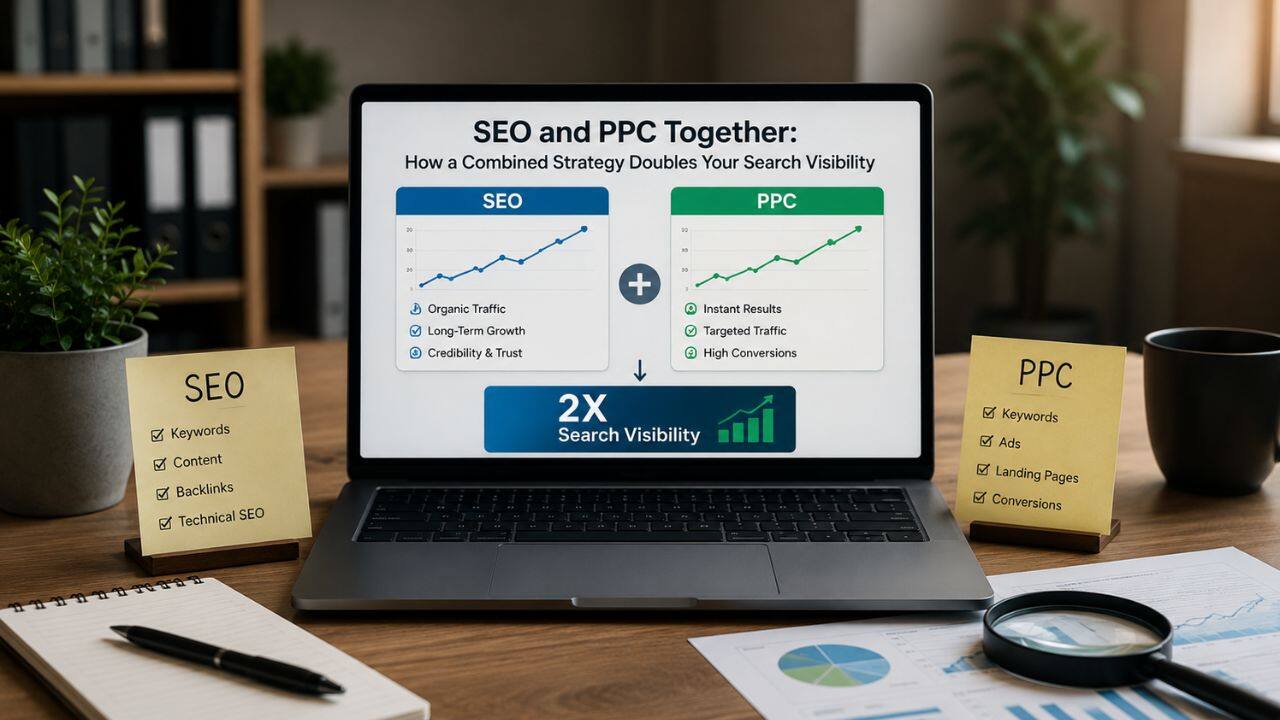
Here’s the core insight: SEO and PPC don’t compete for the same results – they cover each other’s weaknesses.
SEO builds organic visibility over time. It’s cost-efficient at scale, builds long-term authority, and generates compounding traffic month over month. But it’s slow – meaningful results often take 4–9 months, and it provides no immediate answer to urgent business needs.
PPC delivers immediate, controllable visibility. You can be at the top of Google search results within hours of launching a campaign. But it’s pay-to-play – the moment your budget stops, your visibility stops too.
Run them separately and you’re always in one of two states: paying for visibility you could eventually earn organically, or waiting for organic rankings that your business needed three months ago. Run them together and you’re always visible – immediately through PPC, and durably through SEO.
What the Data Says About Combined Search Visibility
Businesses running integrated SEO and PPC strategies consistently report:
- Higher overall click volume from the same search results page – studies show that appearing in both paid and organic results increases total clicks compared to appearing in either alone
- Lower average cost per acquisition over time – as SEO rankings improve for high-intent keywords, PPC spend can be shifted to newer or more competitive terms
- Better Quality Score in Google Ads – organic content that ranks well signals to Google that your landing pages and website are authoritative, which feeds into ad relevance scores
- Stronger brand recall – users who see your brand in both organic and paid positions on the same page register stronger brand recognition than those who see it in one position only
In India’s increasingly crowded search landscape, search visibility 2026 is not about winning one position – it’s about dominating the page.
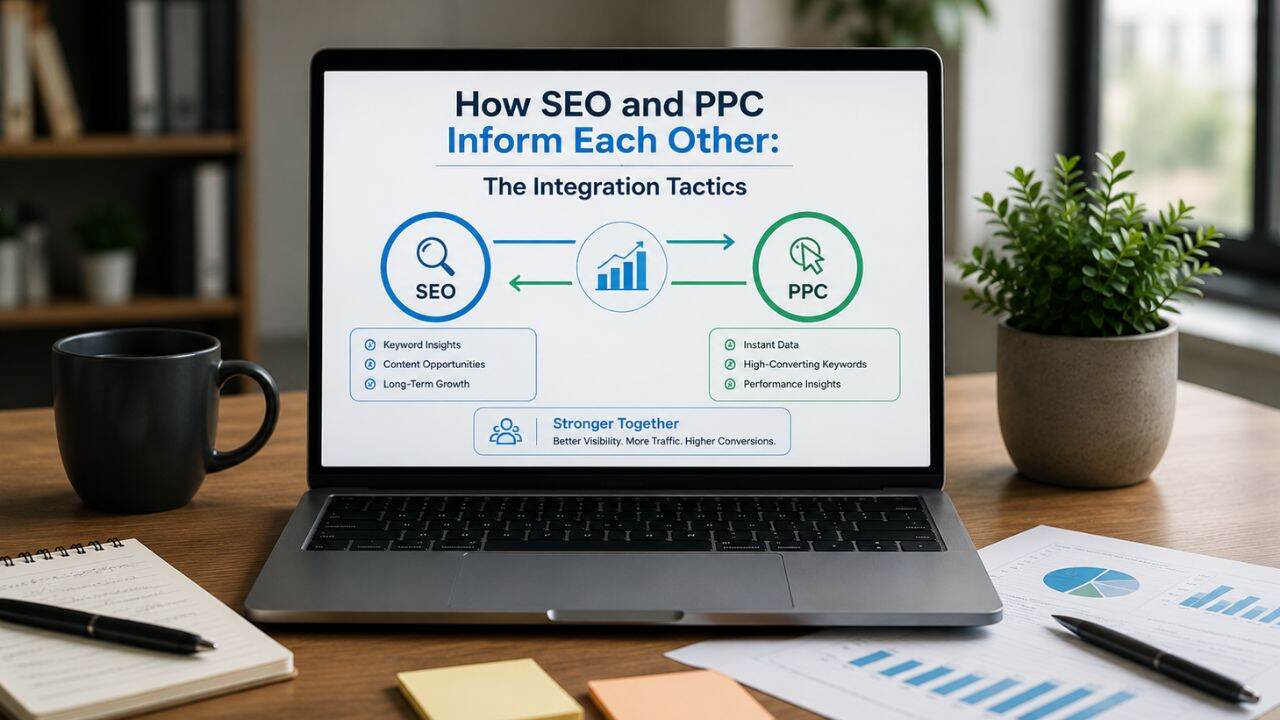
How SEO and PPC Inform Each Other: The Integration Tactics
Use PPC Data to Accelerate SEO
PPC gives you keyword intelligence that SEO research alone can’t.
When you run Google Search campaigns, you generate real data – not estimates – about which keywords drive clicks, which ad copy drives conversions, and which landing page messages resonate with your audience. This data is extraordinarily valuable for SEO content strategy.
Specifically:
- High-converting PPC keywords → priority targets for organic content and on-page SEO. If a keyword drives conversions at a profitable CPC, investing in organic content to rank for it organically reduces your long-term cost per acquisition.
- Search terms report data → reveals actual language your customers use. These phrases – often more colloquial or specific than your initial keyword research – become natural language targets for SEO content, particularly valuable for voice search and AI Overview optimisation in 2026.
- A/B tested ad headlines and descriptions → become the basis for title tags and meta descriptions. The headline that produced a 6% CTR in paid search will likely outperform a generic organic title tag too.
Use SEO Rankings to Reduce PPC Spend Strategically
As your organic rankings improve for specific keywords, you can reduce PPC spend on those terms without losing total visibility.
If your business ranks in position 1 organically for “SEO agency Chandigarh,” you’re already getting strong clicks from that query at zero marginal cost. Continuing to run aggressive PPC spend on the same term is partially redundant – you can reallocate that budget to keywords where you have no organic presence yet.
This is the compounding benefit of paid and organic search strategy done right: SEO progressively reduces the cost of maintaining search visibility, while PPC covers gaps and accelerates reach in areas where SEO hasn’t matured yet.
PPC for Testing, SEO for Scaling
PPC is the fastest way to test content and messaging before committing to an SEO content investment.
Writing a 2,000-word SEO content piece, building links, and waiting 6 months to see if it ranks and converts is a slow, expensive experiment. Running a PPC campaign for 4 weeks on the target keyword – with a dedicated landing page – tells you quickly whether:
- The keyword drives qualified traffic
- The audience converts on the offer
- The messaging resonates
Once PPC validates the keyword and offer, the SEO content investment is de-risked. You’re not writing a blog post hoping it converts – you’re writing one you know converts.
Double Coverage on High-Value Keywords
For your most commercially important keywords – the ones where a competitor taking your position would meaningfully hurt your business – running both paid and organic simultaneously provides insurance.
If a competitor overtakes you in organic search for your most valuable keyword, your PPC presence maintains visibility while you work to recover organic rankings. If Google’s algorithm updates affect your organic position (which happens unpredictably in 2026’s AI-influenced search landscape), paid search catches the traffic drop.
The most expensive moment in search marketing is when you lose visibility on a high-intent keyword with no backup channel. Integrated SEO and PPC prevents that scenario.
SEO PPC Integration: Building the Shared Infrastructure
Running SEO and PPC together effectively requires shared infrastructure – not two separate teams executing disconnected strategies.
Shared Keyword Universe
Maintain a single master keyword list that categorises all target keywords by:
- Organic priority – keywords where you’re building SEO content and links
- Paid priority – keywords where you’re running active PPC campaigns
- Overlap zone – high-value keywords where you’re deliberately running both
- PPC-only for now – keywords with clear commercial intent where SEO hasn’t delivered rankings yet
This shared view prevents duplication of effort and makes budget allocation decisions clearer.
Consistent Messaging Across Channels
When your ad copy and your organic search snippet say different things about the same offer, you create confusion rather than reinforcement.
The headline themes, value propositions, and CTAs that perform in your PPC campaigns should influence your title tags, meta descriptions, and landing page headlines. Consistent messaging across paid and organic touchpoints builds familiarity – when a user sees your brand in both positions on the same page with aligned messaging, the reinforcement effect is significantly stronger.
Unified Conversion Tracking
Both SEO and PPC performance should be measured against the same conversion events – form submissions, phone calls, WhatsApp clicks, purchases.
Without unified conversion tracking, SEO looks like a traffic source and PPC looks like a cost centre – because you can’t attribute value accurately to either. Google Analytics 4 with Google Ads linked, combined with Google Search Console data, gives you the full picture: which organic pages assist conversions, which paid keywords close them, and how paid and organic touchpoints work together across a multi-session journey.
When to Prioritise SEO vs PPC in the Combined Strategy
The balance between SEO investment and PPC spend should shift over time:
Early Stage (0–6 months)
Lean PPC-heavy. Organic rankings take time to build. PPC provides the immediate visibility needed to generate leads and revenue while SEO work compounds in the background. Use PPC data aggressively to inform your SEO keyword and content strategy.
Growth Stage (6–18 months)
Balance both actively. As organic rankings begin to materialise for target keywords, use the data to identify where SEO can start replacing PPC spend. Keep PPC active on high-competition keywords and new opportunity areas.
Maturity Stage (18+ months)
Let SEO carry baseline traffic, use PPC for acceleration. For businesses with strong organic footprints, PPC shifts from providing baseline visibility to accelerating specific campaigns – new service launches, festive season promotions, competitor conquesting, geographic expansion.
The Bottom Line
SEO and PPC are not competing line items in your marketing budget – they’re complementary channels that produce compounding returns when run in coordination.
The question isn’t SEO or PPC. The question is: are you running both in a way that makes each one better?
Want BeSky Marketing to Build Your Integrated Search Strategy?
Frequently Asked Questions (FAQs)
Q1. Should I do SEO or PPC first with a limited budget?
If you need quick leads, start with PPC. For long-term growth, begin SEO alongside PPC from month one to build organic visibility over time.
Q2. Does PPC improve SEO rankings?
Not directly. Google says PPC doesn’t affect rankings, but paid traffic can improve engagement and help identify high-performing SEO keywords.
Q3. Which keywords should I target in both SEO and PPC?
Focus on high-intent, high-converting keywords – especially service + city terms and competitive commercial keywords.
Q4. How long does an SEO + PPC strategy take to work?
PPC shows results in days, while SEO takes 4–9 months. The biggest efficiency gains from combining both usually appear around 6–9 months.
Q5. Can small Indian businesses afford both SEO and PPC?
Yes. Many SMBs run both successfully by starting small – focusing PPC on high-intent keywords and building SEO around the same topics.
