Most people learn SEO the wrong way.
They pick up a tactic here, a tool tip there, watch a few YouTube videos, and end up with a scattered collection of half-implemented ideas that don’t compound into anything meaningful. Their rankings plateau. Their traffic flatlines. And they conclude that SEO is too complicated, too slow, or simply doesn’t work for their business.
None of that is true. SEO works – when it’s approached as a system, not a collection of tricks.
Here’s how to do SEO in 2026 – from the ground up.
First, Understand What SEO Actually Is in 2026

Before we get into the framework, let’s be clear about the landscape you’re operating in.
This has changed what SEO means. It no longer means just “rank #1 and get traffic.” It now means:
- Being cited as a source in AI-generated answers
- Appearing in rich results through structured data
- Owning SERP real estate across multiple feature types – featured snippets, PAA boxes, local packs
- Building brand authority that makes users search for you directly
The good news? The fundamentals that drive all of this are still the same: technical health, content relevance, and earned authority. The framework below covers all three – in the order they should be built.
The 5-Phase SEO Framework for 2026
Phase 1: Technical SEO – Build a Foundation Google Can Trust
Nothing else matters if Google can’t crawl, understand, and index your website properly. Technical SEO is unglamorous. It’s also non-negotiable.
Start with a full technical audit covering:
- Crawlability – can Google access all your important pages? Are robots.txt or noindex tags accidentally blocking key content?
- Indexation – are the right pages indexed? Are thin, duplicate, or low-value pages being excluded?
- Page speed – run your core pages through Google PageSpeed Insights. Target LCP under 2.5 seconds, CLS under 0.1, INP under 200ms
- Mobile experience – Google indexes mobile-first. A poor mobile experience directly suppresses rankings
- Canonical tags – duplicate content from URL parameters, pagination, or platform quirks silently splits your ranking signals
- XML sitemap – submitted to Google Search Console, and updated whenever you add significant new content
- HTTPS – still a ranking signal, still frequently misconfigured on new sites
For eCommerce stores specifically, add: duplicate product URLs, crawl budget management, and structured data implementation to that list.
Fix technical issues before building anything else. A technically broken website is like a leaking bucket – no matter how much content you pour in, you’ll never fill it.
Phase 2: Keyword Research – Find What Your Audience Is Actually Searching
Keyword research is market research. Done properly, it tells you exactly what your potential customers want, how they phrase their needs, and which queries you can realistically compete for.
How to Do Keyword Research in 2026
Start with seed keywords – broad terms that describe your product, service, or niche. Then expand outward using:
- Ahrefs or Semrush – filter by search volume, keyword difficulty, and traffic potential for your target geography
- Google Autocomplete and People Also Ask – these reveal how real people phrase real queries, including the long-tail variations that convert best
- Competitor gap analysis – which keywords are your competitors ranking for that you aren’t? These are your fastest wins
- Search intent mapping – categorise every keyword by intent: informational, commercial, navigational, or transactional
For an SEO strategy 2026 India context, also filter by local search behaviour. Indian buyers use different phrasing, different price-point modifiers, and different seasonal contexts than Western markets – even in English.
Phase 3: On-Page SEO – Optimise Every Page With Intention
On-page SEO is where most beginners spend all their time – and where most experienced marketers leave easy wins untouched.
The On-Page SEO Checklist for 2026
For every key page on your website:
- Title tag – under 60 characters, primary keyword near the front, differentiator included
- Meta description – 150–160 characters, clear value proposition, soft CTA. Doesn’t affect rankings directly but significantly affects click-through rate
- H1 – one per page, contains the primary keyword, matches user intent
- H2/H3 subheadings – structured to answer secondary questions, naturally include related keywords
- First 100 words – establish the primary keyword early, set the page’s topical context clearly
- Internal links – every new piece of content should link to and from existing relevant pages
- Image alt text – descriptive, keyword-relevant, not stuffed
- Schema Markup – at minimum, Article schema for blogs, Product schema for products, FAQPage schema wherever you have FAQ sections
The most underused on-page opportunity in 2026: FAQ sections. Adding 4–6 genuinely useful FAQs to key pages targets People Also Ask boxes, enables FAQPage schema rich results, and directly feeds content that AI Overviews extract and cite. Every important page should have one.
Phase 4: Content Strategy – Build Topical Authority
In 2026, Google rewards topical authority, not just individual pages.
How to build it:
- Create 1 pillar page (broad topic)
- Add cluster blogs (specific subtopics)
- Use strong internal linking between them
This shows Google your site covers the topic fully and builds authority.
What content works in 2026:
- Definitive guides
- Comparison (“vs.”) content
- “Best under ₹[price]” pages
- Case studies
- FAQ-rich how-to content
Write for users first, then structure for AI with clear headings, direct answers, and concise content.
Phase 5: Off-Page SEO – Earn the Authority You Can’t Build Alone
Everything in Phases 1–4 makes you rankable. Phase 5 is what makes you rank above competitors who have done the same work.
Backlinks remain one of Google’s strongest ranking signals in 2026. A link from a trusted, relevant website is a vote of confidence that Google still counts heavily – especially as AI-generated content floods the web and Google leans harder on human-verified authority signals.
The Most Effective Link Building Approaches in 2026
- Digital PR – publish original research, data, or a genuinely newsworthy story. Journalists and bloggers cite sources they trust.
- Guest posting on relevant publications – contribute expert content to industry blogs, not generic link farms
- Resource link building – get your best guides listed on “resources” or “tools” pages in your niche
- Broken link building – find dead links on authoritative sites and offer your content as a replacement
- Unlinked brand mentions – use tools like Ahrefs Alerts to find mentions of your brand that aren’t linked, then request the link
For an SEO guide 2026 India context: building relationships with Indian industry publications, regional business media, and niche community platforms is often more effective – and significantly less competitive – than chasing international backlinks.
How to Track SEO Progress in 2026
Most people track the wrong metrics. Rankings fluctuate daily. Traffic numbers without context are meaningless.
Track these instead:
- Organic sessions by page cluster – is your content architecture driving traffic across topics?
- Impressions and click-through rate – from Google Search Console. Impressions growing with flat CTR = title/meta optimisation opportunity
- Keyword position distribution – how many keywords are in positions 1–3, 4–10, 11–20?
- AI Overview appearances – manually check priority keywords and track which content gets cited
- Domain authority trends – slowly rising over 6–12 months signals healthy link acquisition
- Organic-attributed revenue – the only metric that ultimately justifies the investment
Review these monthly. Make decisions based on 90-day trends, not weekly fluctuations.
The Most Common SEO Mistakes in 2026
Before you start, know what to avoid:
- Ignoring technical SEO – beautiful content on a broken site still doesn’t rank
- Targeting keywords that are too broad – “shoes” is not a keyword strategy. “Men’s leather loafers India under ₹2000” is.
- Publishing and abandoning content – Google rewards freshness. Update your top pages every 6–12 months
- Building links before building content – links to thin, low-value pages won’t move rankings
- Optimising for clicks over conversions – more traffic from the wrong keywords is worse than less traffic from the right ones
The Bottom Line on How to Do SEO in 2026
SEO is a compounding investment—what you do today drives results months and years later.
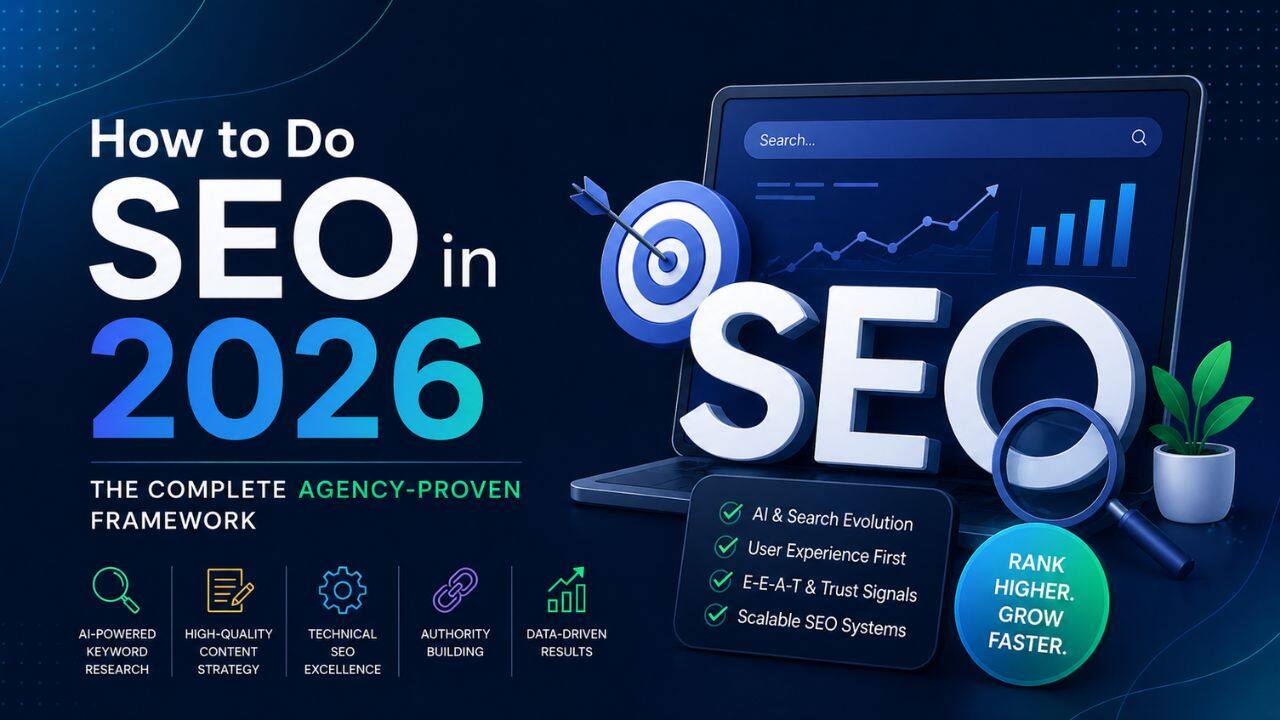
Follow the right order: Technical → Keyword Research → On-Page → Content → Off-Page.
Start with the foundation, build step by step, track performance, and stay consistent.
Want an Expert Team to Execute This Framework for Your Business?
At BeSky Marketing, we’ve applied this exact framework for clients across India – from eCommerce brands and D2C startups to service businesses and SaaS companies. Every engagement starts with a full audit and a custom strategy built around your business, your keywords, and your competition.
Frequently Asked Questions (FAQs)
Q1. How long does SEO take in 2026?
SEO typically shows results in 3–6 months. Quick wins may appear in weeks, but competitive rankings take longer. It’s a long-term, compounding strategy.
Q2. Is SEO still worth it in 2026 with AI Overviews?
Yes. Strong SEO helps you appear in AI Overviews and search results. It’s now essential for visibility, not optional.
Q3. What is the most important SEO factor in 2026?
There’s no single factor, but high-quality content and topical authority matter the most in competitive niches.
Q4. Can I do SEO myself or do I need an agency?
You can start SEO yourself. Agencies help with faster growth, expertise, and scaling, especially in competitive markets.
Q5. How is SEO in India different?
SEO in India is more mobile-first, price-sensitive, and locally driven, with unique search behavior and regional intent.
