
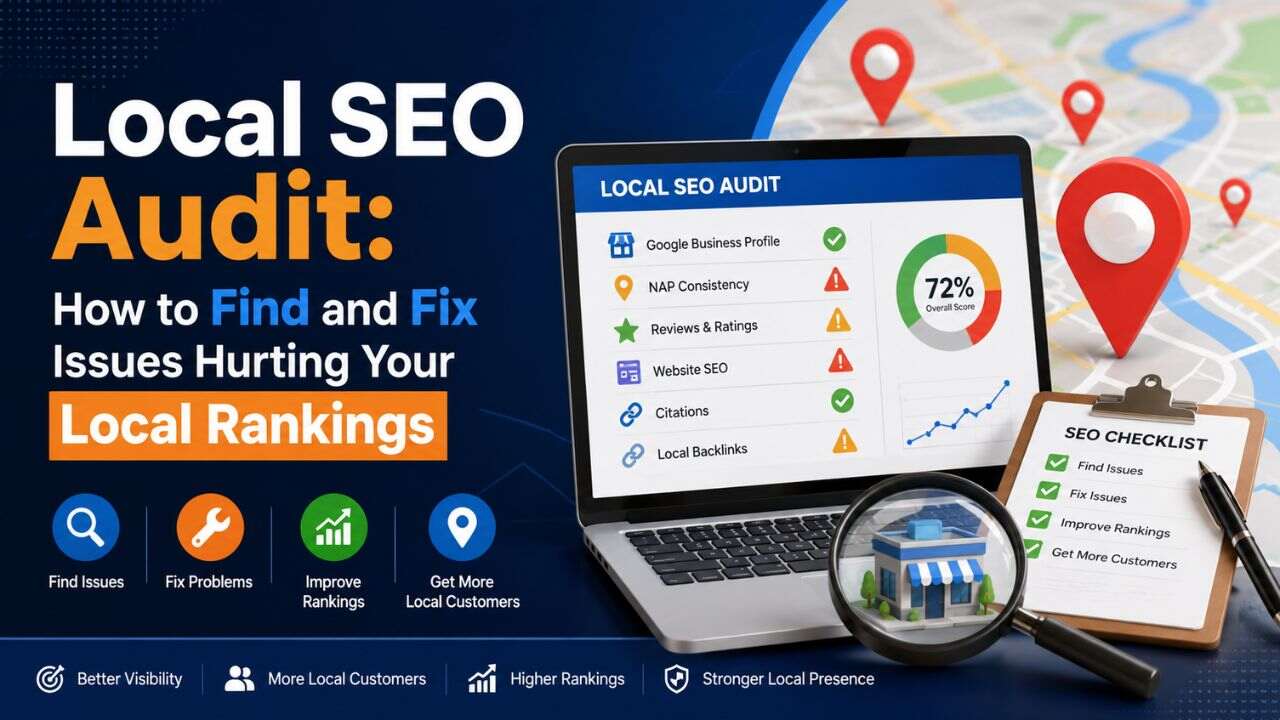
Your business is on Google. You have a Google Business Profile. You’ve collected some reviews. But you’re still not showing up where you should be.
Before you add more content, run more ads, or chase more backlinks – run a local SEO audit first. Nine times out of ten, the reason a business isn’t ranking isn’t a content problem. It’s a foundational problem that’s been quietly suppressing rankings for months.
This is your complete local SEO audit checklist 2026 – built for Indian businesses who want to diagnose exactly what’s holding back their Google Maps and local search rankings, and fix it systematically.
What Is a Local SEO Audit?
A local SEO audit is a systematic review of every factor that affects how your business appears in local search results – Google Maps, the Local Pack, and AI Overviews for local queries.
It covers six areas: your Google Business Profile, your website’s local optimisation, your NAP consistency across directories, your review profile, your local link footprint, and your technical website performance. Most local businesses have significant issues in at least three of these six areas – often without realising it.
The goal of a local SEO audit guide isn’t just to find problems. It’s to prioritise them – identifying which fixes will produce the fastest ranking improvements so you know where to start.
Section 1: Google Business Profile Audit
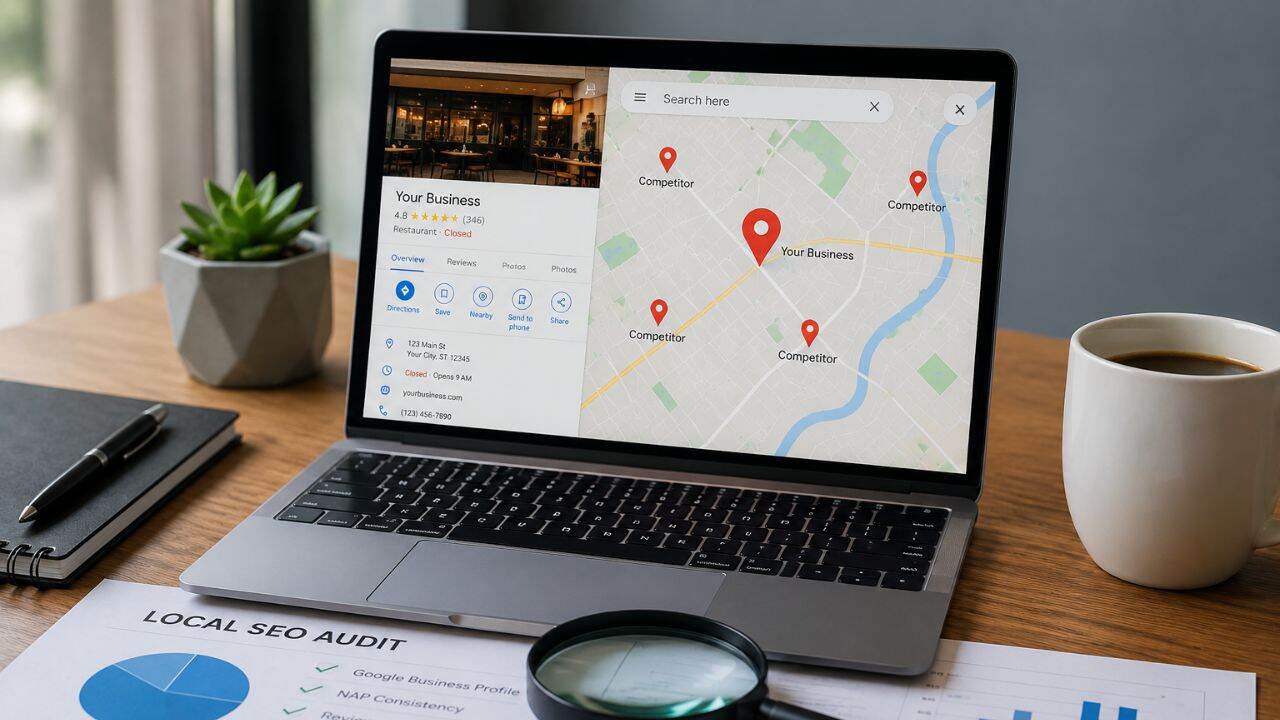
Your Google Business Profile (GBP) is one of the biggest ranking factors for Google Maps. Start your local SEO audit here.
GBP Completeness Checklist
- Business name: Use your real trading name only – no extra keywords
- Categories: Choose the most specific primary and relevant secondary categories
- Description: Clearly mention services, location, and ideal customers
- Services: Add all services with short descriptions
- Photos: Keep 10+ recent photos uploaded regularly
- Business hours: Ensure timings and holiday hours are accurate
- Website link: Point to the most relevant page, not always the homepage
- Q&A + Posts: Add FAQs and post regularly to keep the profile active
Red Flags to Fix Immediately
- Duplicate or permanently closed profile
- Suspended listing from guideline violations
- Unverified GBP limiting visibility and performance
Section 2: NAP Consistency Audit
NAP – Name, Address, Phone – inconsistencies are one of the most common and damaging local SEO issues. They’re also completely invisible unless you actively check.
How to Run a NAP Audit
Step 1: Define your Master NAP – the single correct version of your business name, address (complete with building, floor, sector/phase, city, state, PIN), and phone number in your chosen format.
Step 2: Search Google for your business name in quotes, your phone number, and your address separately. Document every listing that appears.
Step 3: Check the priority platforms manually – your GBP, your website contact page, JustDial, Sulekha, IndiaMart, Bing Places, Apple Maps, and any industry-specific directories relevant to your category.
Step 4: Use BrightLocal or Whitespark to surface additional listings that manual searching misses.
Common NAP issues to fix:
- Address formatted differently across listings (Sector 17-C vs Sec 17C vs S-17C)
- Old phone number still active on directories after a change
- Old address remaining on directories after an office move
- Business name with keyword additions on some platforms
Fix approach: Update every inconsistency to your Master NAP. Don’t delete old listings – update them. Deleting can sometimes create more confusion and new duplicate listings.
Section 3: Review Profile Audit
Reviews are the highest-weight ranking signal in Google’s local algorithm – and they also feed AI Overviews in 2026.
Review Audit Checklist
- Total review count: Is it competitive for your category and city? Check your top 3 Local Pack competitors to benchmark
- Review velocity: When was your most recent review? Google weights recency heavily – a business that received 5 reviews last month ranks better than one with 80 reviews where the last was 9 months ago
- Average rating: Below 4.0 actively suppresses visibility. Between 4.0 and 4.4 is competitive. Above 4.5 is a ranking advantage.
- Response rate: Are you responding to every review? Google’s algorithm weights responsiveness. Unanswered reviews – particularly negative ones – signal an inactive business.
- Review specificity: Do your reviews mention specific services and locations? Generic “great service!” reviews carry less AI citation value than specific, keyword-rich reviews.
Issues to fix:
- No review acquisition system → implement a systematic WhatsApp-based request process
- Unanswered reviews → respond to every outstanding review this week, then maintain 48-hour response discipline
- Negative review patterns → if the same complaint appears repeatedly, it’s an operational issue, not a reputation issue. Fix the root cause.
Section 4: Website Local SEO Audit
Your GBP ranking is supported by your website’s local optimisation signals. A technically broken or locally thin website limits how high your GBP can rank.
On-Page Local SEO Checklist
- Homepage title tag: Does it include your primary service and your city? (“SEO Agency in Chandigarh | BeSky Marketing”)
- Contact page: Does it display your complete NAP in text format (not just embedded in an image)? Is there an embedded Google Map?
- Location pages: If you serve multiple areas, do you have a dedicated page for each? Are they genuinely different, or duplicate pages with the city name swapped?
- Schema markup: Do you have LocalBusiness schema on your homepage and contact page? Do service pages have appropriate Service schema? Do FAQ sections have FAQPage schema?
- Internal linking: Do your location pages and service pages link to each other logically?
Technical Local SEO Issues to Check
Use Google Search Console and PageSpeed Insights to surface:
- Indexation issues: Are your most important local pages (homepage, service pages, location pages) actually indexed? Check Search Console → Coverage
- Mobile performance: Is your LCP under 2.5 seconds on mobile? India’s local search traffic is 70%+ mobile – slow mobile pages directly hurt local rankings
- Core Web Vitals: Red or orange scores on CLS and INP need to be addressed – they affect both organic and local rankings
- HTTPS: Is your entire site secure? Non-HTTPS pages are deprioritised in mobile and voice search
Section 5: Local Citation Audit
Beyond NAP consistency, assess the breadth and quality of your citation footprint.
Citation Audit Questions
- Coverage: Are you listed on all priority platforms for your category? (JustDial, Sulekha, IndiaMart, Bing Places, Apple Maps as a baseline – then industry-specific platforms)
- Completeness: Are your directory listings complete with description, photos, and services – or just the bare minimum?
- Duplicate listings: Does more than one listing exist for your business on the same platform? Duplicates confuse Google and split your citation authority. Request removal of duplicates.
- Dead links: Do any of your directory listings link to pages that no longer exist on your website?
Section 6: Local Link Profile Audit
Local backlinks – particularly editorial links from local news, business associations, and partner businesses – directly support Google Maps rankings in competitive categories.
Quick Local Link Audit
Search: link:yourdomain.com in Ahrefs or Semrush Site Explorer. Review your linking domains and ask:
- Are any links locally relevant? Links from local news, city directories, business associations, or local partner businesses carry local prominence signals
- Are there any toxic links? Links from spam, irrelevant international directories, or link farms can be disavowed via Google Search Console
- What’s missing? If you have zero local editorial links, this is a priority fix – particularly if you’re in a competitive category in a major Indian city
Prioritising Your Fixes: The Fix Local SEO Issues Framework

Not all audit findings are equal. Use this priority order:
Priority 1 – Fix within 1 week:
- GBP suspension, verification, or duplicate issues
- Incorrect business hours
- NAP inconsistencies on your GBP and website
- Unanswered negative reviews
Priority 2 – Fix within 30 days:
- Complete all incomplete GBP sections
- Fix NAP inconsistencies across top 10 directory listings
- Implement review acquisition system
- Add LocalBusiness schema and FAQPage schema to website
- Fix critical technical issues (indexation errors, HTTPS)
Priority 3 – Build over 3–6 months:
- Expand citation coverage to additional relevant directories
- Build local editorial links (Chamber of Commerce, local media, partner websites)
- Create location pages for each service area
- Develop FAQ content optimised for voice search and AI Overviews
- Maintain GBP post cadence (weekly)
The Bottom Line
A local SEO audit isn’t a one-time exercise. Run a full audit annually, and a lighter quarterly review of your GBP, citations, and review profile throughout the year.
Find the gaps. Fix them in priority order. Then build the positive signals – reviews, posts, links – that compound over time.
Want BeSky Marketing to Audit Your Local SEO?
At BeSky Marketing, we run full local SEO audits for Indian businesses – covering GBP, NAP consistency, review profiles, website technical issues, citation footprints, and link profiles – while applying rank restaurant salon clinic Google Maps 2026 strategies to deliver a prioritised fix plan for stronger local visibility and rankings.
Frequently Asked Questions (FAQs)
Q1. How often should I run a local SEO audit?
Run a full audit at least once a year and a quick GBP/NAP check every few months.
Q2. What is the most common local SEO issue?
NAP inconsistency and incomplete Google Business Profiles are the biggest local SEO problems.
Q3. Can I do a local SEO audit myself?
Yes. Most checks can be done in-house, though agencies help uncover deeper technical and citation issues.
Q4. How long does it take to see results after fixes?
Most businesses see improvements within 4–8 weeks, depending on the issue fixed.
Q5. What tools do I need for a local SEO audit?
Use Google Business Profile, Search Console, PageSpeed Insights, and citation tools like BrightLocal or Whitespark.
