
There’s a business in Chandigarh with a solid Google Business Profile, decent reviews, and a well-built website. But they’re ranking fourth in the Local Pack -behind two competitors with weaker profiles and fewer reviews.
The reason? Their business address appears as “SCO 45, Sector 17-C” on their GBP, “SCO 45, Sec 17C” on JustDial, and “Shop 45, Sector 17” on their Facebook page. Three listings. Three slightly different addresses. And Google can’t confidently confirm they’re all the same business.
That’s the NAP consistency problem -and it’s suppressing more local rankings than most businesses realise.
This is your complete guide to NAP consistency local SEO 2026 -what it is, why it matters more than ever in the age of AI search, and exactly how to fix it.
What Is NAP Consistency and Why Does It Matter?
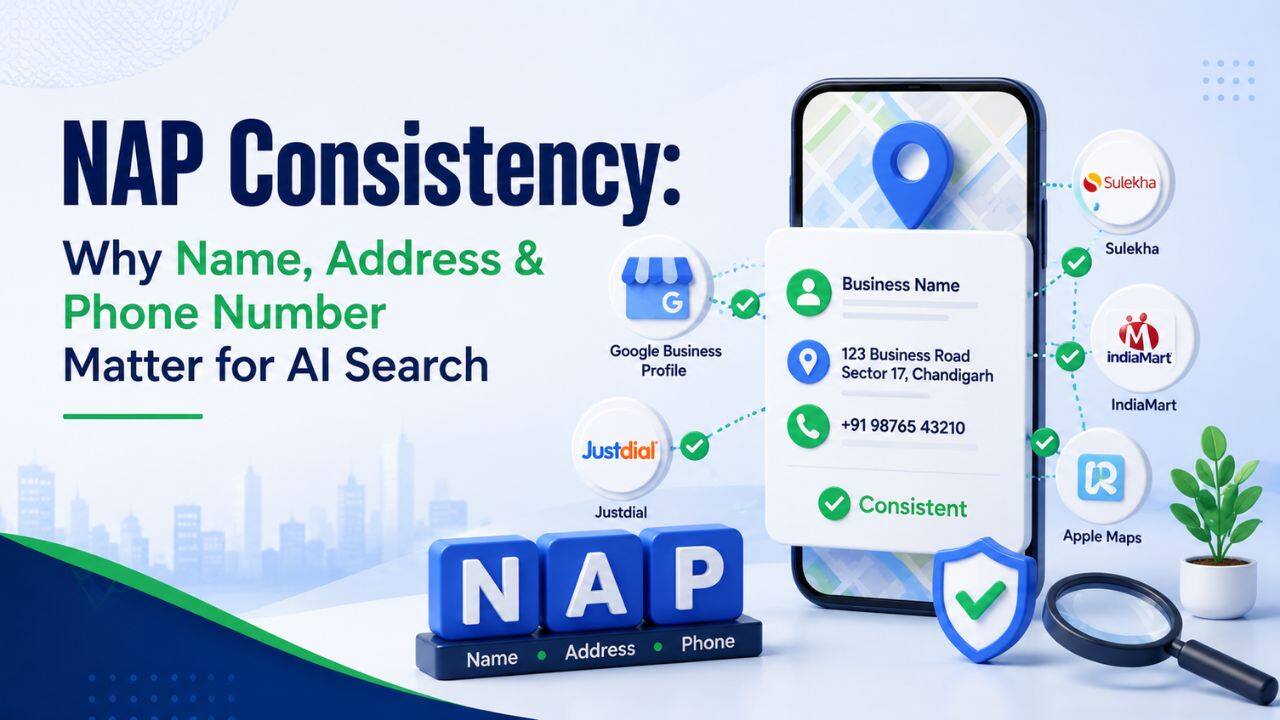
NAP stands for Name, Address, Phone number -the three core data points that identify a business across the web. Every time your business is listed anywhere online -a directory, a social profile, a news mention, a partner website -those three pieces of information appear.
NAP SEO importance comes from how Google’s local algorithm works. Google doesn’t just look at your Google Business Profile in isolation. It cross-references your business information across dozens of online sources -directories, websites, social platforms -to confirm that you are who you say you are, located where you claim to be.
When your NAP data is consistent everywhere, Google receives clear, corroborating signals: this business is real, established, and trustworthy. When it’s inconsistent, Google’s confidence in your listing decreases -and lower confidence typically means lower rankings.
Why NAP Consistency Matters Even More in 2026

NAP has always mattered for local SEO. But 2026 has introduced a new dimension: AI local search.
Google’s AI Overviews now generate summaries for local queries -“best CA firm in Chandigarh,” “top interior designers in Mohali” -by pulling from multiple data sources simultaneously. These AI systems aggregate information from your GBP, your website, directories, reviews, and third-party mentions.
If your NAP data conflicts across these sources, AI systems face the same confidence problem Google’s traditional algorithm faces -but at scale. An AI trying to confirm your business details across eight different sources that show three different address formats will deprioritise your business in favour of one whose data is clean and consistent everywhere.
Citation consistency in 2026 is therefore not just a traditional ranking signal -it’s a prerequisite for AI local search visibility.
The Most Common NAP Inconsistency Problems
Most businesses don’t have wildly different information -they have subtle inconsistencies that accumulate over time. Here are the most common ones:
Business Name Variations
- Formal legal name vs. trading name (“BeSky Solutions Pvt. Ltd.” vs. “BeSky Marketing”)
- Abbreviations (“St.” vs. “Street,” “Pvt.” vs. “Private”)
- Keyword additions on some platforms (“Best Digital Marketing Chandigarh” instead of the actual business name)
- Old name that was never updated after a rebrand
Address Variations
- Sector formatting (“Sector 17-C” vs. “Sec. 17C” vs. “S-17C”)
- Building/office number format (“SCO 45” vs. “Shop No. 45” vs. “Unit 45”)
- Missing floor or suite numbers on some listings
- Old address still active on directories after a move
- State abbreviations (“Punjab” vs. “PB”)
Phone Number Variations
- With vs. without country code (“+91-172-XXXXXXX” vs. “0172-XXXXXXX” vs. “172XXXXXXX”)
- Old phone number still active on directories
- Multiple numbers listed -some with the main line, some with a mobile
Each of these variations is small on its own. Combined across 15–20 directory listings, they create a fragmented data picture that actively works against your local rankings.
How to Audit Your NAP Consistency
Before fixing anything, you need to know what you’re dealing with. Here’s how to run a NAP audit for name address phone number local SEO:
Step 1: Define Your Master NAP
Decide on the single, definitive version of each element:
- Business name: Use exactly what appears on your legal registration or GST certificate -this is your canonical name
- Address: Use the complete, official postal address -including building name, floor, sector/phase, city, state, and PIN code -in one consistent format
- Phone number: Choose one primary number (ideally landline for local SEO authority, or the number you check most reliably) and format it consistently: +91-XXXXXXXXXX or 0XXXXXXXXXX -pick one and apply it everywhere
Write this Master NAP down. Every listing, every platform, every page on your website should match it exactly.
Step 2: Search for Your Existing Listings
Search Google for:
- Your exact business name
- Your phone number
- Your address
Look at every result -directories, social profiles, business listings, map entries, news mentions. Document every inconsistency you find.
Step 3: Use a Citation Audit Tool
Manual searching catches some issues but misses many. Tools like BrightLocal, Whitespark, or Moz Local will crawl major directories and surface NAP inconsistencies automatically. For Indian businesses, also manually check JustDial, Sulekha, IndiaMart, and Bing Places -these aren’t always included in Western citation tools.
How to Fix NAP Inconsistencies
Once you’ve identified every inconsistency, the fix process is methodical -not glamorous, but essential.
Priority Order for Fixing
Fix high-authority sources first -the ones Google weighs most heavily:
- Google Business Profile -verify your NAP here first; this is Google’s primary source
- Your own website -check your contact page, footer, and any embedded maps
- JustDial -highest authority Indian directory
- Bing Places -feeds Microsoft’s AI search
- Facebook Business Page
- Apple Maps -claim and update via Apple Business Connect
- Sulekha, IndiaMart, IndiaMART -major Indian B2B and service directories
For each listing, log into the platform and update to your Master NAP. For directories where you can’t claim or edit the listing, use the “suggest an edit” or “report incorrect information” function -most major directories have this.
Don’t delete old listings -this can sometimes create more confusion. Update them to your correct information instead.
Maintaining NAP Consistency Going Forward
Fixing existing inconsistencies is a one-time project. Maintaining consistency is an ongoing discipline.
Common Future Triggers for NAP Problems
- Moving office: The single biggest source of new inconsistencies. Update every listing within the first 30 days of any address change.
- Getting a new phone number: Audit and update all listings immediately. Keep the old number active (redirect it) for 90 days minimum.
- Rebranding: A business name change requires updating every listing -plan for this as part of any rebrand project.
- New staff managing platforms: Brief anyone who creates or manages online business listings about your Master NAP document.
Build a quarterly citation review into your local SEO workflow. Spend 30 minutes every quarter checking your top 10 directory listings for accuracy. It’s less work than a full audit and prevents small inconsistencies from compounding.
NAP Consistency and AI Search: The 2026 Connection

Here’s the forward-looking part that most citation consistency guides haven’t addressed yet.
AI search systems -Google’s AI Overviews, Bing’s Copilot local answers, and emerging AI search tools -are fundamentally data aggregation systems. They build understanding of local businesses by cross-referencing multiple sources. The more consistent your data is across sources, the more confidently AI systems can cite your business in local responses.
Think of it this way: if an AI system finds your business listed with five different address formats across ten sources, it flags your data as low-confidence. If it finds your business with identical NAP data across every source, it classifies you as a reliable, established entity -and cites you accordingly.
In 2026, NAP consistency is as much an AI optimisation strategy as it is a traditional local SEO tactic. The businesses investing in clean, consistent citation data now are building the AI-ready data foundation that will drive local visibility for years.
The Bottom Line
Fix your NAP. Define your Master NAP. Audit quarterly. And make citation consistency part of every major business change from day one.
The businesses ranking consistently in Chandigarh, Mohali, Delhi NCR and every other Indian city aren’t just the ones with the best GBP or the most reviews. They’re the ones whose data is clean, consistent, and trustworthy -everywhere Google and AI systems look.
Want BeSky Marketing to Audit Your Citations?
Frequently Asked Questions (FAQs)
Q1. How much does NAP inconsistency affect local rankings?
NAP inconsistency weakens Google’s trust in your business data and can suppress local rankings – especially in competitive markets like Chandigarh, Delhi, Mumbai, and Bengaluru. Consistent listings act as a strong trust signal for local SEO.
Q2. Does my Google Business Profile name need to match my legal name?
No. Your GBP name should match the name customers recognise and the one used consistently across your website and directories. Avoid adding keywords to your business name, as it violates Google’s guidelines.
Q3. What should I do if my business moves to a new address?
Update your Google Business Profile first, then your website and major directories like JustDial, Sulekha, IndiaMart, Bing Places, and Apple Maps. Keep all listings consistent and update old citations instead of deleting them.
Q4. How many directory listings should an Indian business have?
Most Indian businesses should aim for 15–25 high-quality directory listings. Focus on trusted platforms and ensure every listing is accurate and complete rather than chasing quantity.
Q5. How often should I audit my NAP data?
Run a full NAP audit at least once a year and whenever your business details change. A quick quarterly check of your top listings helps catch inconsistencies before they affect rankings.
