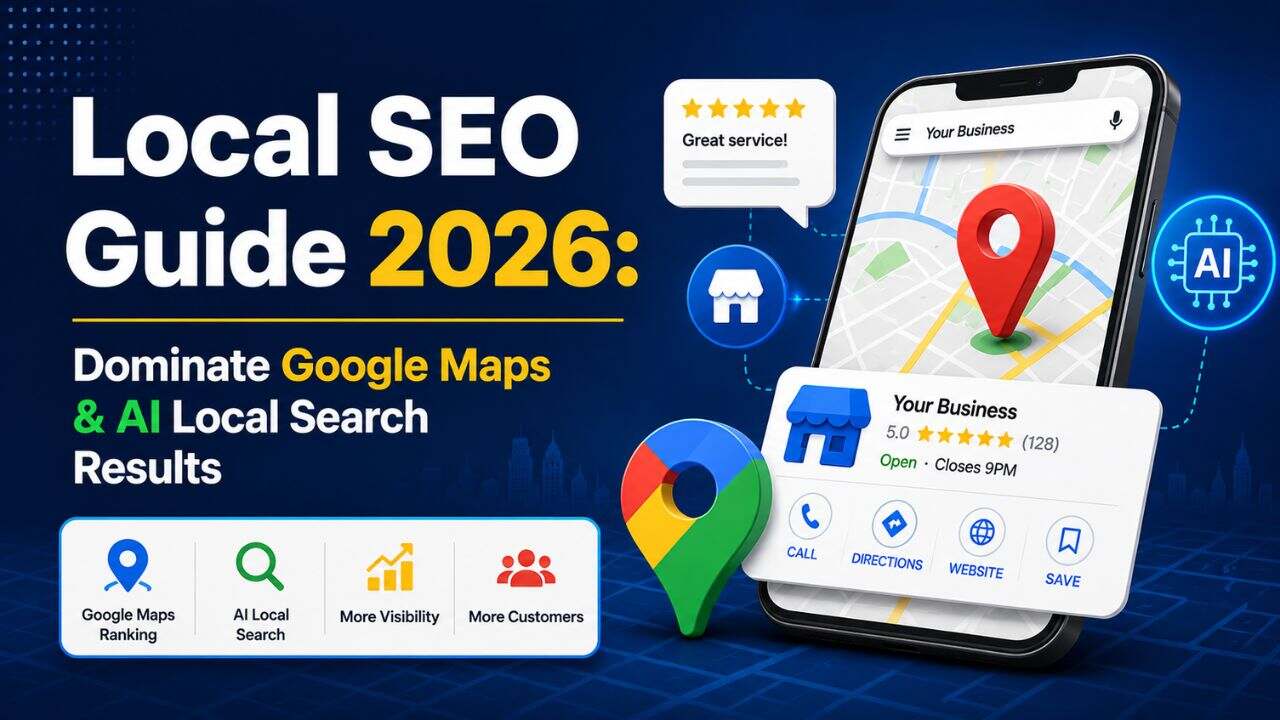
When someone in your city searches for what you sell, does your business show up?
Not on page three. Not buried in the organic results below the map. Right there – in the top three of Google Maps, the Local Pack, and increasingly in AI-generated local search answers.
For most local businesses in India, that single question – “do we show up when people search nearby?” – determines whether a potential customer walks through the door or calls a competitor. Local SEO is the discipline that answers it.
This is your complete local SEO guide 2026 – built for Indian businesses navigating both traditional Google Maps ranking and the AI-powered local search features that are reshaping how local intent is served.
What’s Changed in Local SEO in 2026
Local SEO has never been static, but 2026 has changed what “showing up locally” really means.
First, Google’s AI Overviews now appear for local searches, pulling information from Google Business Profiles, reviews, and local website content. Ranking in the Local Pack is no longer enough – businesses also need visibility in AI-generated local summaries.
Second, voice search and conversational AI are driving more “near me” searches. Modern Local SEO India strategies must now optimise for conversational queries, review sentiment, and local authority alongside traditional keyword rankings.
The Local Pack: How It Works and Why It Matters
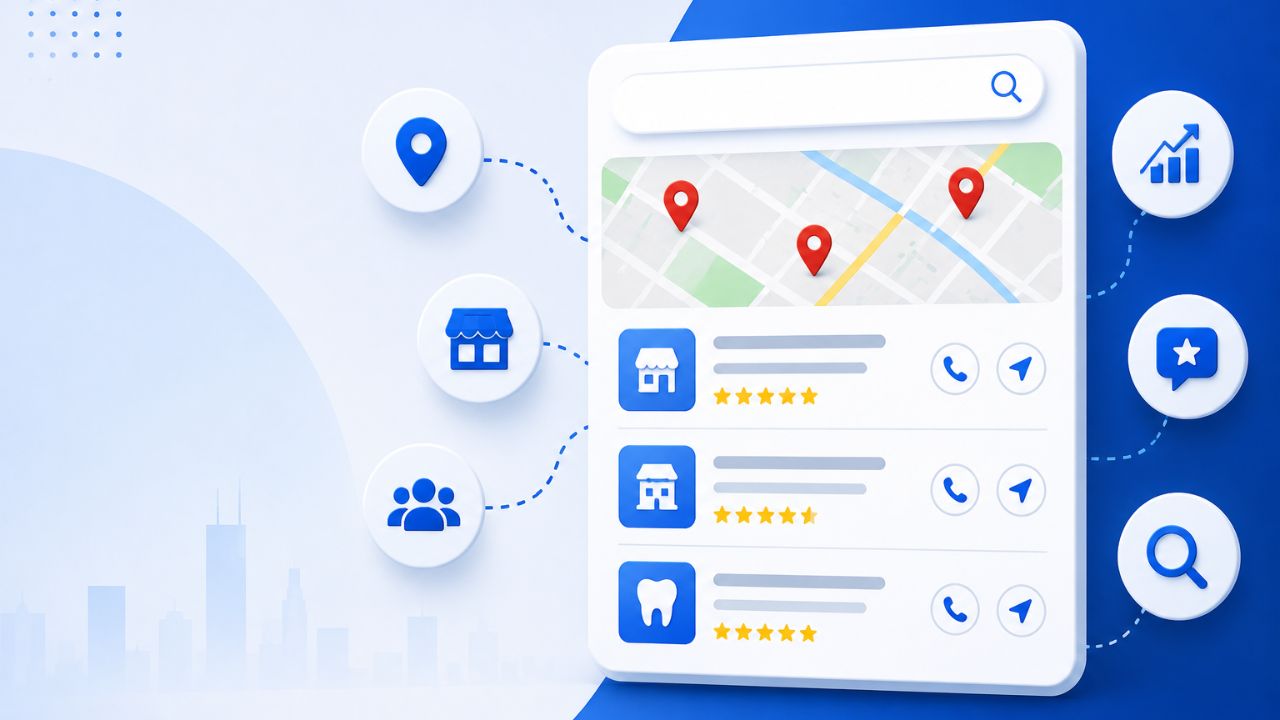
The Local Pack is the map and three business listings that appear at the top of Google results for local queries. It gets the most clicks of any SERP element for local intent searches – often capturing 40–50% of all clicks on the page.
Getting into the Local Pack (and staying there) depends on three signal categories:
- Relevance – does your Google Business Profile tell Google clearly what you do, where you do it, and who you serve?
- Distance – how close is your business to the searcher? You can’t change your physical location, but you can optimise for the specific areas you serve.
- Prominence – how well-known and credible is your business across Google’s data sources? Reviews, backlinks, citations, and GBP completeness all feed prominence.
Step 1: Google Business Profile Optimisation
Google Business Profile optimization is the single most impactful thing you can do for local visibility – and most Indian businesses are leaving significant opportunity on the table.
Complete Every Section of Your GBP
A half-complete Google Business Profile is a missed ranking opportunity. Make sure you fully optimise:
- Business name: Use your real business name without keyword stuffing.
- Category: Choose the most accurate primary category and relevant secondary categories.
- Description: Clearly explain what you do, where you operate, and your core services.
- Services: Add all services with short descriptions and pricing if relevant.
- Business hours: Keep hours updated, including holidays.
- Photos & videos: Regularly upload fresh, high-quality visuals.
- Website URL: Link to the most relevant service or location page, not just the homepage.
GBP Posts: The Most Underused Local SEO Feature
GBP posts – short updates that appear on your Business Profile in search results – are used by fewer than 30% of Indian businesses despite being completely free and directly visible in the Local Pack.
Post consistently (at least once per week) about:
- New services or product launches
- Promotions and seasonal offers
- Blog content or expert tips
- Testimonials or case study highlights
- Festive season offers (Diwali, Holi, New Year – high-intent local searches spike during these periods)
Step 2: Review Strategy – The Most Powerful Local Ranking Signal
Reviews are not a nice-to-have. In 2026, review quantity, recency, and sentiment are among the highest-weight ranking signals in Google’s local algorithm – and they feed directly into AI-generated local summaries.
How to Build Reviews Systematically
- Ask directly after a positive interaction – in person, by WhatsApp, or by email. Timing matters: ask within 24–48 hours while the experience is fresh.
- Make it easy: Send a direct link to your GBP review page. Remove every friction point. The more steps between “I want to leave a review” and “review submitted,” the lower your conversion rate.
- Respond to every review – positive and negative. Google’s algorithm weighs business responsiveness. Responding to negative reviews professionally also significantly reduces their negative impact on conversion.
- Include keywords naturally in your responses: “Thank you for visiting our CA firm in Chandigarh – we’re glad our tax filing service was helpful.” This feeds keyword context into your GBP profile at no additional effort.
Step 3: Local Citations and NAP Consistency
A local citation is any mention of your business name, address, and phone number (NAP) across the web – directories, industry listings, news sites, and social platforms.
Inconsistent NAP data is one of the fastest ways to suppress local rankings. If your address appears as “Sector 17-C” on some sites and “Sector 17C” on others, or your phone number has formatting inconsistencies, Google’s local algorithm treats these as separate entities – diluting your citation authority.
Priority Citation Sources for Indian Businesses
- JustDial – still one of the most authoritative local directories in India
- Sulekha – particularly strong for service businesses
- IndiaMart – essential for B2B local presence
- Bing Places – often overlooked but feeds into Microsoft’s Bing AI search
- Apple Maps – growing in importance as iPhone adoption increases in India
- Industry-specific directories – legal, medical, financial, and hospitality sectors each have dominant vertical directories worth claiming
Audit your existing citations quarterly using a tool like BrightLocal or Whitespark – find inconsistencies, correct them, and add listings on high-authority sites you’re not yet present on.
Step 4: Local Content Strategy
Google rewards local businesses that demonstrate genuine, specific expertise in their area. Generic service pages don’t build local authority. Location-specific content does.
Local Content That Builds Rankings
Location pages. If you serve multiple areas, create a dedicated page for each major location – not duplicate pages with the city name swapped, but genuinely different pages that include local landmarks, area-specific service details, and location-specific testimonials.
Local blog content. Write about topics specific to your city or region:
- “GST Filing for Small Businesses in Chandigarh: What’s Changed in 2026”
- “Best Areas in Bangalore for D2C Warehousing: A 2026 Guide”
- “How Pune’s Construction Boom Is Affecting Interior Design Timelines”
This content earns local backlinks, attracts local searchers, and signals to Google that your business is genuinely embedded in its community – not just claiming geographic relevance.
FAQ content with local context. Address questions specific to your local market. “What does a CA firm in Chandigarh charge for GST filing?” is a query your local blog can own. Generic national-level content can’t.
Step 5: Local Backlinks – The Underbuilt Pillar
Local SEO India strategies frequently neglect link building in favour of GBP optimisation and citation building. Both matter, but backlinks from locally relevant, authoritative sources significantly accelerate Local Pack rankings – especially in competitive city markets.
How to Build Local Backlinks
- Local news coverage: Reach out to local journalists or contribute expert commentary on business topics relevant to your city
- Local business associations: Join your city’s Chamber of Commerce or industry association – membership pages typically link back to member websites
- Sponsor local events: Most local event websites link to sponsors; the links are modest in authority but locally relevant
- Collaborate with complementary local businesses: A CA firm co-authoring content with a legal firm in the same city builds local relevance signals for both
- Get featured in local “best of” lists: Journalists and bloggers regularly publish these – a polite pitch explaining your credentials and local presence is often enough
Optimising for AI Local Search in 2026
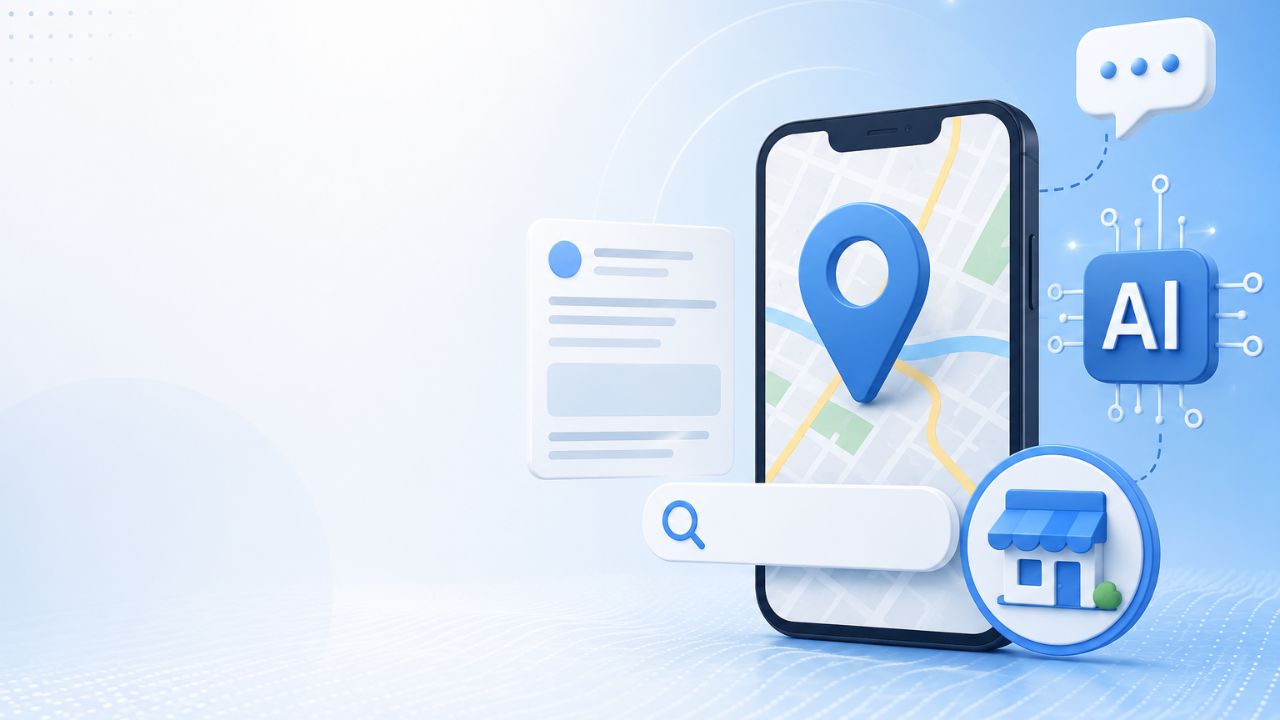
Google Maps ranking 2026 is increasingly influenced by AI-generated local summaries that appear before the traditional Local Pack. These summaries pull from your GBP data, review text, and indexed local content.
To appear in AI local summaries:
- Ensure your GBP description explicitly answers the most common local intent queries in your category (“We provide GST filing, tax advisory, and company incorporation services for businesses in Chandigarh and the Tricity region”)
- Encourage reviewers to mention specific services and locations in their reviews – AI systems extract this detail
- Publish FAQ content on your website with FAQPage schema addressing common local queries
- Build a consistent review velocity – AI systems weight recency, so a steady stream of new reviews consistently outperforms a burst followed by silence
The Bottom Line
For most Indian local businesses, the fastest wins are: complete and active GBP, a systematic review acquisition process, and consistent citation cleanup. Get those right first. Then build the content and link layer that creates compounding local authority month over month.
Want to Dominate Local Search in Your City?
Frequently Asked Questions (FAQs)
Q1. How long does local SEO take in India?
Basic Google Business Profile improvements can show results in 4-8 weeks. Competitive city rankings usually take 4–9 months.
Q2. How many Google reviews do I need for Local Pack rankings?
It depends on competition. Smaller cities may need 15-25 reviews, while major metros often require 100+ reviews with consistent recent activity.
Q3. Can I rank in local SEO without a physical address?
Yes. Service-area businesses can rank using Google Business Profile, reviews, citations, and strong website authority.
Q4. What’s the difference between Local Pack and organic rankings?
Local Pack rankings rely on Google Business Profile signals, while organic rankings depend on traditional SEO factors like content and backlinks.
Q5. How do I optimise for AI local search results in 2026?
Optimise your Google Business Profile, encourage detailed customer reviews, and publish local FAQ content with schema markup.
