This is the question every business owner asks after signing up for SEO – usually around month two, when the rankings haven’t moved and the impatience starts building.
It’s a fair question. And it deserves an honest answer, not the vague “it depends” that most agencies give just to avoid the conversation.
Here’s the truth: SEO takes longer than most people expect, delivers more than most people anticipate, and compounds in ways that paid advertising simply cannot. But none of that matters if you go in with unrealistic expectations and pull the plug too early.
Why SEO Takes Time: The Honest Explanation

SEO isn’t a switch you flip. It’s a signal you build.
Google’s ranking systems evaluate hundreds of signals – your site’s technical health, the authority of your domain, the quality and depth of your content, the links pointing to your pages, and how users behave when they land on your site. None of these signals can be manufactured overnight, and Google doesn’t instantly reward improvements – it observes patterns over time.
Think of it like building a reputation in a new city. You can’t walk in on day one and expect people to trust you. You show up consistently, you deliver quality, you build relationships – and over months, the trust compounds.
When does SEO work? When it’s approached as a sustained investment rather than a short-term campaign.
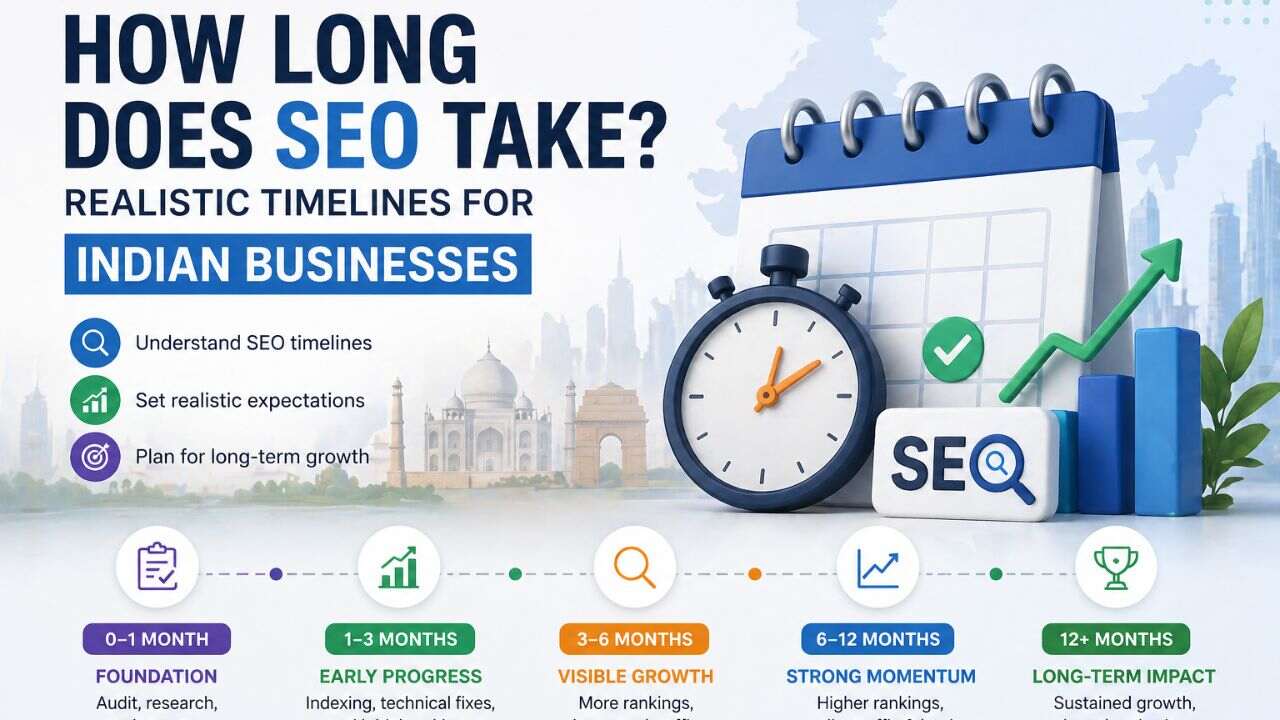
The Realistic SEO Timeline: Month by Month
Months 1–2: Foundation and Setup
This is the phase where experienced agencies do the most important work that nobody sees.
What happens in this phase:
- Full technical SEO audit – crawlability, indexation, page speed, Core Web Vitals
- Comprehensive keyword research and content mapping
- On-page optimisation of existing pages
- Schema markup implementation
- Google Search Console and Analytics setup and baseline data collection
- Initial content strategy planning
What you won’t see yet: meaningful ranking movement. This is the groundwork. Without it, everything built later is unstable.
What you should see: Google Search Console beginning to show impressions for target keywords – your pages appearing in search, even if not at the top yet. This is the first signal that the technical foundation is working.
Months 3–4: First Movements
This is when the work from months one and two starts showing up in the data.
For most Indian businesses, months 3–4 bring:
- Long-tail keyword rankings appearing in positions 8–25
- Impressions increasing noticeably in Search Console
- Traffic movement on pages that were technically optimised
- Featured snippet or People Also Ask appearances for well-structured content
This is also the phase where businesses with unrealistic expectations start doubting the investment. Don’t. Positions 10–25 are meaningful progress – they mean Google has found, crawled, evaluated, and started ranking your content. Moving from 20 to 5 is significantly faster than moving from unranked to 20.
Months 4–6: Compounding Momentum
If the foundation was built correctly and content has been published consistently, this is when SEO results time 2026 starts to feel real.
What typically happens:
- Long-tail keywords move into the top 10
- Organic traffic begins showing a clear upward trend month-over-month
- Some mid-competition keywords enter the top 20
- AI Overview appearances begin for well-structured, schema-marked content
- Internal linking improvements start distributing authority to previously weak pages
This is also when the compounding effect begins. Each piece of content that ranks starts generating internal link authority for other pages, which accelerates the ranking of your broader content cluster.
Months 6–12: Real Business Impact
This is the window where most well-executed SEO strategies start delivering measurable business outcomes – not just rankings, but actual leads and revenue.
Expect:
- Primary target keywords entering positions 1–10
- Organic traffic significantly exceeding the pre-SEO baseline
- Organic leads and conversions becoming measurable in GA4
- Content clusters generating authority that lifts category and product pages
- Reduced dependency on paid traffic for the keywords where you’re now ranking organically
For eCommerce businesses specifically, ₹5–₹20 lakh in monthly organic revenue becomes realistic in competitive Indian niches when the strategy has been executed properly through this full period.
Month 12 and Beyond: The Compounding Phase
This is where the real SEO advantage becomes undeniable.
Pages that have been ranking for 6+ months accumulate historical data – click-through rate signals, dwell time, return visits – that reinforce their position. Content published today continues generating traffic for years. Authority built this year makes next year’s rankings faster and more competitive.
The brands that reach month 12 with a well-executed SEO strategy almost universally continue – because by this point, the organic channel is delivering ROI that makes the investment obviously worthwhile.
What Affects Your SEO Timeline in India
The timelines above are averages. Your specific timeline depends on several factors.
Your Domain’s Starting Authority
A brand-new domain with zero backlinks and no indexation history will take longer than an established domain with existing content and authority. If you’re starting from zero, add 2–3 months to every phase above.
Your Industry’s Competition Level
A Tier 2 city service business targeting local keywords is competing against a very different landscape than a national eCommerce brand targeting high-volume product keywords. Low-competition local SEO can show meaningful results in 8–12 weeks. Highly competitive national keywords may take 12–18 months.
Content Velocity
The more high-quality, targeted content you publish, the faster topical authority builds. Businesses publishing two to four optimised pieces per month consistently outperform businesses publishing sporadically – even if the sporadic content is individually higher quality.
Consistency matters more than occasional brilliance in SEO.
Technical Health at the Start
A site with significant technical issues – slow page speed, crawl errors, duplicate content, missing schema – will see delayed results until those issues are resolved. Every month spent with unresolved technical issues is a month of delayed ranking progress. This is why technical audit and cleanup should always come first.
Link Acquisition Pace
Domain authority is built through backlinks, and authority determines how quickly new pages rank. Businesses actively building quality links through digital PR, guest posting, and resource link building will see results faster than businesses relying on content alone.
How to Tell If Your SEO Is Working (Before Rankings Move)
This is critical – because results often exist in the data before they appear in visible rankings.
Healthy early indicators:
- Search Console impressions growing – your pages are appearing in search results, even if not at the top
- Index coverage increasing – more of your important pages are being crawled and indexed
- Core Web Vitals improving – better page experience scores translate to better ranking potential
- Keyword positions moving from 50+ to 20–30 – movement in any direction is progress
- AI Overview appearances – being cited in AI-generated answers often precedes organic ranking gains
If these signals are trending positively in months 2–4, your SEO is working. The visible traffic and revenue outcomes come later – but the foundation is solid.
Red Flags: When Your SEO Isn’t Working

Not all SEO agencies deliver equally. Here’s when to ask harder questions:
- Zero impression growth at month 3 – something fundamental is wrong with crawlability or indexation
- No technical audit was conducted – content-only SEO without fixing technical issues rarely delivers meaningful results
- Keyword targets don’t match your business – optimising for high-volume keywords with no purchase intent won’t generate leads
- No reporting on Search Console data – if your agency isn’t showing you impression and position data, they may not be tracking what matters
SEO that isn’t moving any metrics at month 3 needs a diagnostic conversation, not more patience.
The Bottom Line
How long does SEO take to show results? The honest answer:
- Weeks 4–8: First technical and indexation improvements visible in Search Console
- Months 3–4: Long-tail keyword rankings and early traffic movement
- Months 4–6: Compounding momentum, traffic trend clearly upward
- Months 6–12: Real business impact – leads, revenue, reduced paid dependency
- Month 12+: Compounding returns that make SEO your most cost-efficient traffic channel
The businesses that win with SEO in India are the ones who treat it as a 12-month investment, not a 3-month experiment. Give it the runway it needs – and measure the right signals in the early months to confirm the investment is on track.
Ready to Build an SEO Strategy with Realistic Expectations?
Frequently Asked Questions (FAQs)
Q1. Can SEO show results in less than 3 months?
Yes, in low-competition or high-authority scenarios, results can appear in 6–10 weeks. For most businesses, expect 3–6 months for meaningful impact.
Q2. Is 6 months enough to evaluate SEO performance?
Yes for trends (traffic, rankings, impressions), but not full ROI. Real business impact is clearer around 9–12 months.
Q3. Why does SEO take longer for new websites?
New sites lack authority, backlinks, and trust signals. Google takes time to validate them, making early rankings slower.
Q4. Does SEO take longer in competitive Indian markets?
Yes-high-competition niches can take 12–18 months. However, long-tail and regional keywords can deliver faster results.
Q5. If I stop SEO after 6 months, do results stay?
Partially, but rankings decline over time without ongoing work. SEO needs consistent effort to maintain performance.
