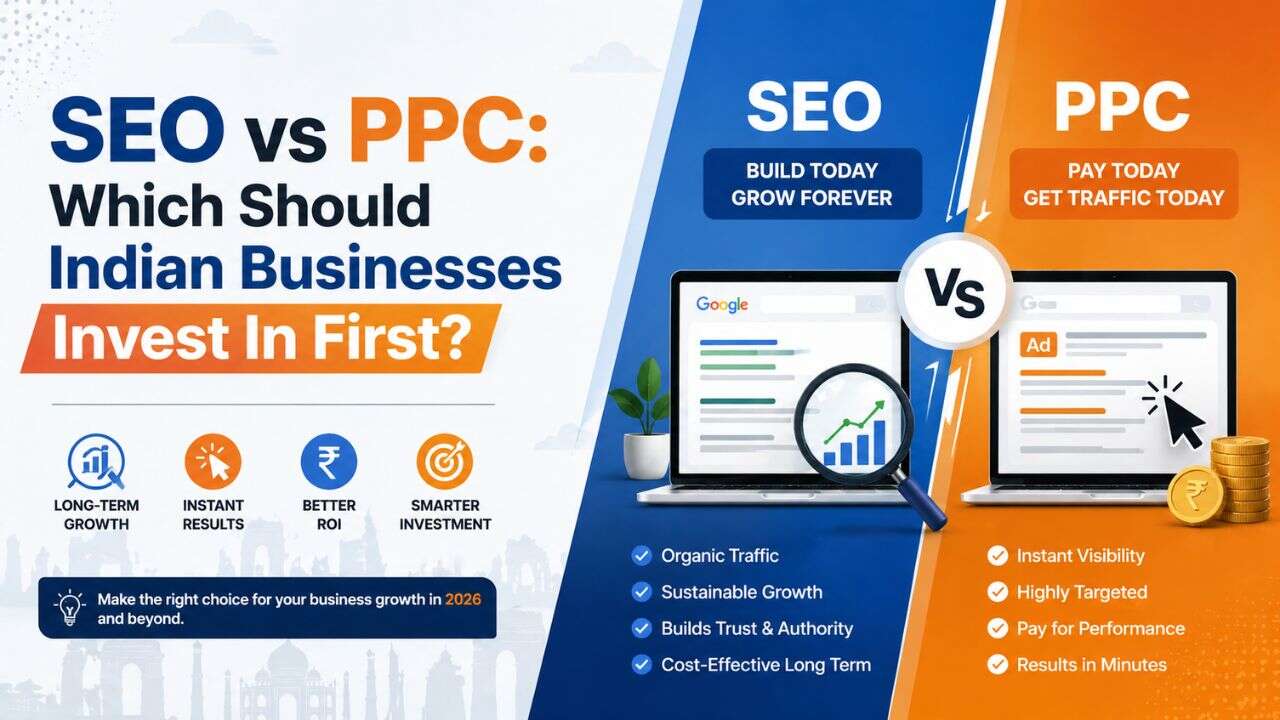
This is one of the most common questions we get from business owners across India.
You have a budget. You want traffic. You want leads. And you’ve been told that both SEO and Google Ads can deliver – but you can’t do everything at once, and you need to make a call.
Here’s the honest answer: it depends on your business, your timeline, and what you’re actually trying to achieve. But that’s not a cop-out – it’s the start of a framework that will help you make the right decision for your specific situation.
Let’s break down SEO vs PPC India 2026 properly, so you can invest in the right channel first.
Understanding What Each Channel Actually Does
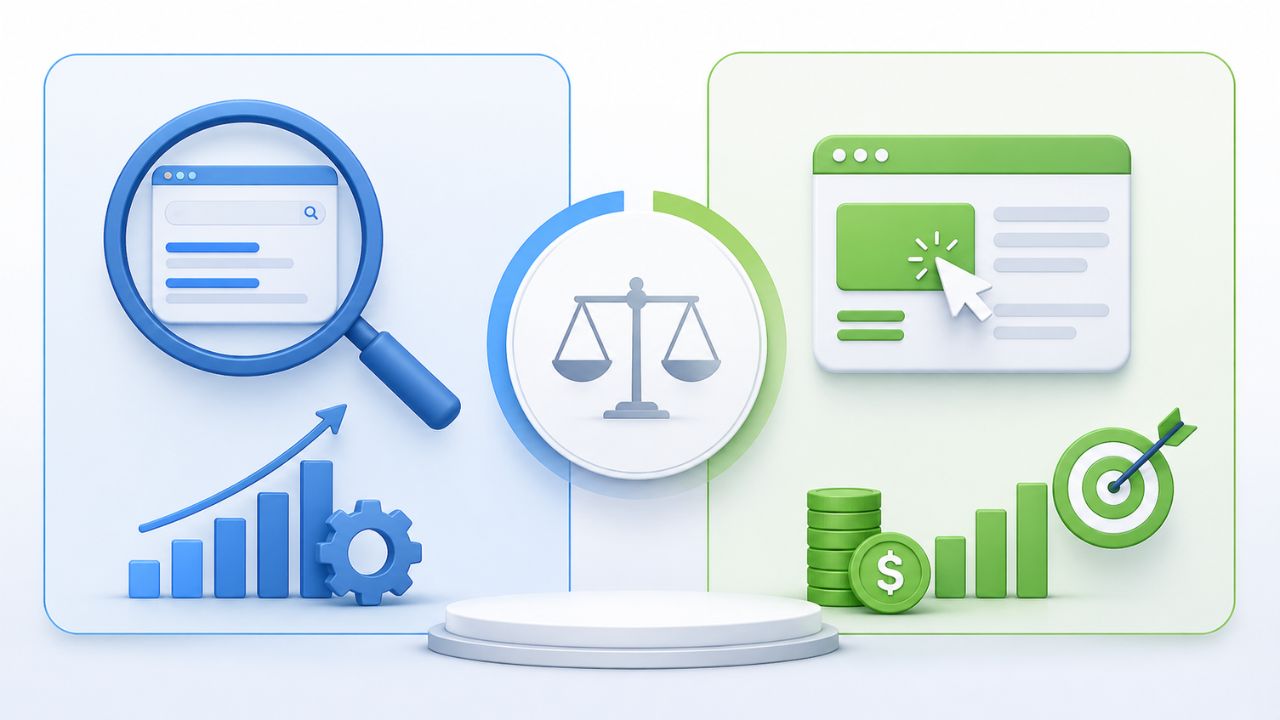
Before comparing them, let’s be clear about what you’re buying with each.
What PPC (Pay-Per-Click) Gives You
PPC – primarily Google Ads in the Indian market – puts you at the top of the search results page immediately. You set a budget, choose your keywords, write your ads, and you’re visible to searchers within hours.
What PPC does well:
- Immediate visibility for high-intent queries
- Precise targeting by keyword, location, device, and audience
- Full control over budget and timing
- Measurable cost-per-click and cost-per-conversion from day one
- Ability to test offers, copy, and landing pages quickly
The core limitation: the moment you stop spending, the traffic stops. PPC rents visibility – it doesn’t build it.
What SEO Gives You
SEO builds organic visibility over time. Through technical optimisation, content strategy, and earned authority, your pages climb the rankings for relevant search queries – and stay there without ongoing ad spend.
What SEO does well:
- Compounding returns – rankings that improve and sustain over time
- Lower long-term cost-per-acquisition vs. paid channels
- Authority and trust signals that paid ads can’t replicate
- Visibility in AI Overviews, featured snippets, and rich results
- Traffic that doesn’t stop when your budget does
The core limitation: SEO takes time. Meaningful results for most Indian businesses take 3–6 months, and competitive keywords often take 9–12 months to rank for.
The Business Case: When PPC Wins First
You Need Revenue Now
If your business is pre-revenue, just launched, or facing a cash crunch, waiting 6 months for SEO to deliver isn’t realistic. PPC gives you a channel you can activate this week and start generating leads or sales from.
This is the single clearest case for leading with PPC: when time-to-revenue is the primary constraint.
You’re Running a Time-Sensitive Campaign
Diwali sale. New product launch. Seasonal inventory you need to move. Events and deadlines don’t wait for organic rankings to mature. PPC lets you be visible at exactly the right moment, for exactly the right audience, without needing months of groundwork.
You’re Testing a New Market or Offer
Before investing in a long-term SEO content strategy, it’s smart to validate that people actually search for – and convert on – what you’re selling.
PPC lets you run keyword and offer tests quickly. If a paid campaign on a keyword doesn’t convert, an SEO campaign targeting the same keyword probably won’t either. This market intelligence is genuinely valuable before committing to organic content at scale.
The Business Case: When SEO Wins First
You Have a 12-Month Horizon
If your business is stable and you can afford to invest for 12 months before expecting significant organic returns, SEO will almost always deliver better ROI in the long run.
The compounding nature of organic search is the key. A well-optimised page that ranks today keeps generating traffic for years. The content you invest in today builds an asset – not a rental.
Your Cost-Per-Click Is Prohibitively High
In some Indian industries – finance, insurance, legal, real estate, and healthcare – CPCs on Google Ads have become extremely expensive. A single click in these categories can cost ₹200–₹800. At those rates, a meaningful paid campaign requires a very large budget to generate volume.
For businesses in high-CPC categories, SEO often represents the only realistic path to sustainable, scalable organic traffic. The investment in content and technical SEO, while significant, becomes far more economical than ongoing PPC spend at those rates.
You Want Brand Authority, Not Just Clicks
PPC drives clicks. It doesn’t build brand perception in the same way that organic visibility does.
When a potential customer sees your brand appearing in Google’s organic results, in AI Overviews, in featured snippets, and across buying guides and review content – that cumulative presence builds a level of trust and authority that a sponsored ad tag simply can’t replicate.
For businesses where trust is central to the buying decision – professional services, healthcare, financial advisory, premium products – organic visibility builds credibility that paid ads can’t buy.
SEO or PPC Which Is Better: The Honest Comparison
Rather than declaring a winner, here’s the realistic breakdown for organic vs paid search India in 2026:
| Factor | PPC | SEO |
| Time to first results | Days | 3–6 months |
| Cost structure | Ongoing (stops when budget stops) | Front-loaded, compounding returns |
| Best for | Short-term, time-sensitive, high-intent | Long-term authority, lower CPA over time |
| Trust signals | Lower (ad label visible) | Higher (organic = third-party endorsement) |
| AI search visibility | Google Ads placements | Organic results + AI Overviews |
| Scalability | Limited by budget | Compounds without proportional cost increase |
The digital marketing ROI calculus almost always favours SEO in the 18–36 month window. But PPC often wins in the first 6–12 months – especially for businesses without existing organic presence.
The Strategy Most Successful Indian Businesses Actually Use
Here’s what works in practice: not one or the other, but a deliberate sequence.
Phase 1: Lead with PPC While Building SEO (Months 1–6)
Use PPC to generate immediate revenue and traffic while your SEO foundation is being built. This ensures your business doesn’t starve during the organic ramp-up period. The PPC data also informs your SEO keyword and content strategy – you learn exactly which queries convert before committing to content clusters around them.
Phase 2: Shift Budget from PPC to SEO as Rankings Arrive (Months 6–12)
As your organic rankings start delivering traffic, reduce your PPC spend on the keywords you’re now ranking for organically. This is where the cost efficiency of SEO starts to materialise – you’re getting the same traffic at a fraction of the cost.
Reinvest the freed PPC budget into either new paid campaigns for keywords you haven’t ranked for yet, or into accelerating your content and link building strategy.
Phase 3: Operate Both Strategically Long-Term
- PPC handles new product launches, seasonal campaigns, and high-intent bottom-funnel queries where speed matters
- SEO owns the long-tail, informational, and commercial-intent keyword landscape – building compounding traffic that doesn’t require ongoing spend
The goal is never to replace one with the other. It’s to reduce your dependency on paid channels over time while building an organic asset that generates ROI independently.
What About AI Search in 2026?
This is the factor most businesses aren’t thinking about yet – and it changes the SEO vs PPC equation.
Google AI Overviews now appear above both organic results and paid ads for many queries. Being cited as a source in an AI Overview builds brand visibility without a click – and without a CPC charge.
This means SEO now delivers a form of brand exposure that PPC simply cannot access. A well-structured piece of content with proper schema markup can appear in AI Overviews across dozens of related queries – generating brand impressions at zero marginal cost.
In 2026, this AI visibility is one of the strongest arguments for investing in SEO earlier rather than later.
The Bottom Line
PPC and SEO answer different questions. PPC answers: “How do I get traffic today?” SEO answers: “How do I build an organic growth engine that compounds over time?”
For most Indian businesses, the right answer is to start both in parallel – with PPC taking the revenue weight in the short term and SEO building the long-term asset. As organic rankings mature, reduce PPC dependency and let the compounding returns from SEO carry more of the traffic load.
The businesses that win at digital marketing in India in 2026 aren’t choosing between SEO and PPC. They’re sequencing them correctly.
Want to Know the Right Mix for Your Business?
At BeSky Marketing, we help Indian businesses build digital marketing strategies that balance short-term revenue with long-term organic growth. Our approach to SEO ROI measurement in 2026 ensures every recommendation is tailored to your industry, competition level, and budget.
Frequently Asked Questions (FAQs)
Q1. Is SEO better than Google Ads for Indian businesses in 2026?
Neither is better-they serve different goals. PPC gives instant visibility, while SEO builds long-term traffic and stronger ROI over time. Most businesses benefit from using both together.
Q2. How much should I budget for SEO vs PPC in India?
Start with 60–70% PPC for quick results and 30–40% SEO for long-term growth. As SEO gains traction, gradually shift more budget toward organic.
Q3. Can I do just SEO without running any paid ads?
Yes, if you have time and budget patience. SEO takes 3-6 months to grow but offers lower long-term acquisition costs, especially in high-CPC industries.
Q4. Which channel delivers better ROI-SEO or PPC?
PPC performs better short-term, but SEO usually wins in long-term ROI. A mix of both, with gradual SEO focus, delivers the best results.
Q5. How does AI search affect the SEO vs PPC decision?
AI Overviews favor SEO by boosting organic visibility without cost. This makes early SEO investment more valuable in 2026 than before.
