
Here’s a conversation that happens in boardrooms across India every quarter.
Someone asks: “We’ve been doing SEO for six months. Is it actually working?”
And the SEO team opens a report full of keyword rankings, organic session counts, and domain authority scores – none of which answer the actual question, which is: how much revenue is organic traffic generating for this business?
This gap between SEO activity and business impact is why so many leadership teams undervalue organic search – and why so many SEO investments get cut before they reach their full potential.
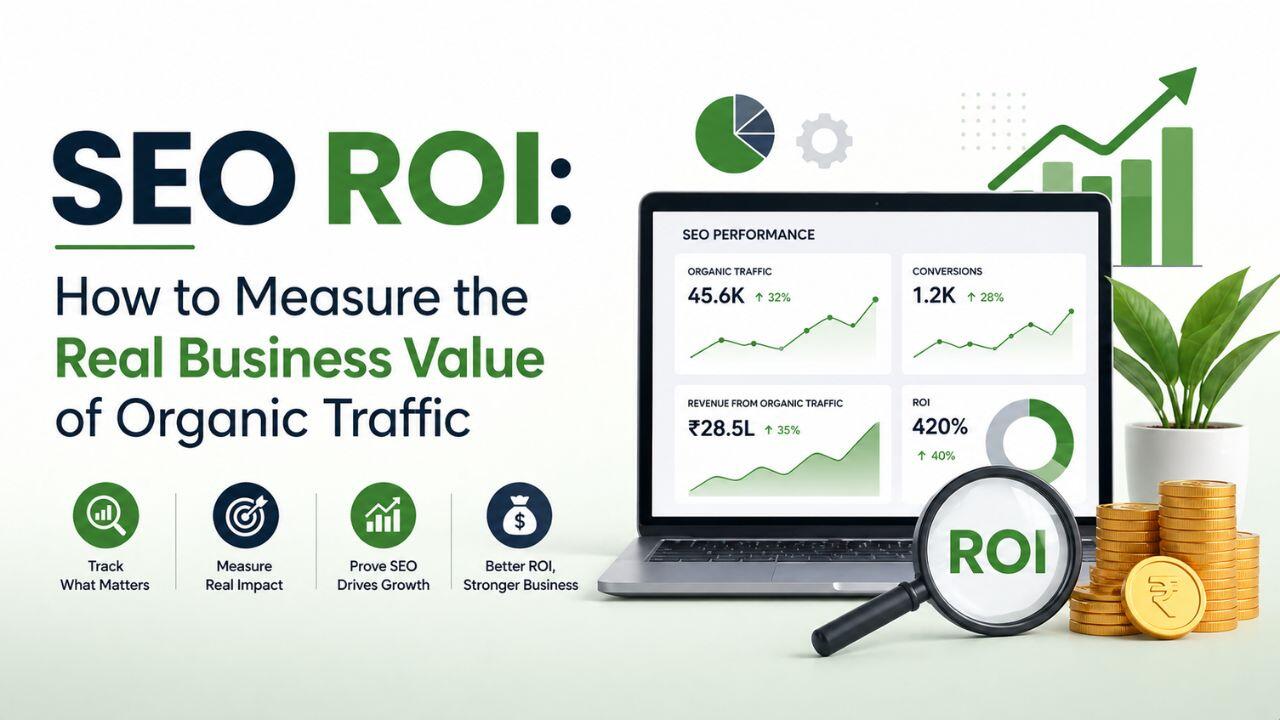
SEO ROI measurement in 2026 is not complicated. But it requires asking the right questions and tracking the right numbers. This blog shows you exactly how.
Why Most SEO Reports Don’t Actually Measure ROI
Let’s start with the uncomfortable truth.
Rankings are not revenue. Traffic is not revenue. Even leads are not revenue – until they close.
Most SEO ROI measurement 2026 reports are built around metrics that are easy to pull from Google Analytics or Search Console. Sessions, impressions, average position. These are useful leading indicators. They are not business results.
A site can rank #1 for 50 keywords and generate zero new customers – if those keywords attract the wrong audience, if the landing pages don’t convert, or if the business simply doesn’t have the infrastructure to handle inbound enquiries.
True SEO ROI connects organic traffic to actual business outcomes. That’s what we’re covering here.
The Right Framework: How to Measure SEO ROI

Step 1: Define What “Value” Means for Your Business
Before you measure anything, you need clarity on what SEO success actually looks like for your specific business model.
For an eCommerce store:
- Organic revenue (tracked in Google Analytics as organic channel attribution)
- Organic transactions and average order value from organic visitors
For a service business or B2B company:
- Organic-attributed leads (form fills, calls, demo requests)
- Organic-attributed pipeline value
- Closed revenue from organic leads (requires CRM integration)
For a content or media business:
- Organic sessions and engagement metrics
- Subscriber or lead capture rate from organic traffic
The definition of SEO ROI is different for every business. Get this alignment done with your leadership team before you build any measurement framework.
Step 2: Calculate the Cost of SEO
This sounds obvious but is frequently skipped. To calculate ROI, you need to know what you’re spending.
Include all of the following:
- Agency retainer or in-house SEO team salaries
- SEO tools (Ahrefs, Semrush, Screaming Frog, etc.)
- Content production costs (writers, designers, video)
- Link building costs
- Developer time for technical SEO fixes
Add these up monthly and annually. This is your SEO cost baseline. Everything you measure on the return side gets divided against this number.
Step 3: Calculate Organic Revenue or Lead Value
This is the core of how to measure SEO ROI – and where most businesses need to invest more attention.
For eCommerce: In Google Analytics 4, go to Reports → Acquisition → Traffic Acquisition. Filter by “Organic Search” as the session source. This shows you revenue, transactions, and conversion rate attributed to organic visitors.
For lead generation businesses:
- Set up conversion tracking for every form fill, call click, and chat initiation
- Assign a value to each conversion based on your average close rate and deal size
- For example: if your average deal is ₹2 lakh and you close 20% of leads, each organic lead has an expected value of ₹40,000
Tracking this consistently over time gives you a monthly organic value figure you can compare directly to your monthly SEO spend.
Step 4: Account for Organic Traffic Value vs. Paid Equivalent
One of the most useful – and most underused – ways to demonstrate organic traffic value is to calculate what the same traffic would cost if you were buying it through Google Ads.
The calculation:
- In Google Search Console, find your total monthly organic clicks
- For each keyword driving significant traffic, note the average CPC in Google Keyword Planner or Ahrefs
- Multiply: organic clicks × average CPC = estimated paid equivalent value
If your site receives 10,000 organic clicks per month, and the average CPC for those keywords is ₹45, your organic traffic is saving you approximately ₹4.5 lakh per month in ad spend.
This figure alone often justifies an entire SEO retainer – and it’s a number that resonates immediately with finance teams and leadership.
Step 5: Track SEO Business Results India – Over the Right Time Horizon
This is the most important thing about measuring SEO business results India – you have to measure over an appropriate time window.
SEO is a compounding investment. Month 1 results look modest. Month 6 results look promising. Month 12 results often look transformational.
A business that measures SEO ROI at the 90-day mark and concludes it’s not working is making the same mistake as a farmer who plants seeds in March and digs them up in April to check if anything has grown.
Measure monthly. Evaluate quarterly. Judge the investment at 12 months.
Build a simple month-over-month tracking table:
- Organic sessions
- Organic conversions (leads or revenue)
- Organic revenue or estimated lead value
- Paid traffic equivalent value saved
- Monthly SEO spend
- Running ROI %
At 12 months, you’ll have a genuinely meaningful picture of whether the investment is working – and at what rate it’s compounding.
Metrics That Actually Tell the SEO Story in 2026
In 2026, with Google AI Overviews reducing clicks on some query types, the traditional traffic-as-success model has limitations. Here are the metrics that give a more complete picture:
Revenue and Commercial Metrics
- Organic revenue – tracked directly in GA4
- Organic-attributed leads – tracked through conversion events
- Cost per organic lead – total SEO spend ÷ organic leads
- Organic conversion rate – are organic visitors actually converting?
Visibility Metrics
- Total impressions in Search Console – your share of mind in Google search, even on zero-click queries
- AI Overview appearances – is your brand being cited as a source in AI-generated answers?
- Branded search volume – are more people searching directly for your brand after seeing you in organic results?
Efficiency Metrics
- Organic traffic equivalent value – what you’d spend on paid to match this traffic
- Revenue per organic session – how much value each organic visit generates on average
Common Mistakes That Distort SEO ROI Calculations
Attributing Everything to the Last Click
Most analytics tools default to last-click attribution – which means if a user first finds you through organic search, browses, leaves, and then returns via a paid ad before buying, the revenue goes to the paid channel.
Organic search frequently initiates the customer journey even when it doesn’t close it. Use multi-touch attribution models in GA4 to see organic search’s role at the top and middle of the funnel.
Not Separating Branded and Non-Branded Traffic
Branded searches (people searching your company name) inflate organic traffic numbers without representing new customer acquisition. Filter branded terms separately to understand how much non-branded organic traffic – which represents genuine new reach – you’re generating.
Measuring the Wrong Keywords
Rankings for keywords that your customers don’t actually search for aren’t moving your business forward. Align your keyword strategy to your buyer journey – and measure performance for the keywords that your actual buyers use, not just the ones that are easiest to rank for.
What Good SEO ROI Looks Like in Practice

At BeSky Marketing, we’ve seen well-executed SEO strategies deliver:
- 3:1 to 6:1 ROI within 12 months for eCommerce brands in competitive Indian niches
- ₹15–₹40 lakh in organic revenue from stores that had zero organic channel six months earlier
- 60–80% reduction in cost-per-lead for service businesses that built content clusters around their core offering
These aren’t outliers. They’re what happens when SEO strategy is connected to business outcomes from the start – and when leadership gives the investment the time it needs to compound.
The Bottom Line
SEO ROI is not a mystery. It’s a measurement discipline.
The businesses getting the most value from organic search in 2026 aren’t necessarily the ones spending the most on SEO. They’re the ones who defined what success looks like, built the tracking infrastructure to measure it, and gave the investment long enough to work.
Start measuring. The data will tell you everything you need to know.
Ready to Understand the ROI of Your SEO Investment?
Frequently Asked Questions (FAQs)
Q1. What is a good ROI for SEO in India?
A strong SEO strategy should show positive ROI within 6–12 months. eCommerce can see 3:1 to 6:1 returns, while service businesses may take longer but deliver higher lifetime value.
Q2. How do I calculate the value of my organic traffic?
Multiply monthly organic clicks by average CPC to estimate paid traffic value. You can also track direct organic revenue using Google Analytics 4 for more accuracy.
Q3. How long does it take for SEO to show positive ROI?
SEO usually starts showing results in 3–6 months, with clear ROI by 9–12 months. Timelines depend on competition, content consistency, and technical setup.
Q4. Should I include content costs in my SEO ROI calculation?
Yes, always include content costs like writing, design, and production. This ensures your ROI reflects the true investment in your SEO strategy.
Q5. How is measuring SEO ROI different in 2026 vs. earlier years?
In 2026, focus goes beyond clicks to impressions, AI visibility, and brand searches. Zero-click searches mean visibility and authority matter as much as traffic.
