
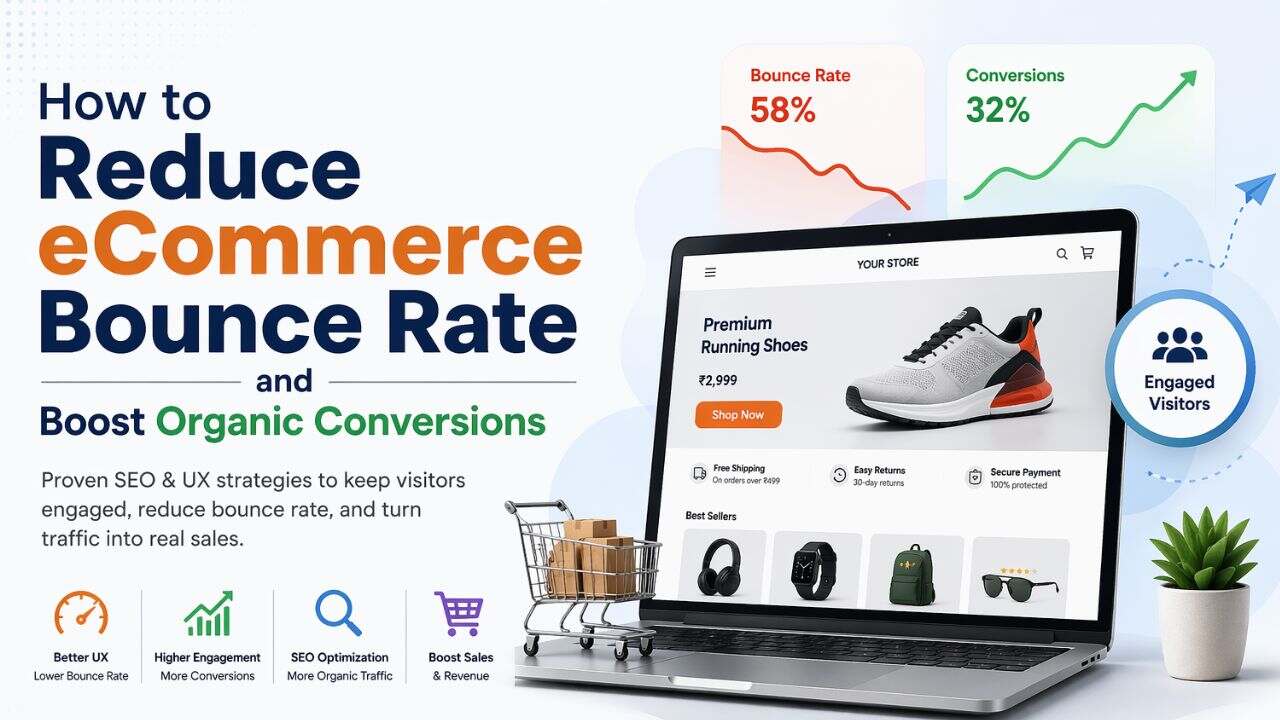
If you’re getting traffic but not sales, your problem isn’t visibility-it’s behavior.
Users are landing on your store and leaving without taking action. That’s your bounce rate talking. And in 2026, with AI-driven search sending more qualified but impatient traffic, fixing this isn’t optional anymore.
This guide breaks down exactly how to reduce ecommerce bounce rate SEO-style and turn that traffic into real conversions.
Why Bounce Rate Matters More in 2026
Search has changed.
If they bounce, it’s not random-it’s a mismatch.
Common reasons:
- Page doesn’t match search intent
- Slow load times
- Weak product presentation
- Lack of trust signals
Reducing bounce rate is no longer just UX-it’s ecommerce conversion SEO.
1. Match Search Intent Immediately (First 5 Seconds Rule)
When a user lands on your page, they should instantly feel:
“Yes, this is exactly what I was looking for.”
If that doesn’t happen in 5 seconds, they leave.
How to fix it:
- Use clear H1 headlines with the keyword
- Show product relevance above the fold
- Avoid generic intros-get straight to the point
Example: Instead of:
“Welcome to our collection of premium products…”
Use:
“Best Running Shoes Under ₹3000 – Lightweight, Durable & Affordable”
That’s how you reduce friction instantly.
2. Improve Page Speed (Non-Negotiable in 2026)
Slow sites kill conversions.
Even a 1-second delay can increase bounce rate significantly. With mobile-first indexing and AI search, speed is directly tied to rankings and user retention.
Quick wins:
- Compress images (WebP format)
- Use lazy loading
- Remove unnecessary plugins
- Use a CDN
Target:
- LCP under 2.5 seconds
- Fully interactive under 3.5 seconds
This is one of the fastest ways to fix your bounce rate fix problem.
3. Make Product Pages Feel Like Landing Pages
Most eCommerce stores treat product pages like listings.
That’s a mistake.
In 2026, every product page should function like a conversion-focused landing page.
Must-have elements:
- Clear product title with keyword
- Benefit-driven description (not just specs)
- High-quality images (multiple angles)
- Short bullet points for quick scanning
- Visible pricing and availability
Add this for better engagement:
- FAQs
- Comparison tables
- Use-case scenarios
The more clarity you provide, the lower your bounce rate.
4. Use Above-the-Fold Trust Signals
Users don’t trust easily anymore.
If your page doesn’t feel credible instantly, they leave-even if your product is perfect.
Add these above the fold:
- Star ratings
- Reviews count
- “Trusted by X customers”
- Secure payment icons
- Easy return policy
These signals reduce hesitation and improve organic traffic conversion 2026 performance.
5. Fix Weak Category Pages (Biggest Missed Opportunity)
Category pages often bring the most traffic-but perform the worst.
Why? Because they’re usually empty.
Optimise your category pages:
- Add 150–300 words of helpful intro content
- Use clear headings with keywords
- Add internal links to products
- Include filters that actually help
Bonus:
- Add short FAQs
- Highlight best-selling products
A well-optimised category page can drastically improve ecommerce conversion SEO.
6. Improve Internal Linking (Guide the User)
If users don’t know where to go next, they leave.
Simple.
Smart internal linking:
- Link blogs → product pages
- Link product pages → related items
- Add “You may also like” sections
Keep it natural:
Don’t force links-guide the journey.
This keeps users exploring your site longer and reduces bounce rate.
7. Write Content That Actually Helps (Not Just Ranks)
Content in 2026 isn’t about stuffing keywords-it’s about solving problems fast.
What works now:
- Short, clear answers
- Scannable sections
- Real-world use cases
Example:
Instead of writing:
“This product is made of high-quality material…”
Say:
“Perfect for daily use-lightweight, durable, and easy to carry.”
That’s how you keep users engaged.
8. Optimize for AI Overviews & Snippets
AI search is pulling answers directly from content.
If your content is structured properly, you get visibility and better engagement.
Do this:
- Answer questions in first 50–60 words
- Use bullet points and lists
- Add FAQ sections
- Keep sentences simple and direct
This improves both visibility and organic traffic conversion 2026.
9. Reduce Visual Clutter
More elements ≠ better experience.
Too many popups, banners, and distractions increase bounce rate.
Clean UX wins:
- Limit popups (especially on mobile)
- Use whitespace effectively
- Keep design simple and focused
Your goal is clarity, not complexity.
10. Use Exit Intent & Smart Retargeting
Not every visitor will convert immediately.
But you can still capture them.
Smart tactics:
- Exit-intent popups (discounts, offers)
- Email capture forms
- Retargeting ads
This turns “lost traffic” into future conversions.
The Real Strategy: Combine SEO + UX
Reducing bounce rate isn’t one fix-it’s a system.
You need:
- Technical performance (speed, structure)
- Content clarity (intent matching)
- Trust signals (credibility)
- User flow (navigation + linking)
When all of these work together, bounce rate drops-and conversions rise.
Quick Checklist: Bounce Rate Fix for eCommerce
Use this as a quick audit:
- Page loads under 3 seconds
- Clear headline matches search intent
- Strong product visuals
- Trust signals visible above the fold
- Internal links guide user journey
- Content is scannable and helpful
- Category pages are optimized
- Minimal distractions
Most stores miss at least half of these.
Final Thoughts
If your traffic is increasing but sales aren’t, the issue isn’t SEO-it’s conversion. With BeSky Marketing, you can turn that traffic into measurable growth.
Fixing bounce rate is one of the highest ROI moves you can make in 2026 – and it’s exactly where BeSky Marketing helps you win.
Focus on:
- User intent
- Page experience
- Content clarity
Do that consistently, and your store won’t just rank-it will convert.
Frequently Asked Questions (FAQs)
Q1. What is a good bounce rate for eCommerce in 2026?
A good bounce rate is typically between 30%–50%. Higher than that indicates poor user experience or intent mismatch.
Q2. How does bounce rate affect SEO?
While not a direct ranking factor, high bounce rates signal poor engagement, which can impact rankings indirectly.
Q3. What is the fastest way to reduce bounce rate?
Improve page speed and match search intent immediately-these deliver the quickest results.
Q4. Do product pages affect bounce rate the most?
Yes. Product and category pages usually have the biggest impact on bounce rate and conversions.
Q5. How can I improve organic traffic conversion in 2026?
Focus on intent-driven content, fast-loading pages, trust signals, and clear user journeys.
