
Here’s a question worth sitting with for a moment.
Two eCommerce stores. Same product. Same keyword ranking. Same position on page one of Google.
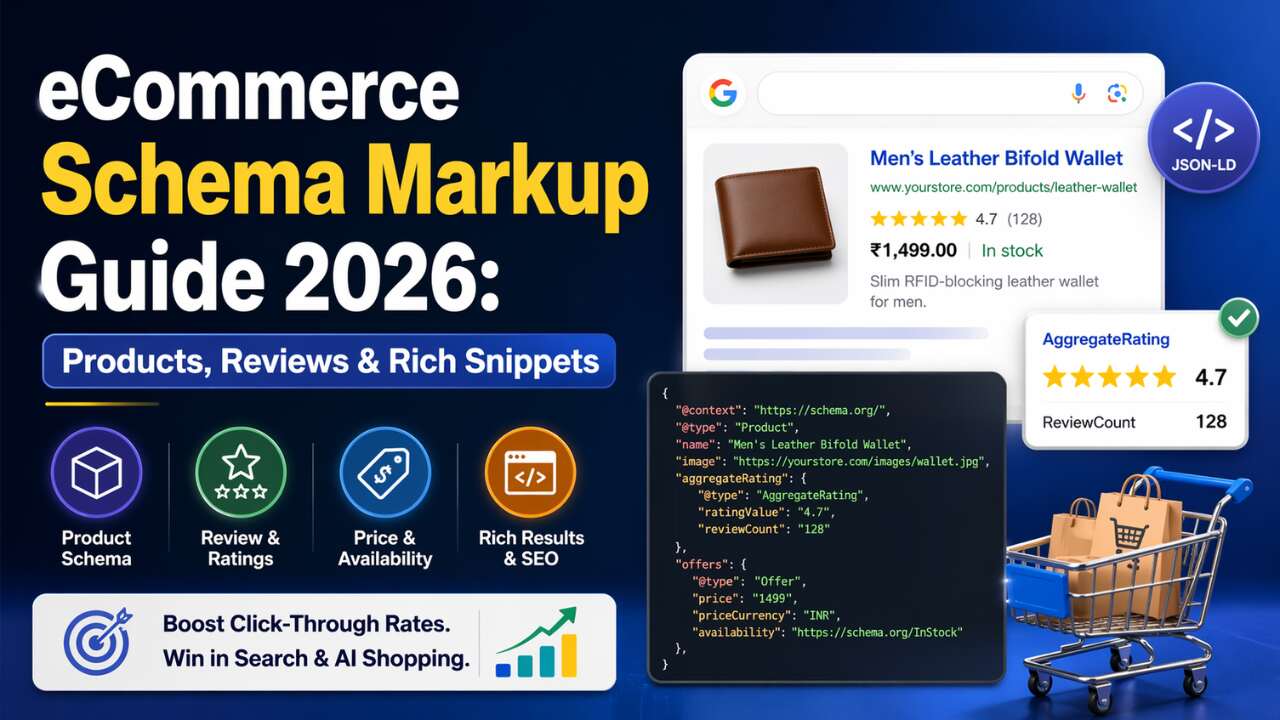
One result shows a plain blue link with a short description. The other shows star ratings, price, stock availability, and a featured badge- all directly on the search results page.
Which one do you click?
That difference- the one that earns the click before the visitor even reaches your website- is schema markup. And in 2026, it’s not a nice-to-have. It’s one of the most impactful, most underused tools in eCommerce SEO.
This guide breaks down exactly what schema markup ecommerce 2026 looks like, which types matter most, and how to implement them in a way that feeds both Google’s traditional results and its AI-powered shopping features.
What Is Schema Markup- And Why Does It Matter More in 2026?
Schema markup is structured data code- typically written in JSON-LD format- that you add to your web pages to help Google understand exactly what’s on them.
Without a schema, Google has to guess. It reads your page content and makes inferences about what you’re selling, what it costs, whether it’s in stock, and how customers rate it. Sometimes it guesses right. Often, it doesn’t have enough confidence to show rich results.
With schema, you tell Google directly. No guessing required.
In 2026, this matters for two distinct reasons.
First, rich results. Google uses structured data to generate enhanced search listings- star ratings, pricing, availability, FAQs- that stand out visually on the SERP and drive significantly higher click-through rates.
Second, AI shopping features. Google’s AI Overviews and Shopping Graph now pull directly from structured data to generate product comparisons, shopping summaries, and recommendation panels. If your ecommerce structured data is missing or incomplete, your products simply don’t appear in those AI-generated results- regardless of your organic rankings.
The Schema Types Every eCommerce Store Needs
1. Product Schema- The Non-Negotiable Foundation
Product schema is the core structured data type for any e-commerce store. It tells Google everything it needs to know about a specific item.
At a minimum, every product page should include:
- name– the product name
- description– a short, accurate product description
- image– at least one high-quality product image URL
- brand– the brand name
- sku– your internal product identifier
- offers– nested Offer schema containing price, currency, availability, and URL
Here’s what a basic product schema JSON-LD looks like:
json
{
“@context”: “https://schema.org/”,
“@type”: “Product”,
“name”: “Men’s Leather Bifold Wallet”,
“image”: “https://yourstore.com/images/wallet.jpg”,
“description”: “Slim RFID-blocking leather wallet for men.”,
“brand”: {
“@type”: “Brand”,
“name”: “YourBrand”
},
“sku”: “WALLET-001”,
“offers”: {
“@type”: “Offer”,
“url”: “https://yourstore.com/products/leather-wallet”,
“priceCurrency”: “INR”,
“price”: “1499”,
“availability”: “https://schema.org/InStock”
}
}
This is the baseline. Once this is in place, Google can display your product’s price and availability directly in search results- without the user needing to click through to find out.
2. AggregateRating Schema- Unlock Star Ratings on the SERP
Review schema rich snippets are the single biggest visual upgrade a product page can get in search results.
When you implement AggregateRating schema correctly, Google can display your product’s star rating- and review count- directly on the SERP. This does two things: it dramatically increases trust at first glance, and it consistently lifts click-through rates.
Add this inside your Product schema:
json
“aggregateRating”: {
“@type”: “AggregateRating”,
“ratingValue”: “4.7”,
“reviewCount”: “128”
}
One important rule: the rating values in your schema must match what’s actually displayed on your product page. Google cross-checks this. Mismatches result in penalties and loss of rich result eligibility.
3. Review Schema- Individual Reviews for Deeper Trust Signals
Beyond the aggregate rating, you can mark up individual customer reviews using Review schema. This gives Google rich, verifiable trust signals at the individual review level- not just the summary score.
json
“review”: {
“@type”: “Review”,
“reviewRating”: {
“@type”: “Rating”,
“ratingValue”: “5”
},
“author”: {
“@type”: “Person”,
“name”: “Rahul S.”
},
“reviewBody”: “Great quality wallet. Exactly as described.”
}
In 2026, individual review schema also strengthens your E-E-A-T signals– showing Google that real people have used and verified your product. This feeds directly into AI shopping recommendation quality.
4. BreadcrumbList Schema- Site Structure for Google and AI
BreadcrumbList schema tells Google how your site is structured- which category a product belongs to, how it nests within your catalogue hierarchy.
This matters for two reasons. It generates cleaner, more informative breadcrumb displays in search results. And it helps Google’s AI features understand your product catalogue well enough to include your items in relevant category comparisons.
json
{
“@context”: “https://schema.org”,
“@type”: “BreadcrumbList”,
“itemListElement”: [
{“@type”: “ListItem”, “position”: 1, “name”: “Home”, “item”: “https://yourstore.com”},
{“@type”: “ListItem”, “position”: 2, “name”: “Wallets”, “item”: “https://yourstore.com/wallets”},
{“@type”: “ListItem”, “position”: 3, “name”: “Men’s Leather Bifold Wallet”}
]
}
5. FAQPage Schema- Capture People Also Ask Boxes
Adding FAQ sections to your product and category pages- and marking them up with FAQPage schema- targets the People Also Ask boxes that appear for many product-related searches.
json
{
“@context”: “https://schema.org”,
“@type”: “FAQPage”,
“mainEntity”: [{
“@type”: “Question”,
“name”: “Is this wallet RFID blocking?”,
“acceptedAnswer”: {
“@type”: “Answer”,
“text”: “Yes, this wallet features full RFID blocking to protect your cards.”
}
}]
}
PAA boxes are one of the few SERP features that still drive consistent clicks in 2026- even in a zero-click search environment. FAQPage schema is one of the fastest wins available to eCommerce stores.
6. ItemList Schema- For Category and Collection Pages
ItemList schema is specifically for category and collection pages- the most underused schema type in eCommerce.
It tells Google exactly which products are in a collection, with names, URLs, and images, so Google can surface the entire collection in Shopping panels and AI product comparison features.
json
{
“@context”: “https://schema.org”,
“@type”: “ItemList”,
“itemListElement”: [
{“@type”: “ListItem”, “position”: 1, “url”: “https://yourstore.com/products/wallet-1”},
{“@type”: “ListItem”, “position”: 2, “url”: “https://yourstore.com/products/wallet-2”}
]
}
If your category pages don’t have ItemList schema, Google’s AI shopping features have no structured way to understand what your collection contains.
How to Implement Schema Markup in 2026

For Shopify Stores
Most modern Shopify themes include basic Product schema by default- but it’s rarely complete. Check your theme’s output using Google’s Rich Results Test (search.google.com/test/rich-results).
For more comprehensive schema implementation, use Schema App or JSON-LD for SEO– both are Shopify-compatible apps that give you full control over every schema type.
For WooCommerce Stores
Rank Math Pro and Schema Pro are the two best options for WooCommerce. Rank Math handles Product, Review, FAQ, and Breadcrumb schema automatically when configured correctly. Schema Pro offers more granular control for stores with complex catalogue structures.
Always Verify After Implementation
After adding any schema markup, run every key page through:
- Google Rich Results Test– checks for errors and previews eligible rich results
- Google Search Console → Enhancements– monitors rich result performance at scale
- Schema Markup Validator (validator.schema.org)- checks for structural errors
Never assume the schema is working without verification. A single syntax error can invalidate the entire schema block- and you won’t know unless you check.
Schema Markup and AI Shopping SEO in 2026
Here’s the part that’s still not widely understood.
Google’s AI Overviews and Shopping Graph don’t just use schema to generate rich results. They use it to decide which products to recommend in AI-generated shopping summaries.
When a user asks Google, “best leather wallets under ₹2000 in India,” the AI doesn’t just check organic rankings. It checks which products have complete, accurate, structured data- and builds its recommendation from those sources.
The Bottom Line
Schema markup is no longer an advanced SEO tactic. In 2026, it’s a baseline requirement for any eCommerce store that wants to compete in both traditional search results and AI-powered product discovery.
The implementation investment is one-time. The benefits- higher CTR, rich result eligibility, AI shopping visibility- compound every single month.
Then watch what happens to your click-through rates.
Want Schema Markup Implemented Across Your eCommerce Store?
At BeSky Marketing, we implement complete structured data strategies for eCommerce stores- from product and review schema to category-level ItemList markup and AI shopping readiness. Every implementation is verified, tested, and monitored for rich result performance.
Frequently Asked Questions (FAQs)
Q1. What is schema markup, and why does it matter for eCommerce in 2026?
Schema markup is structured data (usually JSON-LD) that helps Google understand your pages. In 2026, it enables rich results, improves CTR, and powers AI shopping features.
Q2. What is the difference between Product schema and Offer schema?
Product schema describes the item (name, image, brand), while Offer schema adds pricing, availability, and purchase details. Both are needed for rich results.
Q3. Do star ratings in Google search results come from schema markup?
Yes. Star ratings come from AggregateRating schema, which shows product ratings and review count in search results.
Q4. What is JSON-LD and is it the best format for eCommerce schema?
JSON-LD is Google’s recommended schema format. It’s easy to implement, manage, and widely used for eCommerce structured data.
Q5. How do I know if my schema markup is working correctly?
Use Google’s Rich Results Test and Search Console to check errors, eligibility, and performance of your schema markup.
