
If you’ve been doing SEO for a while, you already know that stuffing a page with keywords stopped working a long time ago.
But here’s what a lot of marketers are still missing in 2026: Google isn’t just rewarding good pages anymore – it’s rewarding authoritative topics.
And with AI search tools like Google AI Overviews, ChatGPT Search, and Perplexity now deciding who gets cited and who gets ignored, topical authority SEO 2026 has become the single biggest differentiator between brands that grow and brands that disappear.
Let’s break down what topical authority actually means today, how to build it strategically, and why AI search tools are obsessed with it.
What Is Topical Authority – And Why It’s Different in 2026
Topical authority is Google’s (and AI’s) measure of how deeply and comprehensively a website covers a particular subject area.
It’s not about having one perfect blog post. It’s about owning an entire conversation – across multiple pages, multiple angles, and multiple formats.
Think of it this way: if someone asked 50 questions about SEO, could your website answer all of them well? If yes, you have topical authority. If you’ve only written about 5 of those questions, you don’t – even if those 5 posts are excellent.
Why AI Search Tools Specifically Reward Topical Depth
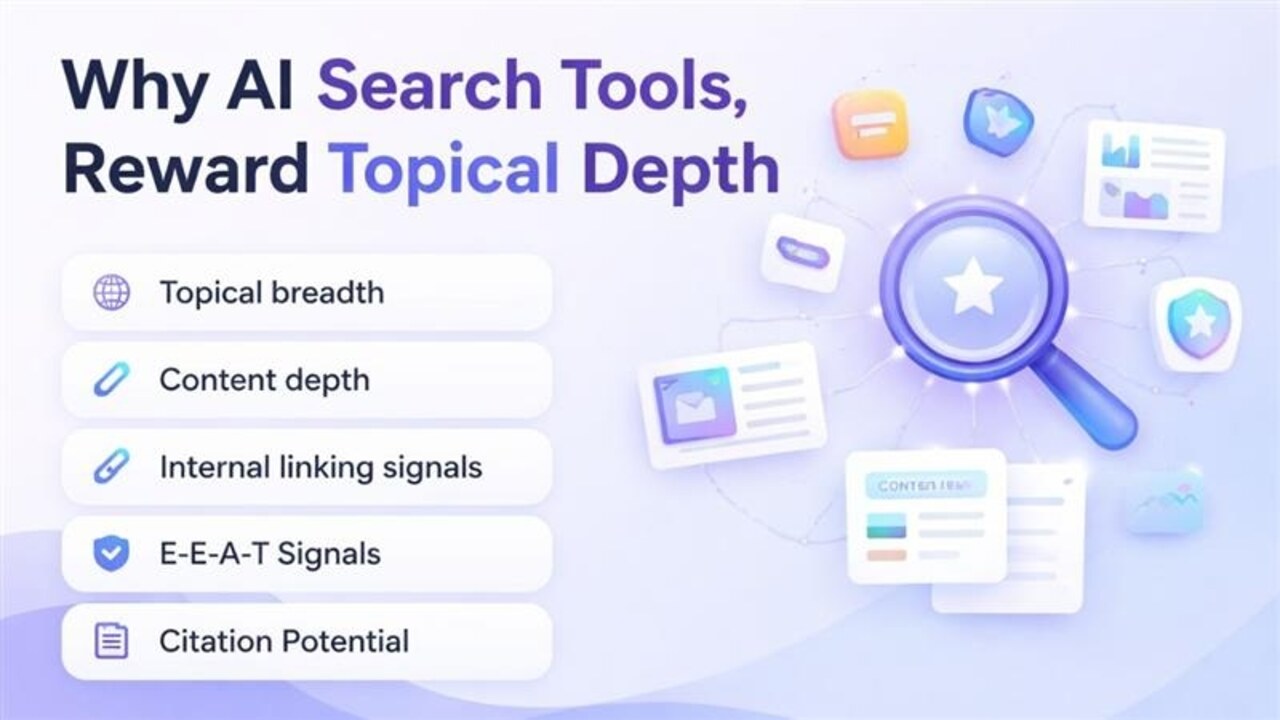
This is where AI search topical depth becomes a concept every marketer needs to understand.
When a user asks ChatGPT or Perplexity a question, the AI doesn’t search for one answer. It looks for sources that have demonstrated authority on the full topic – not just the question being asked right now.
Here’s what AI search engines are evaluating:
- Topical breadth – Does this site cover the subject from multiple angles?
- Content depth – Are the individual pieces thorough and well-researched?
- Internal linking signals – Are related pages connected in a logical structure?
- E-E-A-T signals – Is there real expertise and authorship behind the content?
- Citation potential – Is the content structured so an AI can easily extract and quote it?
Brands that win in AI search aren’t just ranking for keywords. They’re being cited as sources. And that only happens when your content signals comprehensive topical authority – not scattered, surface-level coverage.
The Role of Content Clusters in Building Topical Authority
You can’t build topical authority with standalone blog posts. You need a cluster strategy – and in 2026, this is non-negotiable.
Content clusters 2026 work on a simple principle:
- One pillar page covers a broad topic in depth (e.g., “The Complete Guide to SEO in 2026”)
- Multiple cluster blogs go deep on specific subtopics (e.g., this blog on topical authority)
- Every cluster blog links back to the pillar – and the pillar links out to each cluster
This structure does two things simultaneously. First, it tells Google that your site has serious depth on the subject. Second, it tells AI models that your content ecosystem is organized, connected, and trustworthy.
What a Strong Cluster Looks Like
Let’s say your pillar is about SEO strategy in 2026. Your cluster blogs might cover:
- GEO vs SEO: What’s the difference?
- How to optimize for Google AI Overviews
- Topical authority SEO 2026
- E-E-A-T: What it means and how to build it
- How to track AI search visibility
- Technical SEO checklist for 2026
Each of these feeds authority back to the pillar. Together, they build a web of expertise that’s hard for competitors to replicate quickly.
How to Build Topical Authority in 2026 – Step by Step
Let’s get practical. Here’s how to build topical authority the right way this year.
Step 1: Choose Your Core Topics Intentionally
Don’t try to own everything. Pick 2–3 topic areas that align with your business and your audience’s real questions. Trying to be authoritative on 10 different subjects will dilute your efforts.
Use tools like Google Search Console, Semrush, or Ahrefs to identify the topic clusters where you already have some traction – then go deeper, not wider.
Step 2: Map Out Your Content Gaps
Look at what your competitors are ranking for in your chosen topic area. Then look at what you’re missing.
Every unanswered question in your niche is a gap. Every gap is an opportunity. Build your cluster to fill every reasonable question your target audience has – before they go looking for answers elsewhere.
Step 3: Write for Depth, Not Just Length
Word count alone doesn’t build topical authority. What matters is how fully you answer the question.
A great cluster blog in 2026:
- Defines the concept clearly at the start
- Uses real data, examples, or case studies to back up claims
- Addresses follow-up questions the reader might have
- Links to related content within your own cluster
- Cites external authoritative sources where relevant
Avoid the trap of writing thin content just to fill a cluster. One mediocre blog in your cluster weakens the entire structure.
Step 4: Optimize Your Internal Linking Architecture
This is one of the most underrated steps in building topical authority – and one of the most impactful.
Every cluster blog should:
- Link to the pillar page (anchor text matters – use descriptive, keyword-rich phrases)
- Link to 2–3 related cluster blogs
- Receive links from the pillar page
This creates a content web that search engines and AI models can navigate clearly. It signals that your coverage isn’t accidental – it’s structured and intentional.
Step 5: Establish Clear E-E-A-T Signals
Experience. Expertise. Authoritativeness. Trustworthiness.
AI search tools heavily weight E-E-A-T when deciding what to cite. To build this into your content:
- Add author bios with real credentials and experience
- Include data-backed claims with source citations
- Showcase case studies or first-hand results
- Keep content updated – outdated information kills trust signals fast
At BeSky Marketing, every piece of content we produce includes author attribution, real-world data, and a consistent internal linking structure – because these signals directly impact how AI tools perceive your site’s authority.
Step 6: Track Your Topical Authority Growth
You can’t manage what you don’t measure. Use these signals to track progress:
- Keyword rankings across your cluster – Are cluster pages ranking for their target keywords?
- Organic traffic distribution – Is traffic spreading across your cluster, or concentrated on one page?
- AI citations – Tools like Brandwatch or Mention.com can flag when AI tools reference your content
- Crawl coverage – Use Screaming Frog or Sitebulb to ensure all cluster pages are being crawled and indexed efficiently
Common Mistakes That Destroy Topical Authority
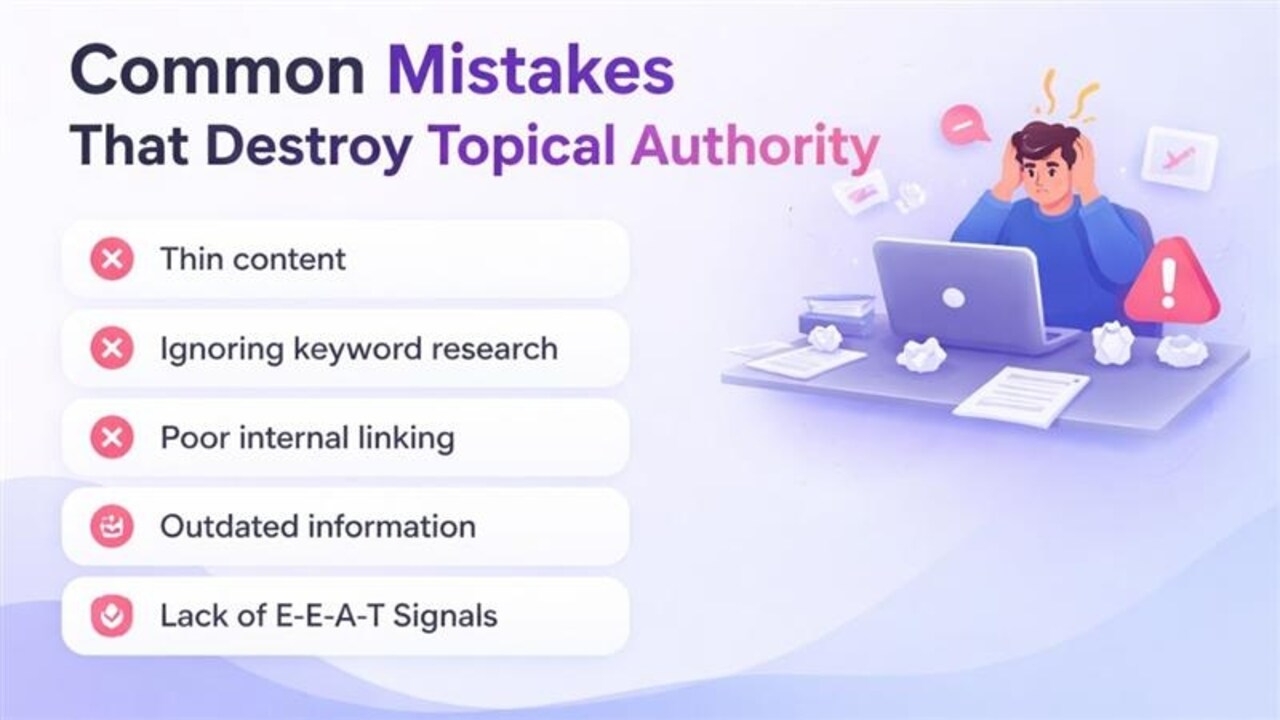
Even well-intentioned content strategies fall apart because of a few recurring mistakes. Watch out for these:
- Publishing too broadly – Covering 10 different topic areas shallowly instead of 2–3 deeply
- Ignoring internal linking – Cluster pages that don’t link to each other send no authority signals
- Writing for robots, not readers – Keyword-stuffed, unreadable content hurts E-E-A-T and user engagement
- Never updating old content – Stale content loses trust signals over time
- No clear pillar structure – Cluster blogs that float without a connected pillar waste their link equity
Topical Authority Is Your Long-Term Competitive Moat
Here’s the honest truth about building topical authority in 2026: it takes time. You won’t see full results in a week or a month.
But that’s actually the point.
The brands investing in topical authority today are building the competitive moat that will protect their search visibility for the next 3–5 years – regardless of how AI search continues to evolve.
At BeSky Marketing, we build content cluster strategies that are designed for exactly this kind of long-term growth. Not just rankings – actual authority.
FAQs – Topical Authority SEO 2026
Q1: How long does it take to build topical authority?
It typically takes 3–6 months to see meaningful movement, depending on your domain authority and how consistently you’re publishing cluster content. Established domains with existing content can see faster results.
Q2: How many cluster blogs do I need per pillar?
There’s no magic number, but a strong cluster usually has 6–15 supporting blog posts. What matters more than quantity is coverage – are you answering every key question within the topic?
Q3: Does topical authority help with AI search citations?
Yes, directly. AI tools like Perplexity, ChatGPT Search, and Google AI Overviews prioritize sources with demonstrated topical depth when selecting content to cite in their answers.
Q4: Can a new website build topical authority?
Absolutely. In fact, new sites can build topical authority faster than older sites that have published inconsistently across too many topics. Focus on one niche, go deep, and build your cluster structure from day one.
Q5: What’s the difference between topical authority and domain authority?
Domain authority is a third-party metric measuring the overall strength of your backlink profile. Topical authority is about how comprehensively you cover a specific subject. You can have low domain authority but high topical authority in a niche – and still rank well.
