Your brand could be invisible in AI search – and you wouldn’t even know it.
With ChatGPT, Perplexity, and Google’s AI Overviews now answering millions of queries daily, traditional rank trackers are blind to what actually matters. If an LLM never mentions your brand, you’re losing traffic you never even see in your analytics.
That’s why AI search visibility tracking tools 2026 have become non-negotiable for serious SEO professionals and agency owners.
This guide breaks down the best platforms available right now – with honest comparisons, use cases, and what to look for before you invest.
Why Your Current SEO Stack Can’t Track AI Visibility
Most rank trackers were built for a ten-blue-links world. They measure Google positions – not whether GPT-4 or Gemini is citing your client’s brand in a response.
The gap this creates:
- No visibility into LLM-generated answers (ChatGPT, Perplexity, Copilot)
- Zero tracking for AI Overviews citations
- No data on brand mentions vs. brand rankings
- No GEO (Generative Engine Optimization) tracking layer
For agency owners managing multiple clients, this blind spot is a liability. You need tools built specifically for the LLM era.
Quick Stat: According to SparkToro’s 2025 research, zero-click searches now account for nearly 60% of all queries. AI-generated answers are accelerating this further in 2026.
Key Features to Evaluate Before Choosing a Platform

Not all LLM visibility software is created equal. Before committing to any tool, evaluate it against these criteria:
- Prompt simulation – Does it test real AI queries your audience asks?
- Multi-LLM coverage – Does it track ChatGPT, Gemini, Perplexity, and Claude?
- Brand mention detection – Can it identify when your brand is cited vs. competitors?
- GEO tracking capabilities – Does it measure performance in generative engines specifically?
- Reporting for clients – White-label or exportable dashboards for agency use?
- Frequency of crawls – Daily, weekly, or real-time monitoring?
These aren’t nice-to-haves. They’re table stakes for competitive AI SEO in 2026.
Top AI Search Visibility Tracking Tools 2026 (Comparison)
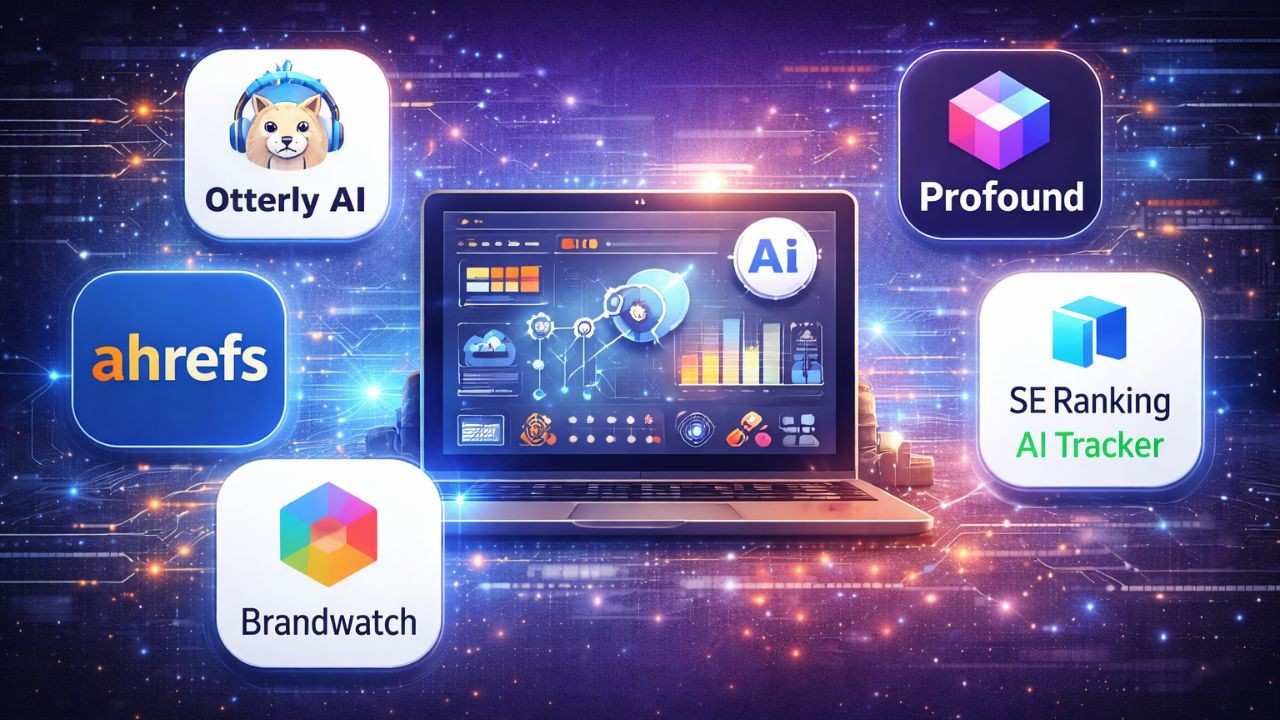
Here’s a data-driven breakdown of the platforms leading this space right now.
|
Tool |
LLMs Tracked | GEO Tracking | Agency Features |
Best For |
| Otterly AI | ChatGPT, Perplexity, Gemini | ✅ Yes | Client dashboards | Agencies & consultants |
| Ahrefs Brand Radar | Limited (expanding) | Partial | Integrated with Ahrefs suite | Existing Ahrefs users |
| Profound | ChatGPT, Perplexity, Copilot | ✅ Yes | Enterprise-grade | Large brands & enterprises |
| Brandwatch | Social + AI signals | Partial | ✅ Strong | Brand monitoring teams |
| SE Ranking AI Tracker | Google AI Overviews | Partial | Mid-tier reporting | SMB agencies |
Otterly AI – Best for Agencies Tracking LLM Brand Mentions
Otterly AI is purpose-built for AI search visibility. You input prompts your target audience would ask, and Otterly runs them across multiple LLMs – then tells you whether your brand appears, where, and how often.
Why it stands out:
- Tracks brand share of voice across AI engines
- Built-in GEO tracking metrics
- Clean client-facing reports – ideal for agency workflows
- Monitors competitor mentions simultaneously
If you manage multiple client accounts and need to prove AI visibility ROI, Otterly is currently the most agency-friendly option available.
Ahrefs Brand Radar – Best for Teams Already in the Ahrefs Ecosystem
Ahrefs Brand Radar tracks brand mentions across the web and is gradually expanding into AI-generated content detection. For teams already paying for Ahrefs, it’s a natural add-on.
What it does well:
- Deep backlink + brand co-occurrence data
- Integrates with existing Ahrefs keyword workflows
- Reliable, established data infrastructure
Current limitation: Its LLM-specific tracking is still maturing compared to dedicated tools like Otterly or Profound.
Profound – Best for Enterprise AI Visibility
Profound targets enterprise brands needing robust LLM monitoring at scale. It tracks how often and how accurately AI engines reference your brand, products, and messaging.
Best suited for: In-house SEO teams at large organizations, not freelancers or small agencies.
What Is GEO Tracking and Why Does It Matter in 2026?
Generative Engine Optimization tracking measures how your content performs inside AI-generated responses – not just on traditional SERPs.
Think of it as the next evolution of position tracking. Instead of “you rank #4 for X keyword,” GEO data tells you:
- Is your brand cited when AI answers questions in your niche?
- How does your brand sentiment appear in AI outputs?
- Are competitors being cited instead of you?
For SEO agencies, adding GEO tracking to client reporting instantly differentiates your service offering. It’s a metric most competitors aren’t measuring yet.
How to Integrate These Tools Into Your SEO Workflow
Getting the data is only half the battle. Here’s how to operationalize it:
- Audit your prompt landscape – Identify the 20–30 questions your target audience asks AI tools
- Set baseline brand mention rates per LLM platform
- Run weekly tracking using your chosen LLM visibility software
- Compare the share of voice against 3–5 competitors monthly
- Feed insights back into content strategy – optimize pages that are close to being cited
Add this as a standing section in your monthly client SEO reports. It demonstrates forward-thinking value and justifies retainer costs.
Frequently Asked Questions
Q. What is AI search visibility tracking?
A. It’s the practice of monitoring whether and how your brand appears in responses generated by AI tools like ChatGPT, Perplexity, Google’s AI Overviews, and similar platforms – distinct from traditional keyword rank tracking.
Q. Is Otterly AI worth it for small agencies?
A. Yes. Otterly AI offers competitive pricing for agencies and provides one of the most complete GEO tracking and LLM brand mention monitoring solutions available in 2026. It’s particularly strong for client reporting.
Q. Does Ahrefs Brand Radar track ChatGPT mentions?
A. Currently, Ahrefs Brand Radar primarily tracks web-based brand mentions. Its LLM-specific tracking capabilities are expanding but not yet as specialized as dedicated tools like Otterly or Profound.
Q. What’s the difference between GEO tracking and traditional SEO tracking?
A. Traditional SEO tracking monitors keyword rankings on search engines. GEO tracking specifically measures brand and content visibility within AI-generated responses – a fundamentally different data layer.
Q. How often should I track AI search visibility?
A. Weekly tracking is the recommended baseline for agency clients. For competitive industries or high-priority brands, daily monitoring via automated LLM visibility software is advisable.
Conclusion
The agencies and SEO professionals winning in 2026 aren’t just ranking on Google – they’re showing up in the answers AI gives your clients’ customers.
Choosing the right AI search visibility tracking tools is your first step. Whether that’s Otterly AI for agency workflows, Ahrefs Brand Radar for an integrated approach, or Profound for enterprise scale – the key is starting now, before your competitors do.
At BeSky Marketing, we help agencies and brands build AI-ready SEO strategies backed by real GEO tracking data. Want to see where your brand stands in AI search today?
Ready to find out where your brand stands in AI search?
